Short answer
The answer in plain English
A STAR answer can sound fake when it has the shape of evidence but none of the details that let an interviewer evaluate it. Keep the Situation and Task brief, then name what was at stake, the constraint that made the problem difficult, the decision you personally made, the trade-off you accepted, and the result you can actually support. Prepare a compact story map instead of memorizing polished sentences word for word.
Why it matters
What to understand
STAR is useful for organizing a behavioral example, but it does not automatically make that example believable. Generic actions, frictionless success, team language that hides individual responsibility, and unsupported results all weaken an answer. The fix is not more drama. It is enough concrete detail to show how you judged a real situation, what your choice cost, and what changed afterward.
Visual guide
How the pieces fit together


STAR is a frame, not the proof
A behavioral interview answer can be perfectly ordered and still feel strangely empty. The situation is clear, the task follows, the candidate lists several actions, and the result is positive. Yet the interviewer still cannot tell whether the example shows judgment, ownership, or even much difficulty.
That is the central limitation of STAR. Situation, Task, Action, and Result are four useful containers. They stop a story from wandering, but they do not decide what evidence goes inside. “I communicated with stakeholders and delivered the project successfully” fits the format while leaving almost every important question unanswered.
The U.S. Office of Personnel Management explains that structured interviews are built around job-related competencies and may use follow-up questions and defined scoring criteria. In that setting, a polished narrative is not the end product. The interviewer needs observable past behavior that can be evaluated against the work.
Start with what was actually at stake
Stakes explain why the situation mattered. They do not need to turn an ordinary assignment into a corporate emergency. A deadline might affect a customer commitment, a missed handoff might block another team, or a flawed process might create rework every week. Early-career examples can involve a student project, volunteer event, or part-time job. The scale is less important than the consequence being clear.
Compare “We had an important demo” with “The demo would determine whether a prospective client moved us into the final sales round.” The second version tells the listener why reliability mattered. It also creates a sensible basis for judging the later decision.
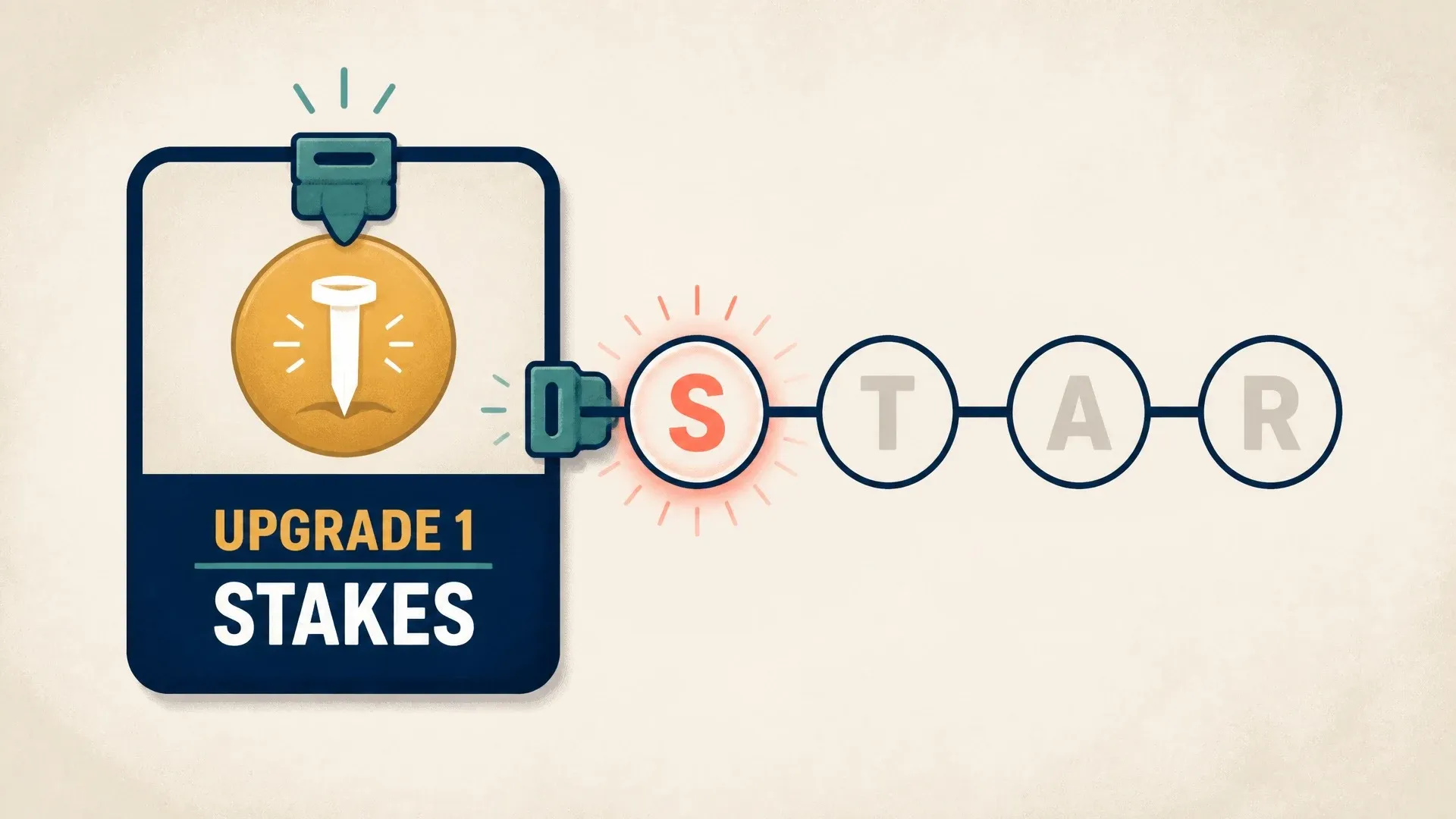
Stakes tell the interviewer what could have been delayed, lost, damaged, or missed if the problem was not solved.
Add the constraint that ruled out the easy answer
A real problem usually contains friction. Time is short, information is incomplete, the budget is fixed, a specialist is unavailable, or two stakeholders want incompatible outcomes. Without that constraint, the solution can sound like a list of competent-sounding verbs pasted onto an unspecified project.
Suppose you wanted to reduce time spent on weekly reporting. “I created a more efficient process” says very little. “I needed to reduce reporting time, but I could not buy new software or change the finance team’s system” gives the interviewer a problem they can evaluate. Now a standardized template, a manual workaround, or a staged automation has a visible reason.
Constraint is also where honest scale enters the answer. If you had three days rather than three months, say so. If another department owned the final decision, separate your recommendation from their authority. Credibility grows when the limits of your control are easy to see.
Show the decision, not only the motion
Candidates often describe activity: scheduled meetings, gathered data, tracked progress, and spoke with the customer. Those actions may all be necessary, but they do not reveal why the candidate chose them.
A decision exposes reasoning. “I decided to demonstrate the stable part of the product rather than risk presenting an unfinished feature” tells the interviewer that alternatives existed. It invites useful follow-up: Why was a reduced scope better than a delay? Who approved the choice? What evidence suggested the stable version was ready?

A decision is more informative than an activity list because it reveals which option you chose and why.
Follow-up questions are not necessarily a sign that the story failed. They often mean the interviewer has found a real judgment call worth examining. A candidate who knows the facts behind the example can answer naturally. A candidate who memorized only the polished paragraph may struggle as soon as the conversation moves off script.
Name the trade-off
Real work rarely offers one option that is faster, cheaper, safer, more complete, and easier for everyone. You protect one priority by accepting a cost elsewhere. A short-term template may reduce duplicate work without removing every manual step. A smaller demo may be reliable but less impressive. A fast decision may use imperfect information.

Naming the trade-off makes the answer more credible by showing what your solution protected and what it gave up.
This does not weaken the story. It demonstrates that you noticed the cost and chose deliberately. An answer that claims every option improved at once can sound less believable than one that states, “This did not solve the entire process, but it removed the highest-risk failure without disrupting the monthly close.”
Keep individual work and team results separate
“We” is appropriate when the outcome belonged to a team. It becomes a problem when it hides the candidate’s own contribution. “I” is appropriate for the analysis you performed, the recommendation you made, or the artifact you built. It becomes a problem when it claims credit for everyone else’s work.
A clean distinction sounds like this: “I asked the engineer for a three-day test estimate and recommended the reduced demo to the sales lead. We rebuilt the presentation around the stable functions, and the client advanced us to the next round.” The listener can see both personal ownership and collaborative delivery.
Results need the same discipline. Use a number only when you can explain where it came from. Otherwise, name a concrete outcome: the client approved the next phase, users adopted the process, the failure stopped recurring, or the team changed its review procedure. If the result was mixed, say what improved and what remained unresolved.
Prepare a map instead of a script
Word-for-word memorization often produces exactly the artificial tone candidates are trying to avoid. It also makes interruption dangerous: one unexpected question can break the sequence.
Prepare a compact story map instead:
- one line for the situation and stakes;
- one line for your responsibility and the main constraint;
- two or three decisions or actions you personally owned;
- the trade-off you accepted;
- the result and how you know;
- one lesson or change in your later work.
This approach complements the broader structure in our guide to explaining your work experience: choose relevant evidence first, then give enough scope and proof for the listener to understand it.
Before the interview, test each story with four questions: What was at risk? What made the obvious solution difficult? What did I decide? What did the result fail to solve? If you can answer those plainly, STAR will support the evidence instead of disguising its absence.

