Short answer
The answer in plain English
If your resume keeps earning interviews but no offer follows, the interview may not be giving the hiring team enough decision evidence. Replace broad claims with specific situations, choices, actions, and effects. Then connect each example to the employer's current problem. Review repeated patterns, but remember that budgets, internal candidates, and changing roles can also decide an outcome.
Why it matters
What to understand
A resume wins permission to talk; an interview helps an employer compare risk and likely performance. Friendly but vague answers can leave little for an interviewer to defend in the hiring discussion. Build a compact story bank, name business impact honestly, close answers with the point, and adjust depth for recruiter, manager, and panel stages. Diagnose patterns across several interviews rather than treating every rejection as proof of failure.
Visual guide
How the pieces fit together


The interview is a different test
A resume can be doing its job even when interviews do not become offers. It answers a screening question: is there enough relevant experience here to justify a conversation? The interview asks something harder: can this person do this work in our environment, and what evidence lowers the risk of choosing them?
That distinction matters because repeated interviews are not necessarily a sign that the whole job search is broken. The application is opening the door. The likely repair area is how your experience becomes evidence once the conversation begins.
“Likely” is important. A budget can change, an internal candidate can emerge, or the role can shift. One rejection reveals little. A similar weak point across several interviews is more useful information.
Vague strengths are difficult to defend
Structured interviews are designed around job-related competencies, consistent questions, and defined standards. Even when a company uses a looser conversation, the people making the decision still need reasons they can compare and explain.
“I am analytical and collaborative” sounds positive but gives the listener no event to inspect. A specific answer identifies the tension and the response: sales needed a report that changed weekly, finance required stable month-end numbers, and you created separate working and locked versions to reduce correction requests.

Positive labels are hard to score when they are not attached to a specific event, action, and result.
Specificity does not require drama. The most useful story may concern a routine handoff, a confusing customer request, or an error you caught. What matters is that the interviewer can follow the problem, your choice, and what changed.
Move from activity to impact
Many candidates describe tasks accurately: projects managed, meetings attended, tools used, and people trained. Those details establish activity, not value. The missing sentence is what became faster, clearer, safer, more consistent, or less expensive because of the work.
Exact numbers are useful only when you genuinely know them. If you do not own the final metric, say so and describe the observable effect. “The checklist removed a manual step that had delayed every weekly handoff” is stronger than an invented percentage.
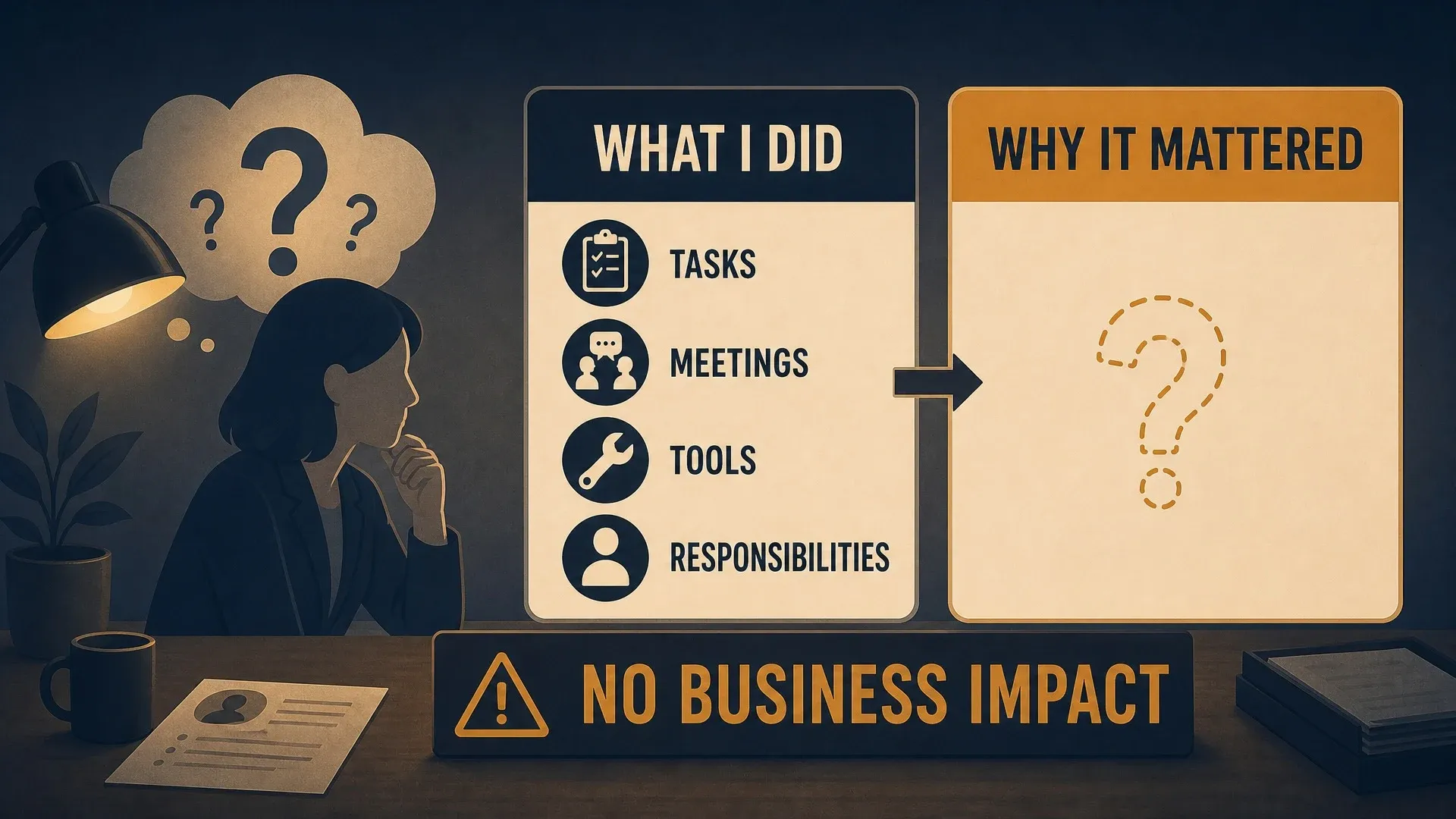
Describing activity leaves the employer to guess what improved. Add the practical effect of your work.
End the story by interpreting it. A closing such as “That is how I handle ambiguous requests: clarify the need, then build a repeatable process” turns a past event into evidence about future work. Without that sentence, even a good story can fade into “so, yes, that was it.”
Give the hiring team a useful pattern
Being broadly competent is not the same as being memorable for the role. The hiring team may be trying to solve one immediate problem: poor cross-team communication, unreliable reporting, messy customer escalations, or slow delivery. Your examples should make a relevant strength visible across different situations.
This is not a slogan. “I fix broken processes” means little on its own. If multiple stories show you locating a bottleneck, making ownership explicit, and leaving behind a repeatable method, the pattern becomes believable.
Impression management is a normal part of interviews, and research finds that self-focused presentation can affect ratings. The practical limit is simple: presentation can help the interviewer notice real evidence, but it should not replace or distort it. A claim that collapses under follow-up is a liability.
Build a compact story bank
Prepare six to eight examples rather than a script for every possible question. Include conflict, a mistake, leadership, technical or functional work, speed under pressure, stakeholder communication, and a measurable or observable result.
For each card, record five points:
- What was the situation?
- What tension or constraint made it difficult?
- What did you personally do?
- What changed?
- What capability does this prove for the target role?
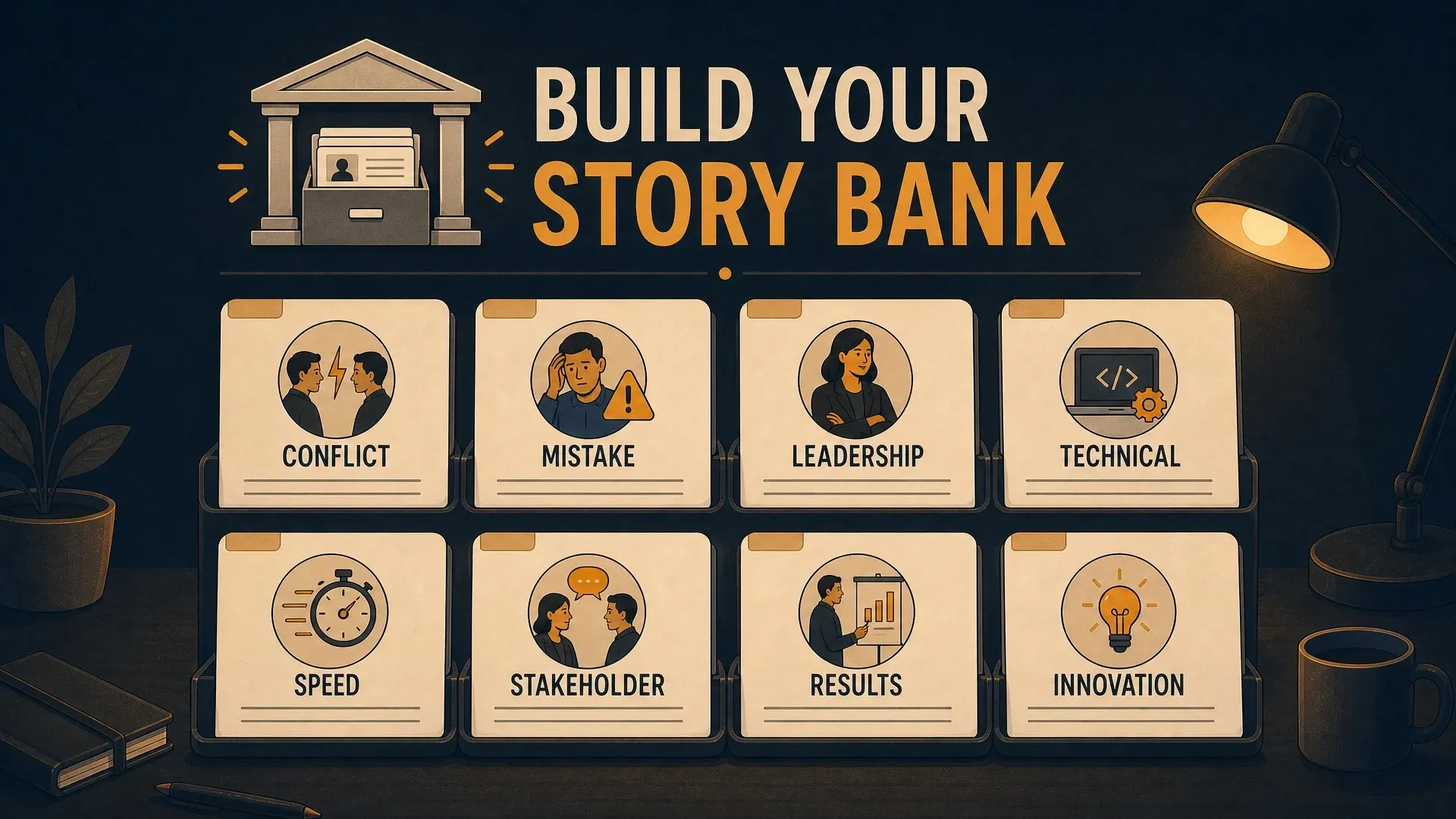
A small, varied story bank makes it easier to select relevant evidence without memorizing a speech.
Reuse is fine, but change the emphasis. In a conflict question, explain the disagreement and how you resolved it. In a leadership question, show how you created direction. In a failure question, own the mistake and the repair.
Adjust for the stage
A recruiter screen rewards clarity. Connect your background to the role quickly and do not make the recruiter reconstruct your career path. A hiring manager usually needs more depth about decisions, tradeoffs, and how independently you work. A panel may contain several risk perspectives, so answer the question first and make the relevance legible to the whole room.
Career changers need especially concrete bridges. Do not merely call a skill transferable. Name the similar user, tool, constraint, or workflow. High-volume customer triage can transfer to support operations because both require identifying the real issue, documenting patterns, and escalating the right details.
After each interview, note the questions, examples, moments of interest, and points of confusion. Score your answers against the five story-bank questions. If the same gap appears across three interviews, repair it deliberately. The goal is not a perfect personality performance. It is to leave the hiring team with clear, truthful reasons to believe you can solve the problems they actually have.


