Short answer
The answer in plain English
Prepare for a skills-based interview by identifying the abilities the role is likely to test, then building a small evidence bank of real experiences that show your decisions, actions, results, and lessons. Learn the facts and reasoning behind each example rather than memorizing full paragraphs. During the interview, identify the skill and constraint in the question, choose the closest evidence, and adapt the emphasis honestly.
Why it matters
What to understand
Strong interview preparation is retrieval practice, not script rehearsal. Start with six to eight priority skills from the job description. Map eight to ten defensible experiences to those skills, including constraints, decisions, proof, setbacks, and lessons. Practice selecting examples for unfamiliar questions, explaining your reasoning under follow-up, and delivering the same evidence in short and long versions.
Visual guide
How the pieces fit together


Prepare evidence, not twenty speeches
Memorizing answers to common interview questions feels productive because it produces tidy paragraphs. It also prepares you for a conversation that rarely happens. An interviewer can change one phrase, ask for a different example, or follow up with “Why did you choose that?” and the rehearsed sequence stops fitting.
Skills-based interviews make that weakness more obvious. They are designed to collect evidence about abilities needed in the role: analysis, planning, customer communication, collaboration, technical judgment, prioritization, or conflict management. The employer may use behavioral questions, realistic scenarios, work samples, presentations, or technical discussions. The format changes, but the underlying question is similar: what can this candidate actually do, and what evidence supports that conclusion?
The practical alternative is a small evidence bank. Instead of writing a speech for every possible question, prepare real experiences deeply enough that you can retrieve and adapt them when the wording changes.
Let the job description choose the test
Start with the actual role. Ignore promotional language and mark responsibilities or requirements that appear repeatedly. A posting that emphasizes stakeholder coordination, deadlines, process improvement, presenting findings, and incomplete information is giving you a preparation map.
Group those signals into roughly six to eight priority skills. Do not copy the employer’s phrases into every answer. Ask where you have done comparable work and what a skeptical listener could evaluate.
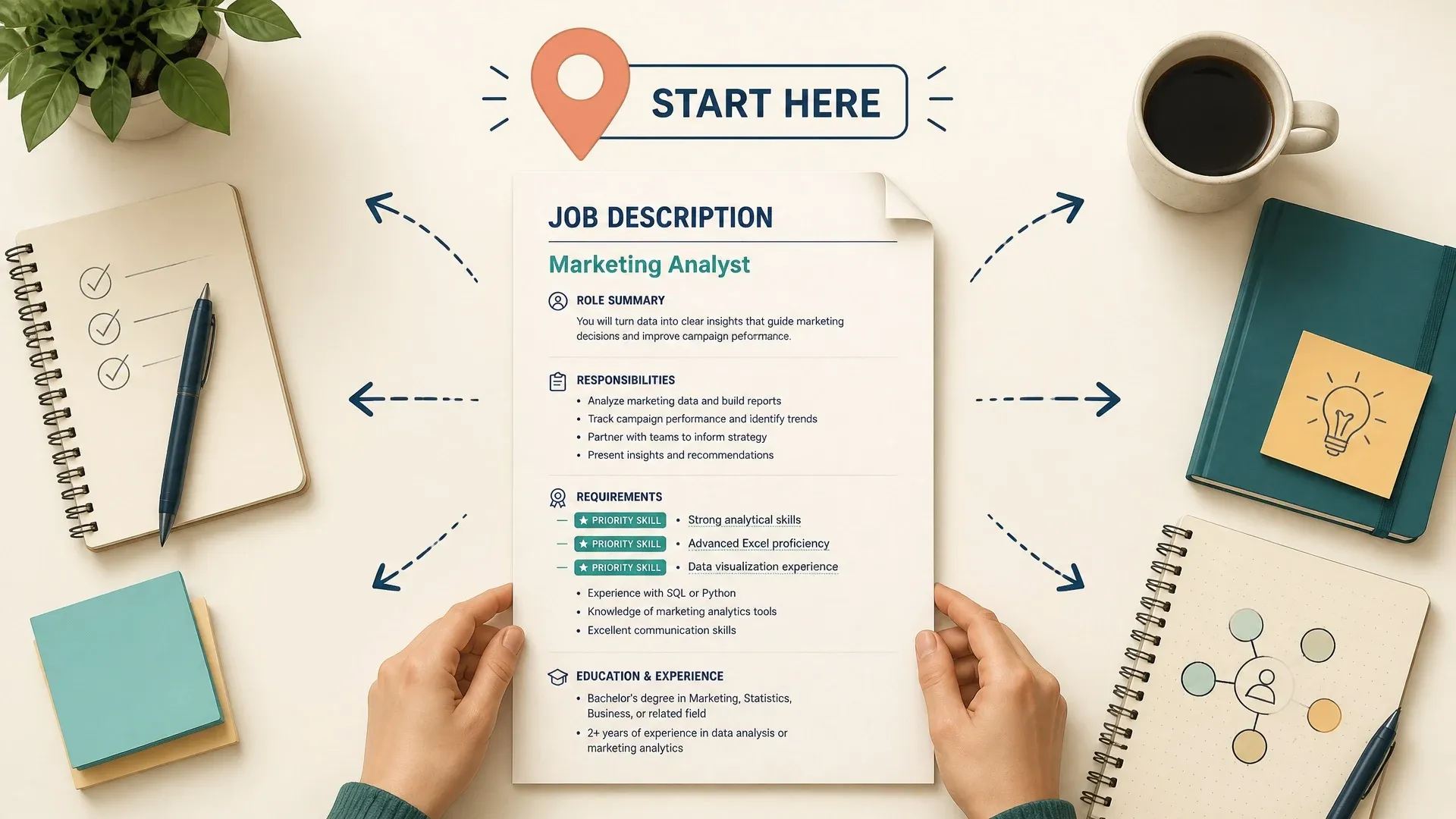
Repeated responsibilities and requirements reveal which abilities the employer is most likely to test; generic question lists do not.
A capability without proof is only a claim. “Strong stakeholder management” becomes useful when you can explain which people wanted different outcomes, what you needed from them, how you handled resistance, and what happened next. “Attention to detail” becomes credible when you can show the error you found, the method that exposed it, and the safeguard you added.
Build eight to ten reusable evidence cards
You usually do not need a different story for every skill. Eight to ten substantial experiences are more useful than twenty thin anecdotes because one real project can reveal several kinds of behavior.
For each experience, note:
- the skill or skills it can demonstrate;
- the situation and what made it difficult;
- the constraint or trade-off;
- the decision you personally faced;
- the actions you personally took;
- the result and how you know;
- what you learned or would change.
Constraint and decision turn an activity list into evidence of judgment. “I created a shared tracker” is an action. A stronger account explains that three regional files used inconsistent categories, that buying software was not an option, that you tested a standardized template with one coordinator, and that the new checks removed a recurring consolidation step.
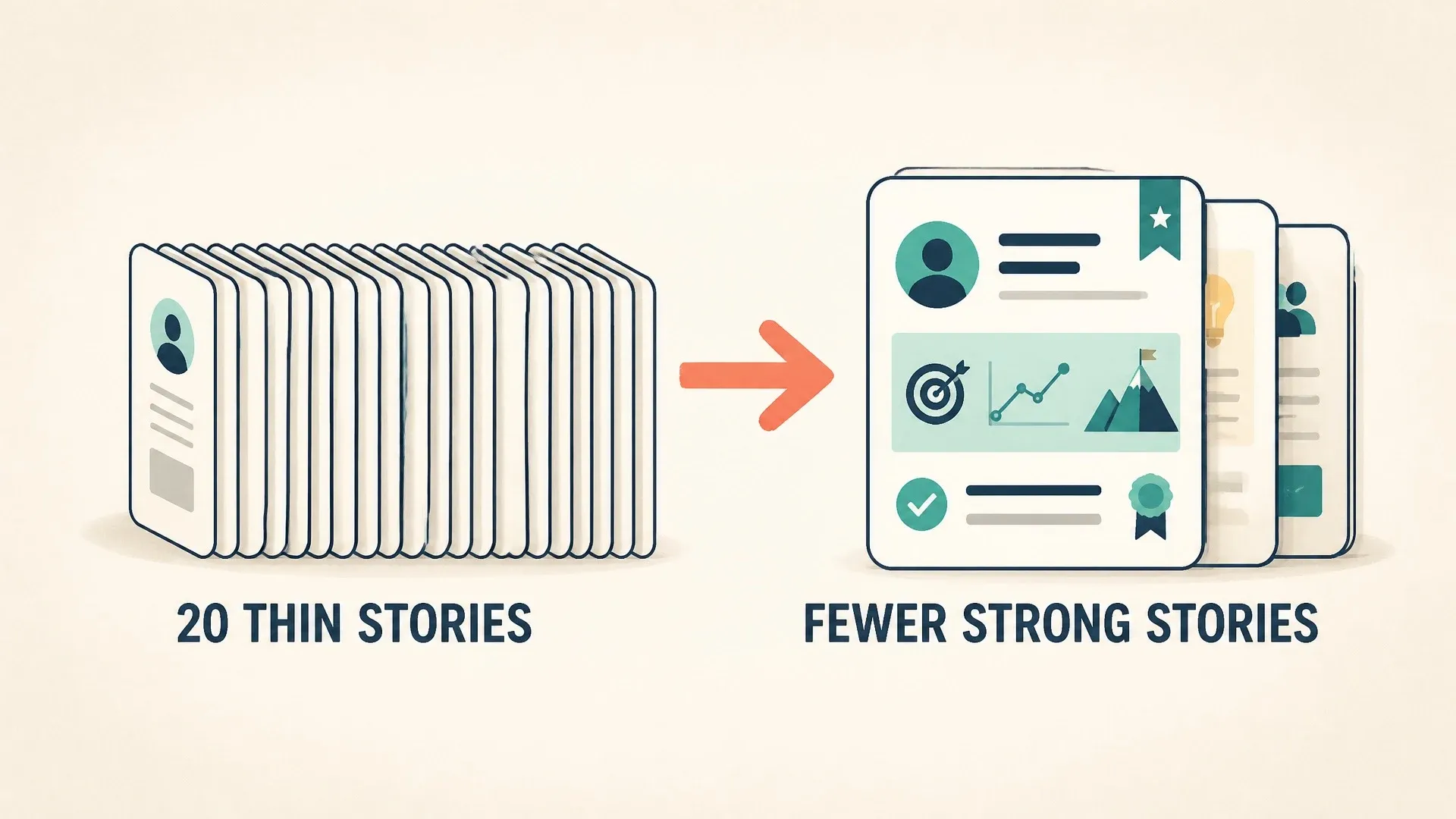
A few strong experiences can support several questions when you understand the decisions, constraints, and results behind each one.
Record proof you can defend: a deadline met, correction requests reduced, complaints resolved, revenue protected, or an error prevented. Do not invent a percentage because the answer seems to need one. A concrete non-numerical result is stronger than a number whose source you cannot explain.
Include at least one setback. Mistake, conflict, feedback, and failed-plan questions test self-awareness and recovery. Choose a problem you can discuss without transferring all blame to someone else. Name your contribution, the correction, and the later safeguard. Limiting damage and preventing a repeat can be a meaningful result even when the original plan failed.
Adapt the emphasis without changing the facts
The same reporting example may answer several questions. For process improvement, emphasize the standardized workflow. For attention to detail, explain how you traced discrepancies. For influence, describe how you gained support. For risk reduction, focus on automatic checks.
The facts remain stable; the emphasis changes because the interviewer is testing a different skill. This is also why a perfect STAR answer can still sound fake. STAR is a useful frame, but structure cannot replace a real constraint, decision, trade-off, and result.
When an unfamiliar question arrives, listen for three elements: the skill being tested, the pressure or constraint added to the situation, and whether the interviewer wants past behavior or a future approach. “Tell me about competing deadlines” may become “When did you disappoint one stakeholder to protect a more important commitment?” The second question is not just about scheduling. It tests prioritization and communication around a trade-off.
Take a short pause. “Let me think of the example that best matches that” is better than instantly delivering a polished answer that misses the point. Open with a one-sentence headline, give enough context to make the constraint understandable, spend most of the time on your reasoning and actions, then finish with the result.
Adjust for scenarios, technical tasks, and career changes
A future-oriented situational question needs an approach first. If asked how you would handle an unhappy customer, explain the steps you would take and then support them with a brief comparable experience. Do not pretend that a past story automatically answers a hypothetical.
For technical questions and work samples, make your reasoning visible. Define the problem, identify missing information, check assumptions, and explain trade-offs. Confident guessing is not evidence of skill.
Career changers can use adjacent proof. A teacher may demonstrate facilitation, conflict management, planning, and performance analysis. A retail supervisor may show scheduling, training, inventory control, and customer recovery. Translate the work without inflating it: name the overlapping responsibility and show a specific example an interviewer can examine.
Practice retrieval under pressure
Reading answers silently tests recognition, not retrieval. Use randomized questions and answer aloud. After each response, ask four follow-ups: Why did I make that decision? What alternative did I consider? What did I personally do? How do I know it worked?
Practice the same example in 30 seconds, 90 seconds, and three minutes. A recruiter screen may need the short version; a hiring manager may probe the longer one. The purpose is not to squeeze an identical script into different time limits. It is to decide which facts are essential at each depth.
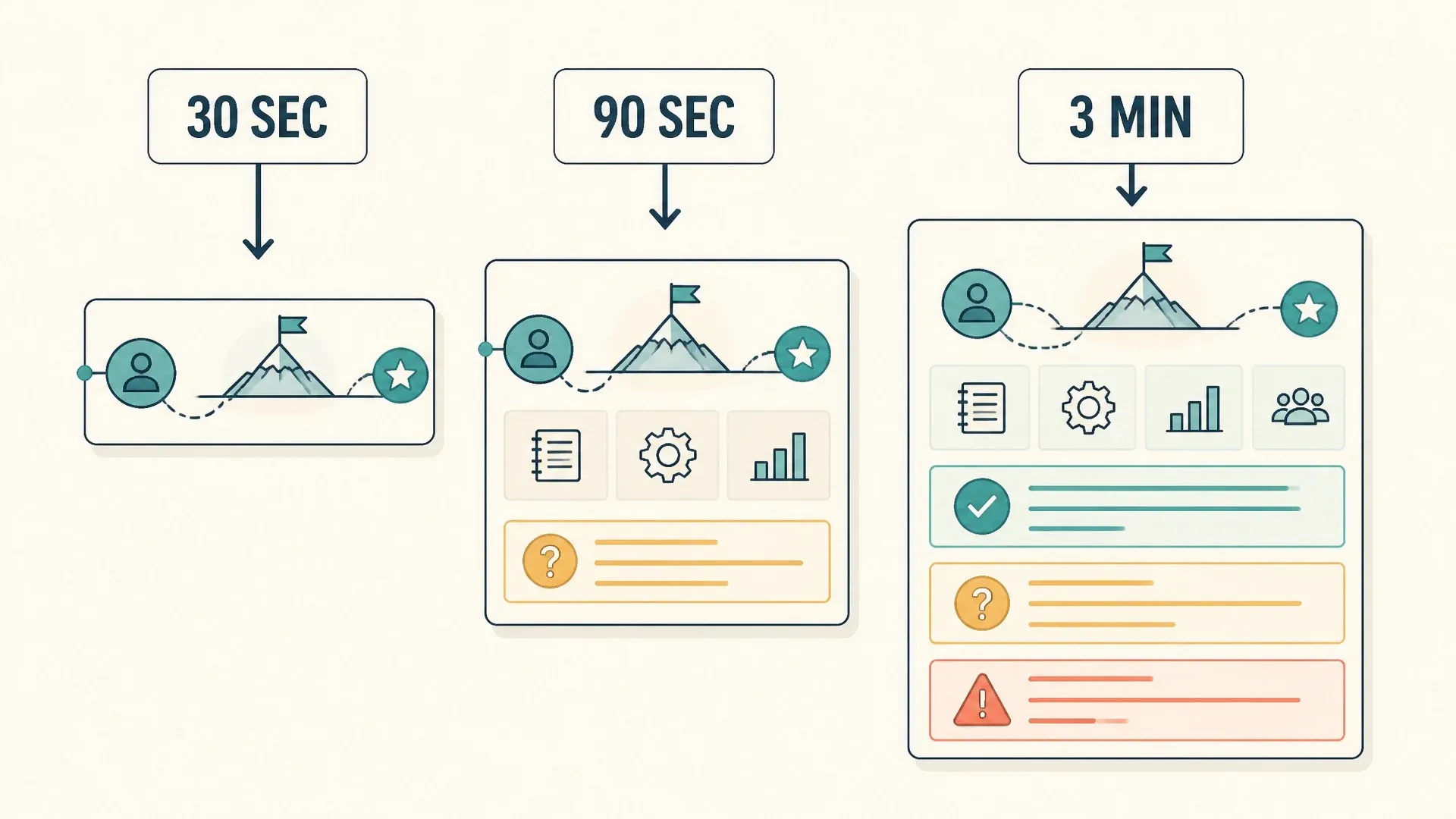
Practicing several lengths builds control over the evidence without locking the candidate into one fragile sequence of sentences.
If you use an AI tool for practice, keep it in the role of interviewer and critic rather than ghostwriter. Our guide to practicing interviews with ChatGPT shows how unseen questions and demanding follow-ups can expose gaps without replacing your voice.
The day before the interview, reduce the bank to one page: priority skills on one side, the strongest evidence cues on the other, plus short reminders of constraints, decisions, results, and lessons. Those cues should help you retrieve the work, not give you paragraphs to read.
Then the task in the room is manageable: listen, identify the skill, choose the closest honest evidence, adapt the emphasis, and explain the judgment behind it. A memorized answer is brittle because it depends on the expected question. An evidence bank stays useful when the conversation moves off script.

