Short answer
The answer in plain English
A true 0% purchase APR can provide useful breathing room, but it does not make a purchase cheaper or erase the debt. It works best when the purchase was already affordable, the repayment money is protected, and the balance is scheduled to reach zero before the promotion ends. Without that system, the regular APR, lost grace periods, or deferred-interest terms can turn a small timing benefit into expensive debt.
Why it matters
What to understand
A promotional card changes the interest rate for a limited period; it does not change the amount owed. The practical test is whether the balance is backed by cash or a comfortable monthly payoff, whether the offer is true 0% APR rather than deferred interest, and whether the borrower has recorded the exact deadline. Paying only the statement minimum, continuing to add purchases, or planning to transfer the balance later leaves the central risk unresolved.
Visual guide
How the pieces fit together


The rate can be free; the purchase is not
A genuine 0% purchase APR offer can be useful. For a limited period, eligible purchases do not accrue interest while the balance remains subject to the card agreement and minimum-payment rules. That can preserve cash during a planned expense or let savings continue earning interest for a little longer.
The useful part is timing. The card has not removed the $6,000 appliance bill; it has moved the deadline. If the $6,000 already sits in a separate savings account, the debt is backed by cash. If the money does not exist and the purchase only feels affordable because the required minimum is small, the same balance is ordinary consumer debt with a temporary discount.
That distinction matters more than the advertised rate. The CFPB’s guidance on promotional offers emphasizes reading the terms, understanding what happens after the promotion, and continuing to make required payments. A useful offer needs a repayment system before the first purchase, not a hopeful plan assembled near expiration.
Build the payoff from the deadline, not the minimum
Suppose the balance is $6,000 and the promotion lasts 15 months. Dividing by 15 gives a $400 monthly payment, but that schedule uses every available month. A processing delay, mistaken expiration date, returned payment, or unexpected expense can leave money outstanding when the regular APR begins.
Using 14 months instead produces about $429. Rounding to $430 aims to clear the balance roughly one month early. The extra month is not wasted; it is a verification window. It lets pending transactions settle and gives the cardholder time to confirm that the promotional balance is actually zero.
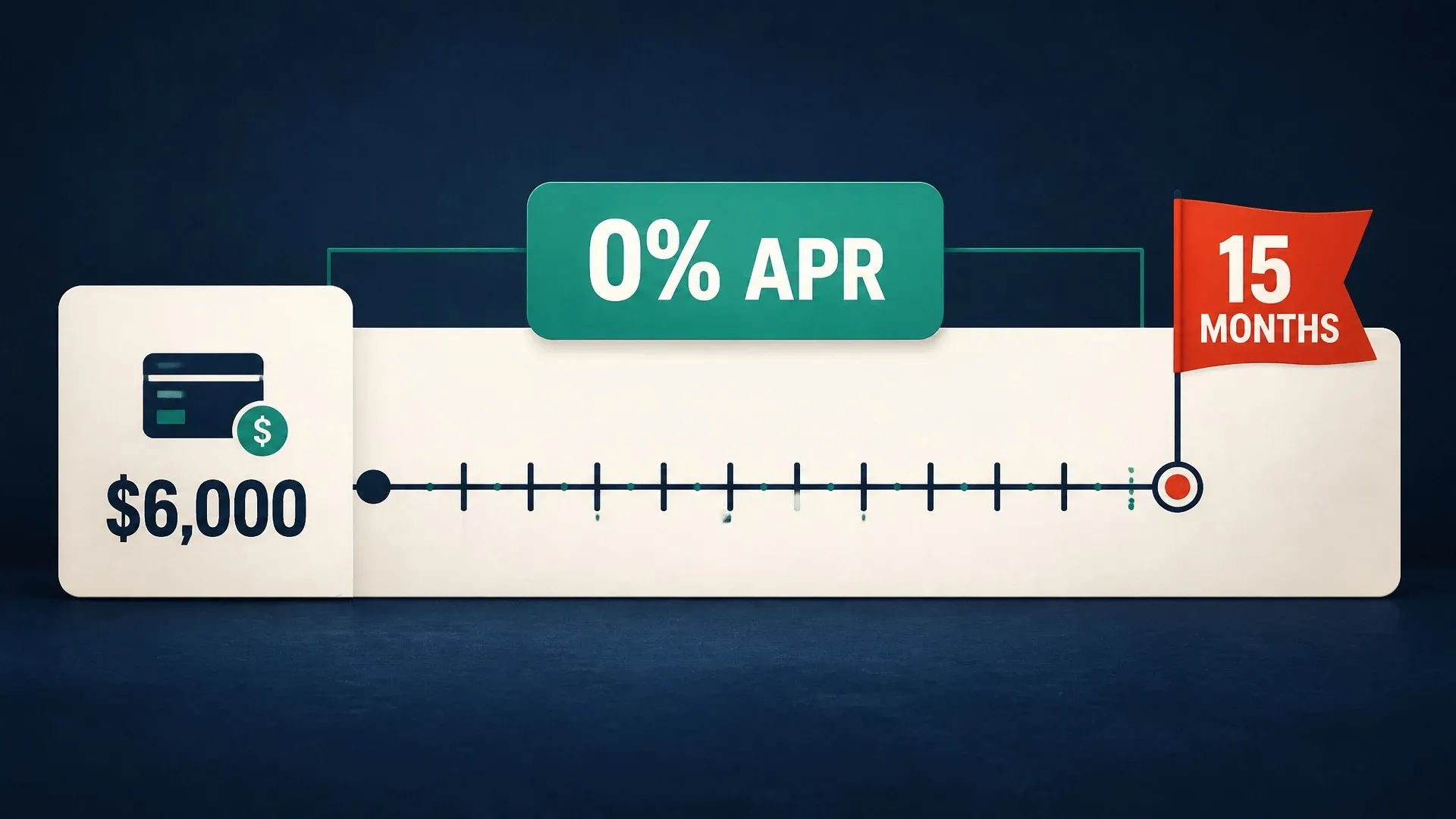
The promotional rate has a fixed clock; the repayment schedule must be built around the exact balance and deadline.
The statement minimum answers a different question: how much must be paid to keep the account current? It is not calculated to guarantee that a promotional balance disappears before its special rate expires. Paying the minimum can therefore satisfy the monthly rule while failing the overall plan.
True 0% APR is not deferred interest
These offers can sound similar but behave differently.
With true 0% introductory APR, the regular rate generally begins applying to the balance that remains after the promotional period. Interest from the zero-rate months is not normally added retroactively. With deferred interest, language such as “no interest if paid in full” makes the final condition decisive. If the qualifying balance is not completely paid by the deadline, interest tracked from the purchase date may be charged.
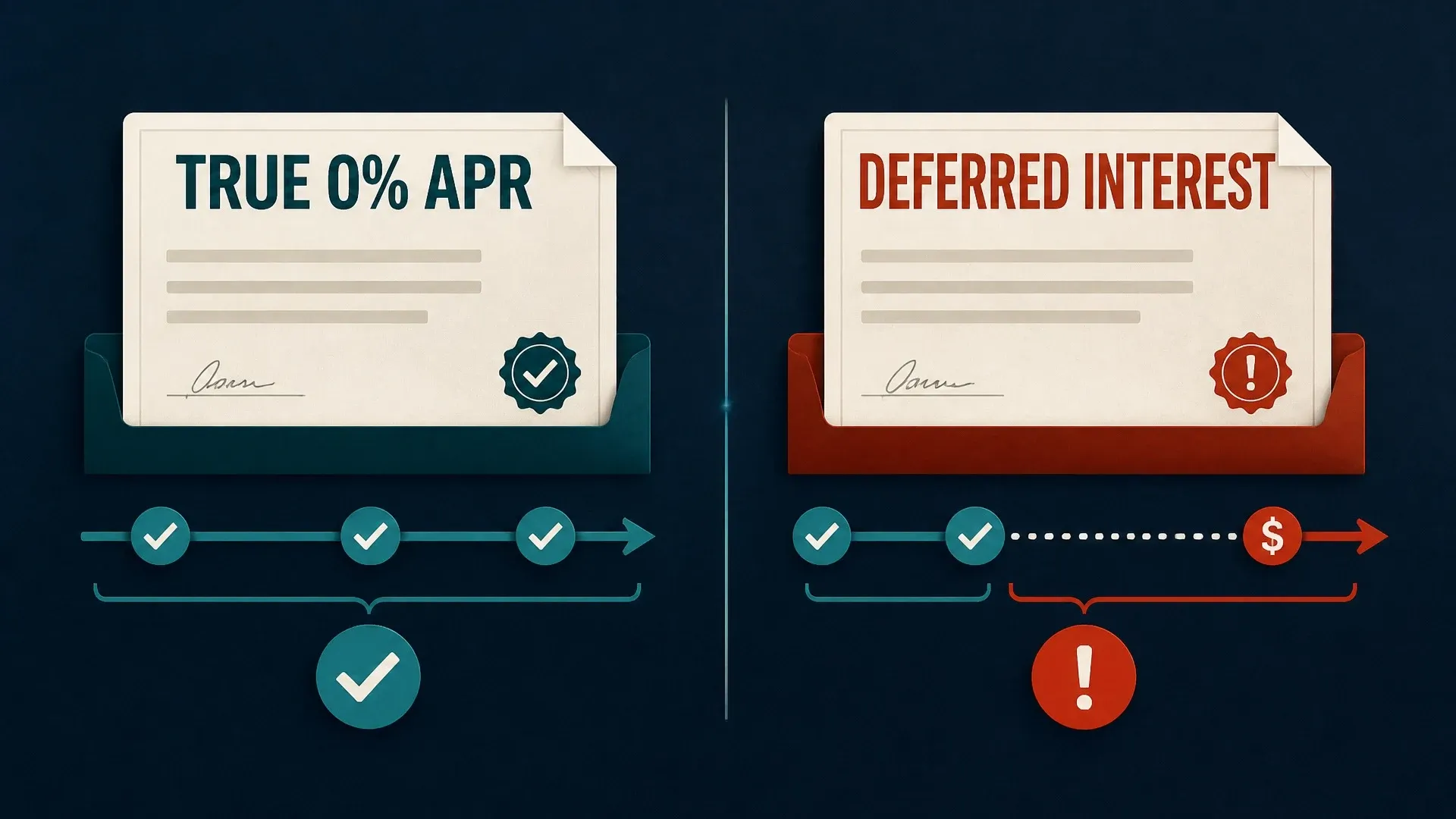
Similar advertising language can hide very different rules when even a small balance remains at the end.
On a $400 purchase, paying $300 before expiration and leaving $100 can therefore lead to two different outcomes. A true 0% promotion usually moves the remaining $100 to the regular rate from that point. A deferred-interest plan may add the interest accumulated on the original promotional purchase. The word “if” in “no interest if paid in full” deserves close attention.
Grace periods can become complicated
A grace period is generally the interval between the close of a billing cycle and the payment due date. When a cardholder pays the full statement balance as required, it can prevent interest on new purchases. The CFPB explains the basic rule, but promotional balances can make one account carry several categories at once: purchases, transfers, cash advances, and balances with different rates.
When the promotion ends, the regular APR may apply to the amount left. Depending on the agreement and balance status, new purchases can also lose the usual interest-free treatment. Continuing to use the card for groceries while trying to finish an old promotional balance can create a confusing mix of allocation rules and daily interest.
The clean approach is to stop adding purchases before expiration, clear the promotional balance, and verify with the issuer how the grace period resumes.
Use a calendar system
“Fifteen months” is not precise enough. The countdown may start when the account opens, not when a later purchase posts. Record the exact expiration date from the agreement or account portal, along with the regular APR that follows.
Set autopay for at least the required minimum as protection against forgetting a due date, then schedule the larger payoff separately. Check the balance about 90 days before expiration. At 60 days, correct any shortfall and stop new spending. Aim for zero one full billing cycle before the official deadline.

Early checkpoints create time to correct a shortfall, stop new spending, and verify that the final payment settled.
Autopay is a safety net, not proof of completion. Bank-account changes, returned payments, and a wrongly selected amount can still break the plan. Statements need checking.
The hidden tradeoffs
Even zero-interest debt can raise credit utilization—the share of available revolving credit currently reported as used. A large balance may matter if a mortgage, car loan, apartment application, or another credit decision is approaching.
There is also a behavioral tradeoff. Keeping $6,000 in savings at an assumed 4% for a year produces roughly $240 before tax if the rate stays unchanged. That is real, but modest. One leftover $1,000 balance exposed to a high regular APR can erase much of the benefit. The strategy makes sense only when the cash remains protected rather than becoming permission to spend twice.
A 0% card is most defensible when the purchase was already planned, its price did not grow because financing was available, the monthly payoff fits comfortably, and the balance can reach zero early. It becomes dangerous when it turns an unaffordable purchase into an apparently manageable minimum payment or depends on finding another transfer offer later.
The simplest test is this: if the promotion disappeared tomorrow, would the purchase still have been affordable? Zero percent is a rate. The plan is the reserved cash, monthly payment, exact calendar date, and decision to stop spending before the clock runs out.


