Short answer
The answer in plain English
The brain is never “finished” because its structure and connections keep changing with development, experience, learning, and aging. Early life builds and selects connections rapidly; adolescence reorganizes motivation, control, and social sensitivity; adulthood tunes established networks through practice; and older brains continue adapting even as speed and some forms of recall decline.
Why it matters
What to understand
Brain development is a sequence of trade-offs, not a climb toward one completed adult state. Early flexibility supports language and attachment, adolescence intensifies exploration and social learning, adult stability supports expertise, and aging changes speed and strategy. The popular claim that the brain becomes fully mature at 25 compresses many different timelines into a false deadline.
Visual guide
How the pieces fit together


The short answer
The human brain has no final assembly date. It changes rapidly in childhood, reorganizes motivation and control in adolescence, adapts established networks through adult learning, and continues adjusting as the body ages. Some changes slow down; others continue. Stability itself is one of the brain’s useful developmental outcomes, not evidence that change has ended.
That is why “the brain finishes at 25” is misleading. Different structures and abilities follow different trajectories, population averages do not define one person’s deadline, and learning keeps altering the system after young adulthood.
Early development builds and selects
A newborn does not arrive with a blank brain. It arrives with a developing system prepared to learn from sights, sounds, movement, care, and repeated patterns. Early childhood includes rapid formation of synaptic connections, followed by strengthening of useful routes and weakening or removal of others.
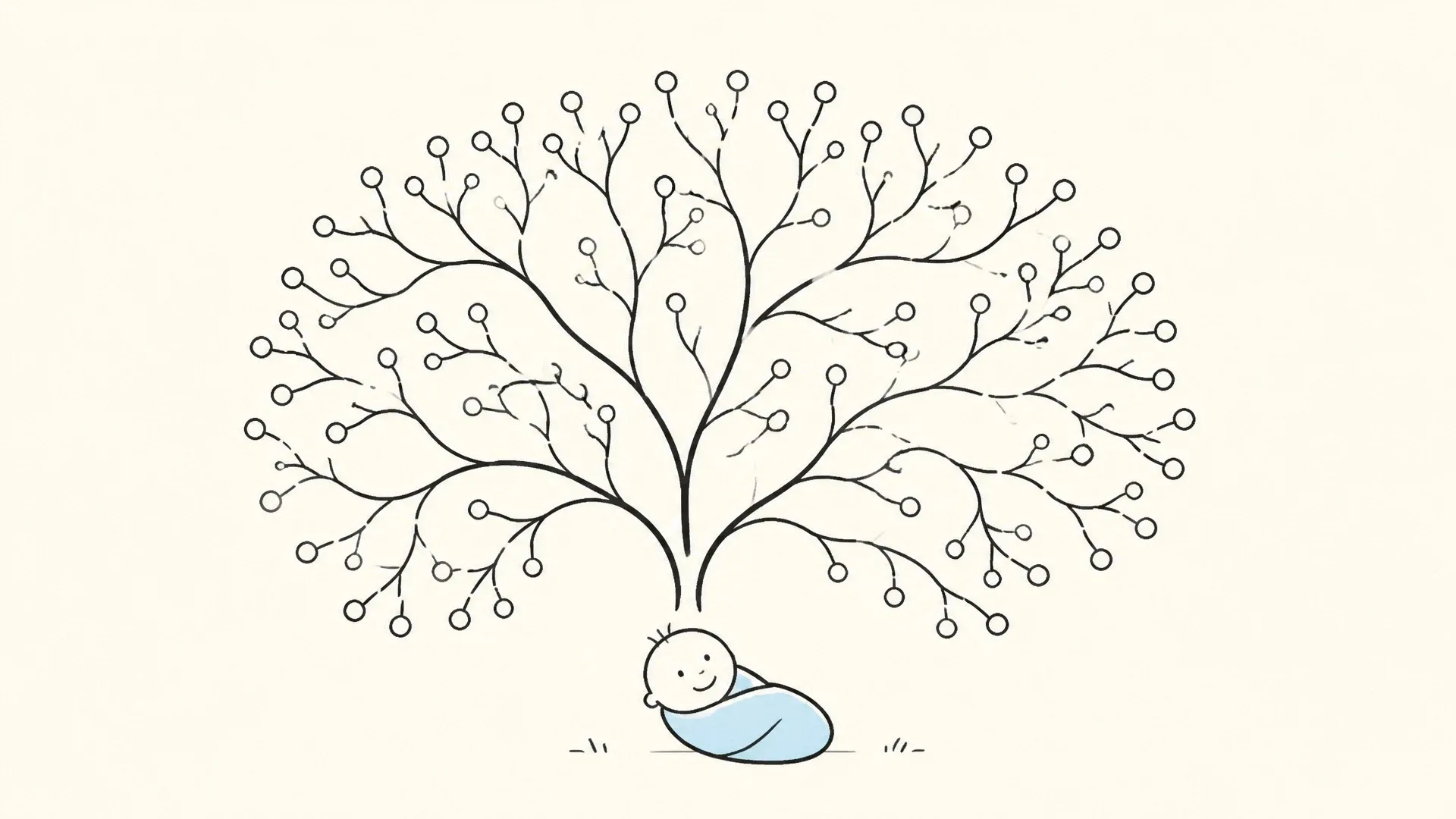
This combination matters. More connections are not automatically a better brain. Development also makes networks faster and more specialized for the environment a child actually inhabits. Repeated exposure tunes speech perception, faces, movement, and expectations about what happens next.
Sensitive periods are part of that tuning. Certain experiences have especially strong effects during particular windows, but “sensitive” does not mean learning becomes impossible afterward. Later learning may require more effort or recruit a different route.
Relationships provide much of the early input. A baby gestures or vocalizes; a caregiver responds. These “serve and return” exchanges connect attention, language, emotion, and regulation. They do not require formal lessons. Eye contact, imitation, naming an object, and responding predictably all help organize a young brain around other people.
Childhood is a social apprenticeship
Humans have a long, costly childhood. The benefit is time to absorb information that genes cannot specify in detail: language, local dangers, food practices, tools, roles, and the unwritten rules of a group.
Later childhood places increasing demands on social prediction. Children learn that other people hold beliefs and intentions different from their own. Games and arguments create small laboratories for fairness, cooperation, competition, reputation, and recovery after conflict.
This is one reason social experiences can feel disproportionately important. The related article on why being ignored hurts examines how uncertain exclusion can threaten belonging and control. Those reactions are not separate from development; they draw on a brain built to learn within relationships.
Adolescence changes the conditions of a decision
Teenage behavior is often reduced to an “unfinished prefrontal cortex.” The prefrontal cortex does support planning, inhibition, working memory, and evaluation of consequences, and its connections continue developing. But adolescence is not one incomplete part waiting for installation.
Networks across the brain become more specialized and coordinated. Myelination can improve the speed and reliability of communication. At the same time, novelty, reward, emotion, acceptance, and rejection can carry unusual weight.
A teenager may reason well in a calm setting and choose differently while excited or watched by friends. The capacity did not vanish. The situation changed which signals dominated. Exploring outside familiar routines can build independence and skill, while the same openness raises exposure to risky environments and powerful rewards.
Plasticity is not automatically good. A changeable brain can acquire expertise, fear, resilience, or a harmful habit. The value depends on what is repeated and reinforced.
Why age 25 is not a finish line
Many measurements show that development continues into the twenties. That finding was simplified into a birthday rule the evidence does not support.
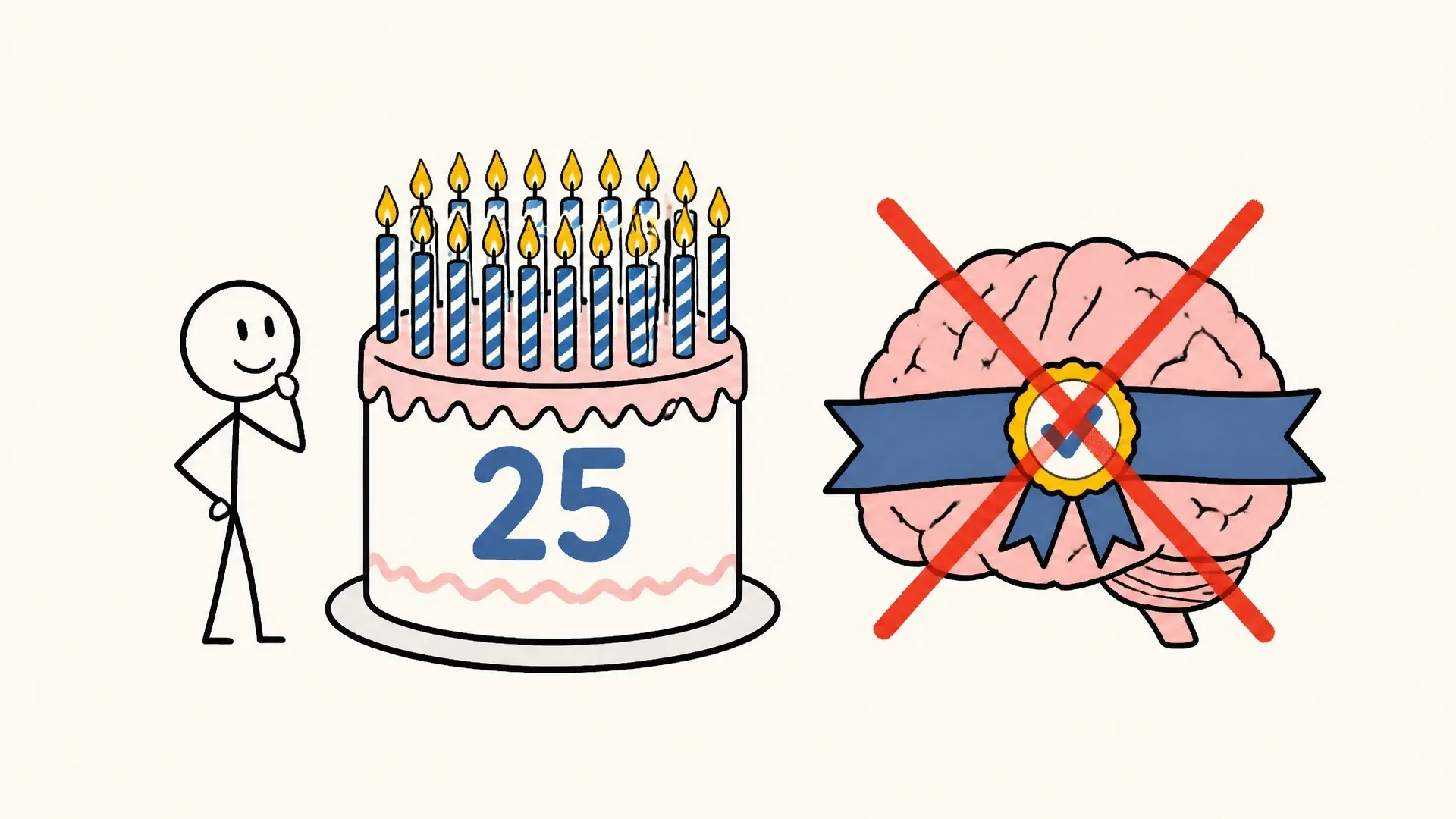
Brain features do not all peak or stabilize together. Structural measurements, network coordination, self-regulation, and performance on particular tasks describe different things. Their average curves also overlap across ages. A group trend cannot tell us that every 24-year-old is neurologically unfinished and every 26-year-old is complete.
The broader lifespan maps published in “Brain charts for the human lifespan” make the point visually: brain measures follow multiple nonlinear trajectories from before birth through old age. Twenty-five is one location on those curves, not their common endpoint.
Adult brains trade openness for efficiency
Adult networks are generally less open-ended than infant networks, which is useful. Stable routes make familiar skills fast and reliable. You do not want to relearn language or vision whenever the setting changes.
Stability can also become rigidity, but learning still alters adult brains. Practice changes connection strength and coordination among regions. Research on skill acquisition describes expansion during learning followed by partial renormalization as the system becomes more efficient. Change is not always permanent growth in volume; it can be temporary remodeling that settles into a better-tuned network.
Expertise further changes what learning looks like. A beginner sees isolated details. An experienced person can group them into patterns and attach new information to a larger structure. Adult plasticity may be narrower and more effortful, yet prior knowledge can make some learning faster.
The same selectivity helps explain why perception feels complete despite limited input. Our article on how the brain constructs visual reality shows how established systems emphasize useful signals and hide missing information rather than preserving a raw copy.
Aging changes the balance again
Aging can shrink some regions and reduce processing speed, multitasking, and rapid recall. A name may be known but slower to retrieve. Those changes are real, but they are not a uniform collapse of every ability.
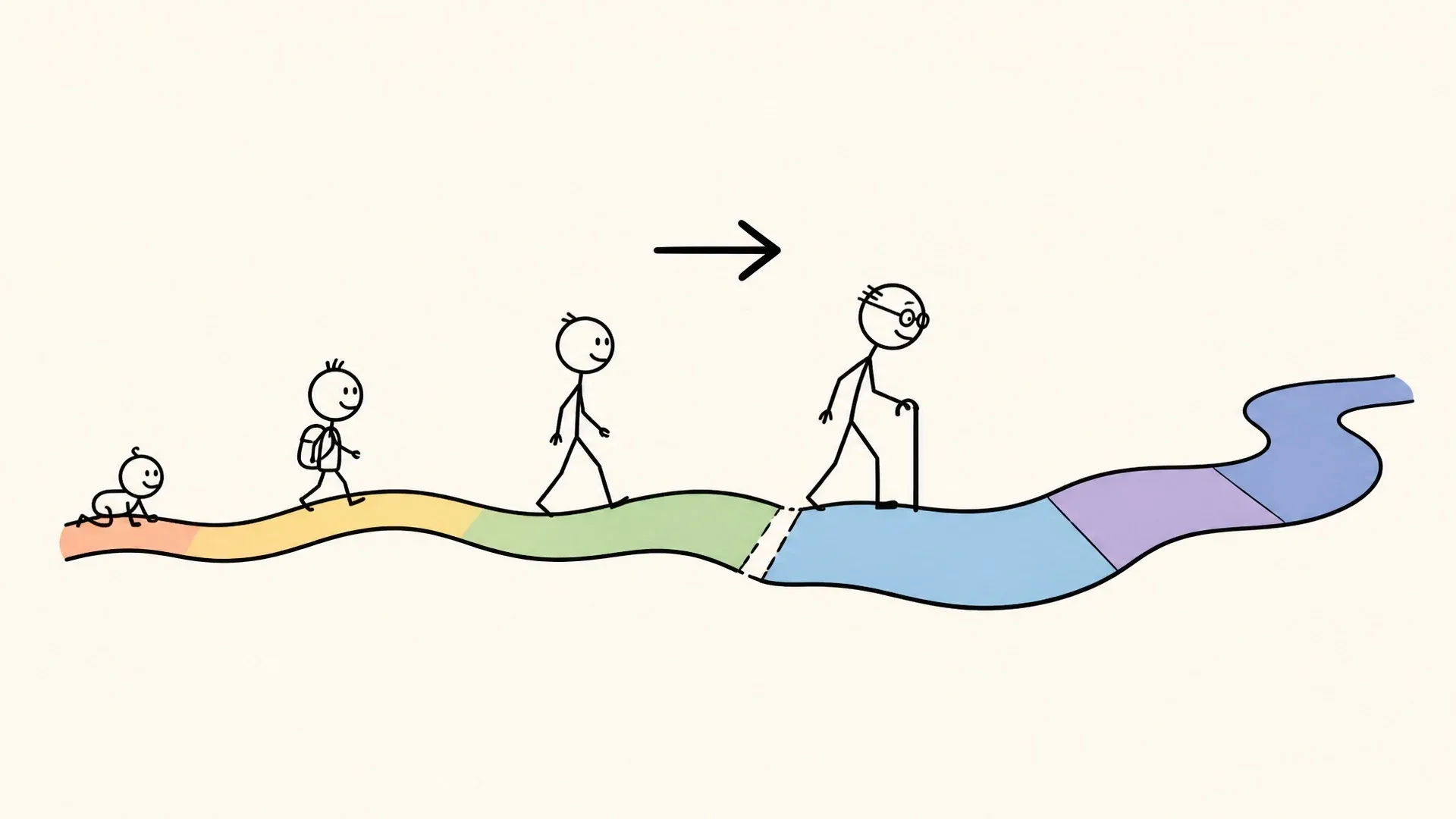
Vocabulary and accumulated knowledge often remain strong. Experience supports judgment in familiar situations. Older adults can form memories, learn skills, recruit alternative networks, and develop strategies that reduce the cost of slower processing. Adaptation may mean solving the task differently rather than recreating a younger brain.
Health also matters. Normal age-related change is not the same as dementia, and sudden or serious cognitive symptoms deserve medical assessment rather than being dismissed as ordinary aging.
Development is a sequence of trade-offs
Early flexibility makes the young brain highly responsive to its environment. Childhood social learning fills it with culture. Adolescent sensitivity supports exploration and independence. Adult stability makes expertise efficient. Aging can reduce speed while preserving knowledge and encouraging new strategies.
No stage is simply the best version. Each solves some problems and creates others. The brain remains plastic, but not equally plastic in every way or at every age.
You therefore never receive a “final” brain. You receive a living system whose structure records repeated experience, current demands, relationships, health, and time—and whose next change begins from everything already built.

