Short answer
The answer in plain English
The exercise did not prove that drones can effortlessly destroy a U.S. armored brigade or that tanks are obsolete. Ukrainian operators used reconnaissance and attack drones to find vehicles and score simulated kills under exercise rules. Their advantage came from a fast, practiced chain connecting observation, decisions, and strikes. U.S. forces then changed their spacing, concealment, electronic warfare, and drone use during later phases.
Why it matters
What to understand
During Combined Resolve 26-07, Ukrainian drone specialists helped an opposing force locate and repeatedly eliminate U.S. vehicles in a simulation. The headline hides the important mechanism. Persistent observation shortened the interval between detection and attack, while current battlefield experience helped the Ukrainian team adapt its equipment and tactics quickly. The Americans also adapted, which is precisely what a demanding war game is meant to produce.
Visual guide
How the pieces fit together


The headline describes a simulation, not a destroyed brigade
Ukrainian drone operators did not blow up a U.S. armored brigade in Germany. They helped an opposing force score enough simulated kills during Combined Resolve 26-07 that some American vehicles were returned to the exercise so the scenario could continue.
That distinction is not an attempt to dismiss the result. It is what makes the result useful. A training exercise uses rules, referees, sensors, and simulated effects to expose mistakes before those mistakes cost lives. It cannot reproduce every feature of combat: live artillery, casualties, fear, logistics, weather, and imperfect intelligence all change decisions. The exercise also put an attacking brigade against a prepared defender reinforced by Ukrainian operators with recent combat experience.
The result therefore does not answer the broad question “Do drones beat tanks?” It shows something narrower and more actionable: an armored formation becomes extremely vulnerable when another force can see its movement, pass that information quickly, and attack before it can hide or respond.
How the simulated kills worked
Combined Resolve is a recurring U.S. Army Europe and Africa exercise at the Joint Multinational Readiness Center in Bavaria. Its official exercise page describes the series as preparation for large-scale ground combat with allies and partners. In the 26-07 rotation, roughly 3,500 U.S. personnel participated, principally from the 3rd Armored Brigade Combat Team, 1st Cavalry Division.
Ukrainian operators from the 412th Nemesis unmanned-systems unit supported the professional opposing force. Reconnaissance drones searched for American positions. Once a vehicle was found, another drone could approach or hover closely enough for an observer to rule that it had been hit. These aircraft generally carried no live explosives. A “destroyed” tank remained physically intact even when exercise control removed it from play.
The apparent ease of some kills still revealed a genuine weakness. Heavy vehicles throw dust, generate heat, leave tracks, use radios, and become conspicuous when they gather or move in columns. A camera looking down can see past concealment that works against an observer on the ground. Armor protects a crew from many threats; it does not make a formation invisible.
The important weapon was the chain
Militaries have always tried to connect observation with firepower. A scout finds a target, reports its position, a headquarters decides what to do, and artillery or aircraft attacks. Every handoff creates delay. While the message travels, the target can move, hide, or strike first.
Small drone units compress that process. A reconnaissance aircraft can provide a live view, and its operator can pass the location to an FPV team, bomber drone, mortar crew, or another weapon nearby. In some units, the sensor and the weapon sit inside the same small organization.
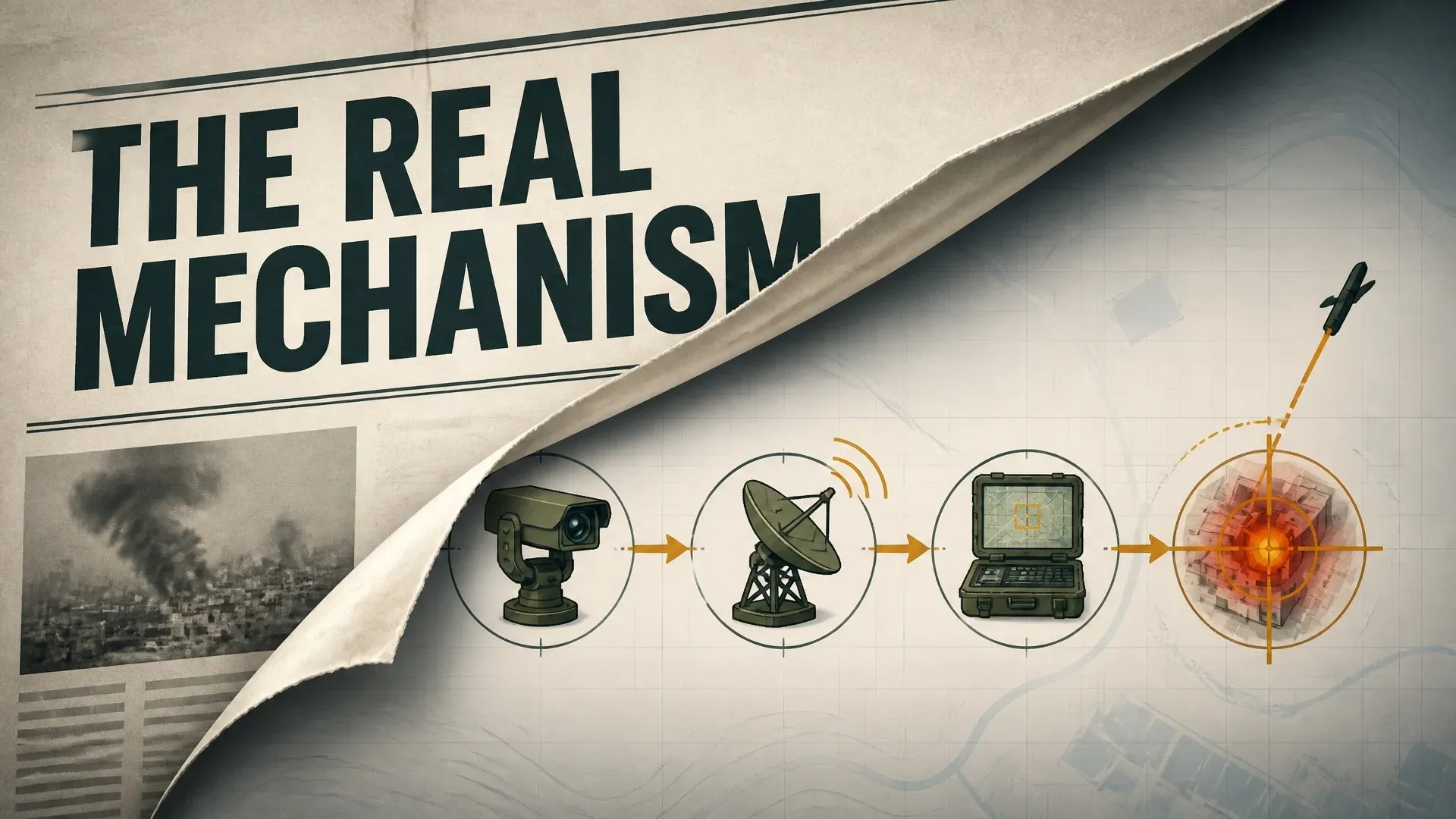
The decisive advantage was a short chain from seeing a vehicle to assigning a weapon against it.
This is why the reconnaissance drone may matter more than the aircraft that performs the final attack. It converts ordinary movement into targeting information. The decisive technology is not one quadcopter; it is the operating system around the aircraft: operators, analysts, radios, maintenance, ammunition handling, concealment, and a habit of testing new responses whenever the enemy changes.
Why 400 drones did not guarantee an advantage
The American formation was not drone-free. Official Army reporting says it employed more than 400 unmanned aircraft across six commands while testing sensor fusion, electronic warfare, distributed communications, and faster decision tools.
Quantity alone does not reveal how naturally a tool fits into battlefield behavior. A brigade can own hundreds of aircraft while information still moves slowly between units, permissions remain cumbersome, repairs take too long, or operators struggle to coordinate with maneuver forces. Ukrainian experience came from repeating the full cycle under pressure: fly, fail, diagnose, change a frequency or route, repair the aircraft, and try again.
That is a harder capability to purchase than a drone. It depends on organization and learning speed. The exercise suggests that distributing equipment is only the beginning; the decisive question is whether the formation can turn many separate tools into one fast system.
A jammer is a layer, not a force field
Electronic warfare is often pictured as a switch that makes every hostile drone fall from the sky. In practice, a defender must detect an aircraft or its control signal, identify the relevant part of the spectrum, transmit enough energy in the right direction, and maintain coverage while moving.
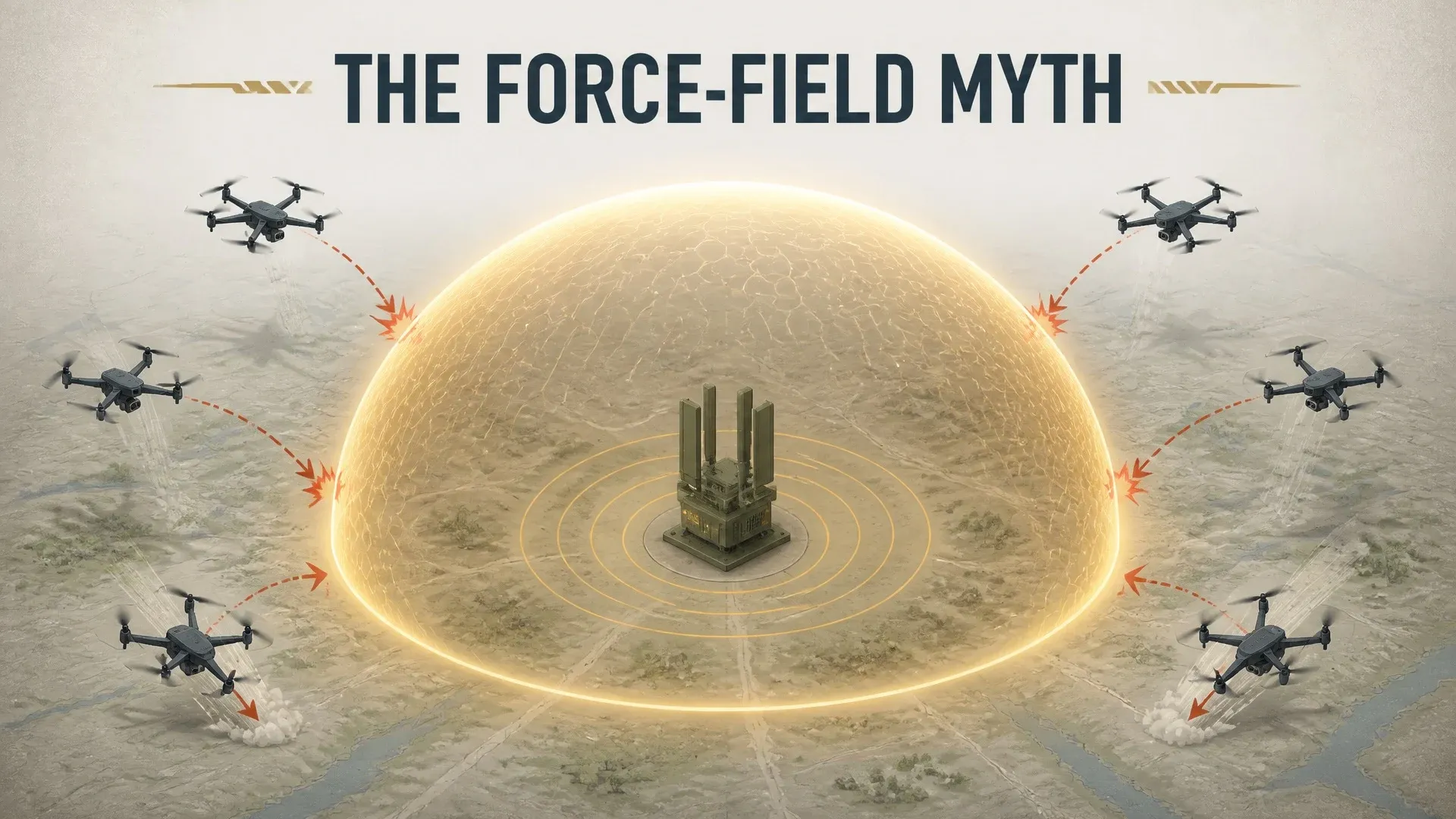
A jammer must detect and disrupt the right link in the right place; it is not a universal shield.
Terrain, trees, buildings, antenna placement, and distance affect performance. Strong jamming can also interfere with friendly radios, navigation, and drones. Attackers can change frequencies, flight paths, launch points, timing, or control methods. Even a successful disruption may arrive after a reconnaissance drone has already reported the vehicle’s position.
Defenders also face an unfavorable numbers problem. They must watch continuously, distinguish hostile aircraft from clutter or friendly systems, and stop enough attacks to preserve the unit. The attacker may need only one aircraft to observe from the edge of the defended area or a few to pass through a gap.
The Americans changed the problem
The first defeat was not the end of the exercise. During later phases, American forces spread vehicles farther apart, improved concealment, and used electronic warfare more effectively. The Ukrainian team later switched sides and helped the Americans employ drones offensively.
Dispersion makes each target less valuable and forces the attacker to search more ground. Better concealment now includes managing dust, tracks, engine heat, radio emissions, lighting, and the overhead shape of a position. Those measures impose costs: separated vehicles can be harder to coordinate, protect, supply, and mass at the moment they are needed. Adaptation is a trade-off, not a simple checklist.
The Army is also testing formations that combine scouts, electronic warfare, unmanned sensors, loitering munitions, mortars, and armor. The goal is not to replace every tank with a quadcopter. It is to connect different tools so each covers another’s weakness.
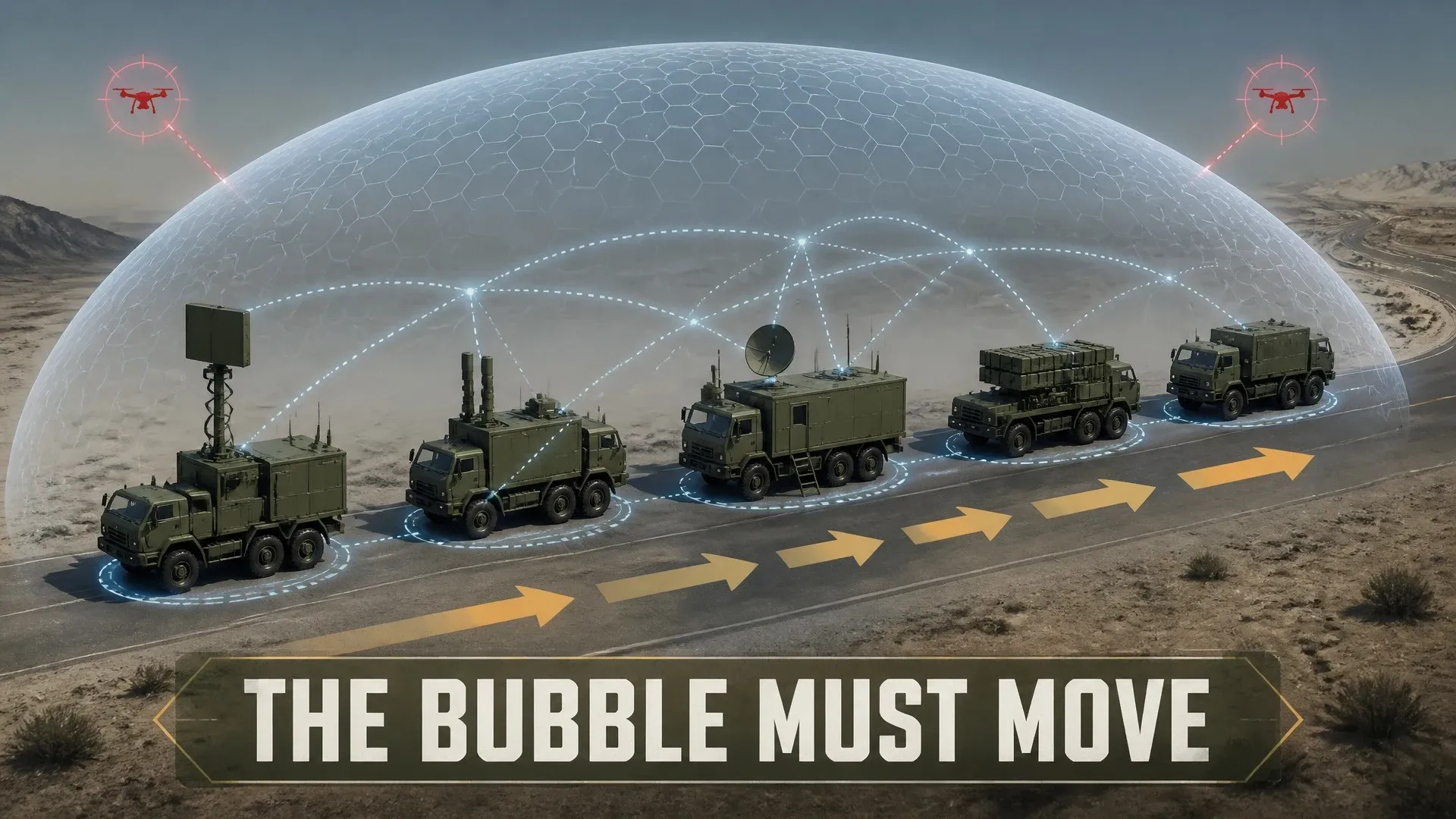
Effective counter-drone protection needs several moving layers, each of which can also be detected and attacked.
A serious defense may combine radio-frequency sensors, radar, cameras, acoustic and infrared detection, jammers, guns, interceptor drones, missiles, or directed-energy systems. The Congressional Research Service’s counter-drone overview explains why the problem spans detection, identification, tracking, and defeat rather than one universal countermeasure. These layers can create a temporary corridor for armored movement, but the defensive network must itself move, communicate, carry ammunition, and avoid detection.
What the war game actually demonstrated
Combined Resolve did not prove that tanks are obsolete or predict how a war between major powers would end. It demonstrated how quickly an armored formation can lose freedom of action when it is persistently observed and the opposing force completes its detect-to-strike chain faster.
The Ukrainian advantage was not simply cheaper hardware. It was an experienced reconnaissance-to-strike system whose people could integrate equipment, repair failures, and change tactics at battlefield speed. The U.S. response matters for the same reason. The brigade adjusted its behavior while the consequences were simulated, then tested a different approach.
That is the productive reading of the alarming headline. A hard exercise exposed a real vulnerability, separated equipment ownership from operational competence, and gave the losing force time to learn. The enduring contest will be between detection and concealment, concentration and dispersion, attack and layered defense. Neither side receives a permanent technological victory.