Short answer
The answer in plain English
Bitcoin is a peer-to-peer settlement network and BTC is its native asset. Wallets authorize transactions with private keys, nodes independently reject invalid transactions and blocks, and miners use proof of work to order valid activity into a shared history. A declining block subsidy approaches a limit of about 21 million BTC. Scarcity is therefore a rule enforced by participants—not a physical shortage or a promise from one company.
Why it matters
What to understand
Bitcoin replaces one authoritative payment database with a ledger that many independent nodes verify. Transactions spend existing outputs and create new ones; miners compete to package them into blocks; proof of work makes rewriting confirmed history costly. The system enables digital scarcity, but it also brings limited block space, variable fees, energy use, irreversible key loss, public transaction history, and volatile market value.
Visual guide
How the pieces fit together


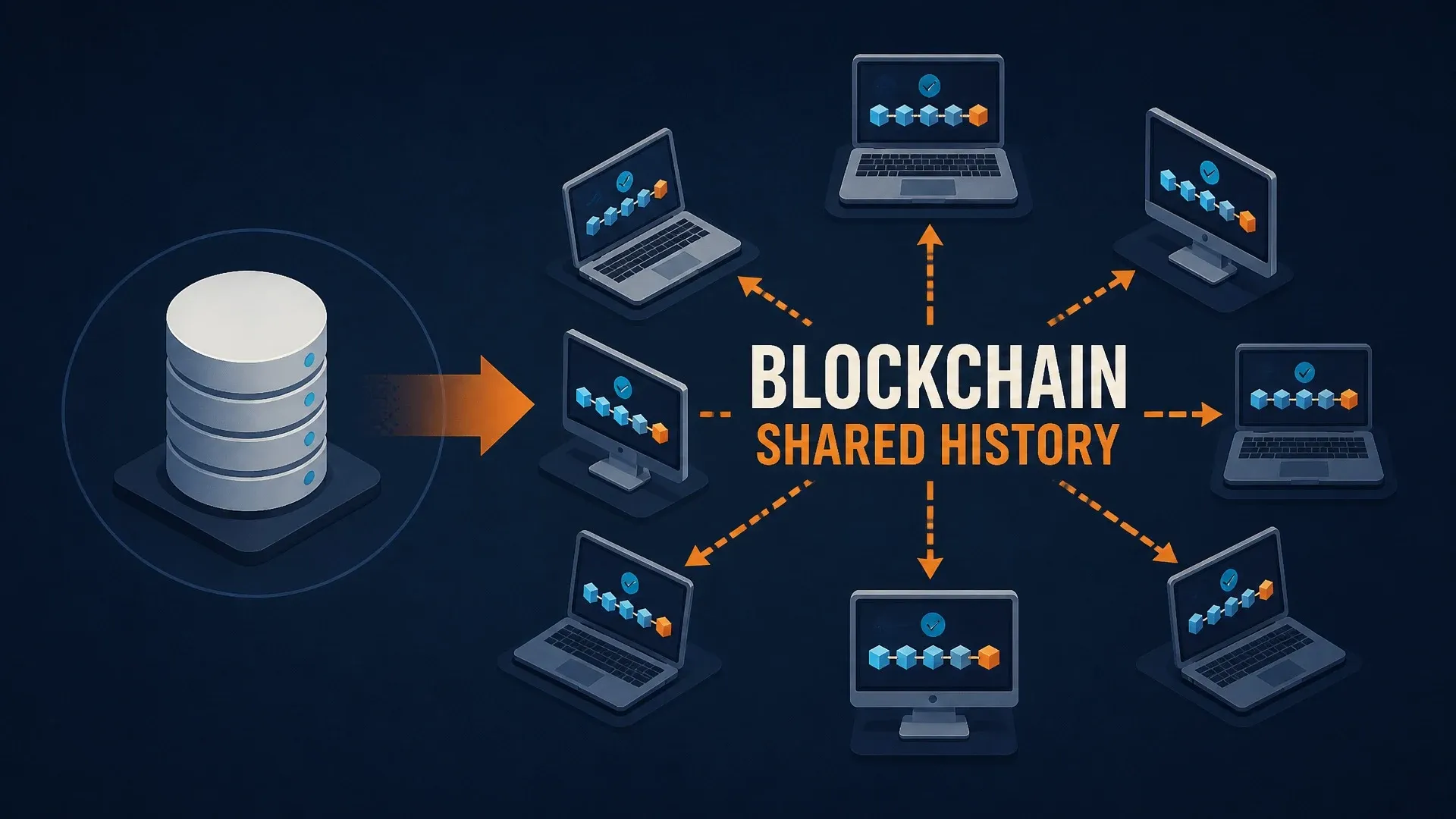
Bitcoin is a ledger without one ledger owner
Bitcoin is both a payment network and the name commonly used for the asset recorded on that network. The asset’s ticker is BTC. No bank holds the master database. Instead, many independently operated computers keep copies of a shared transaction history and apply the same rules to proposed updates.
This solves a peculiar problem with digital value. Information is easy to copy. If a digital coin were just a file, its owner could duplicate it and pay two people with the same unit. Conventional payment systems prevent that double spend through an authoritative database. Bitcoin uses a blockchain, digital signatures, proof of work, and independent verification instead.
The original Bitcoin paper described the basic idea: transactions can be ordered into a history whose alteration would require redoing computational work and overtaking the continuing network.
What happens when a wallet sends BTC
Bitcoin does not maintain account balances in the same way as a banking app. Its transaction model tracks unspent transaction outputs, or UTXOs. These are amounts created by earlier transactions and locked by conditions that a future spender must satisfy.
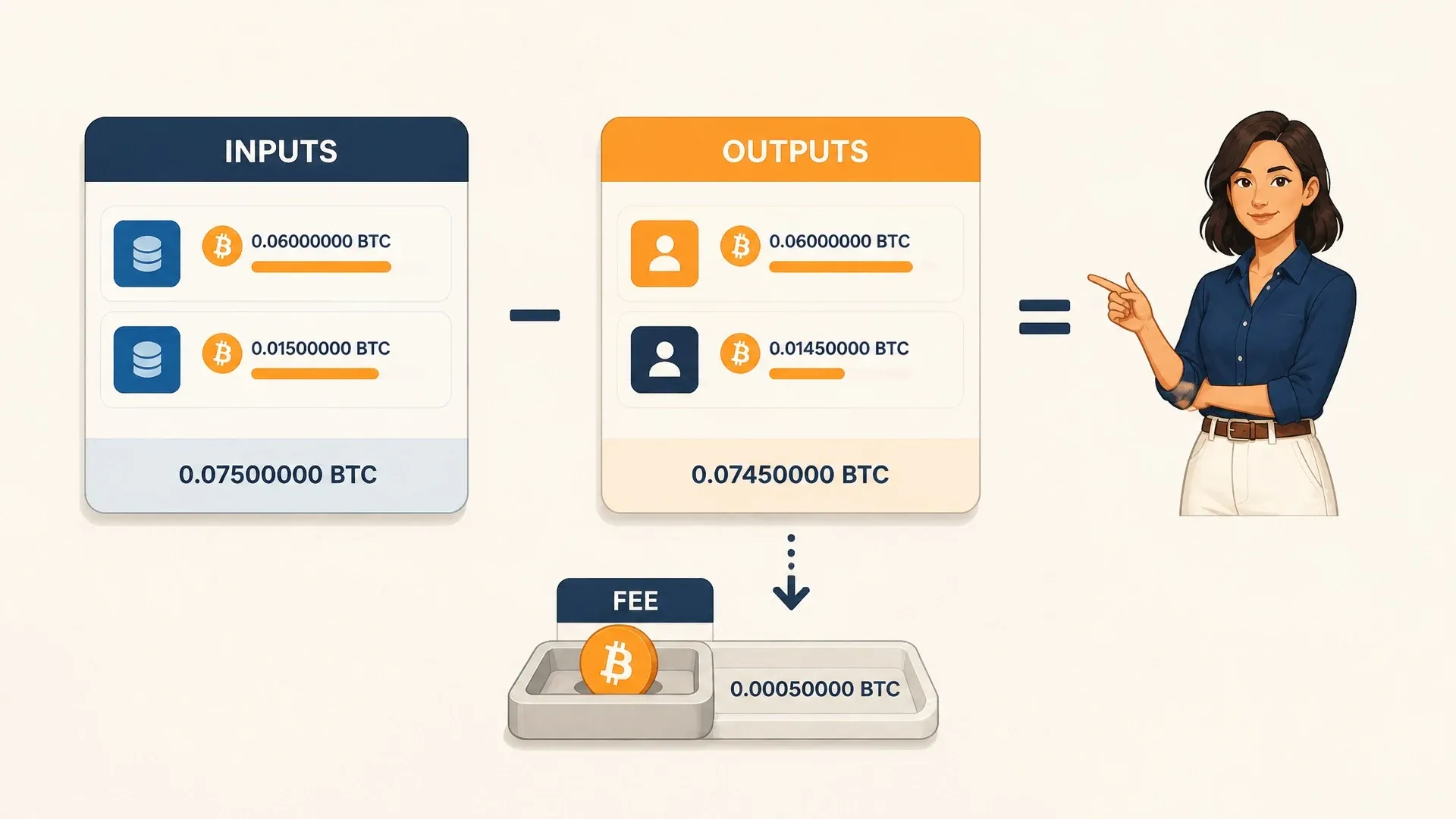
Suppose Maya pays Daniel. Maya’s wallet selects one or more UTXOs, creates an output controlled by Daniel, and usually creates another output that returns the remainder to Maya as change. The difference between the selected inputs and the new outputs is the transaction fee. The developer transaction guide documents this structure in more detail.
Maya’s wallet signs the transaction with her private key. Nodes can verify the signature without learning that key. They also check that the inputs exist, remain unspent, and do not create value from nowhere. A valid transaction can be relayed across the network and wait in mempools until a miner selects it.
The blockchain therefore does not contain a bitcoin file traveling from device to device. It records that old outputs were consumed and new spending conditions were created. Wallet software reads this history and recognizes outputs controlled by its keys.
Miners order transactions; nodes enforce validity
Miners assemble valid transactions into candidate blocks and repeatedly hash the block header while changing permitted data. A block is acceptable only when its hash falls below the current target. Finding such a result takes many attempts and real electricity; checking it is quick.
A successful miner broadcasts the block. Nodes verify the proof and every transaction before adding it to their copy of the chain. This division matters: miners propose history, but they do not receive permission to invent BTC or spend someone else’s outputs. Properly functioning nodes reject a block that violates their consensus rules, regardless of how much work produced it.
Bitcoin adjusts the difficulty periodically so blocks arrive roughly every ten minutes on average. Individual intervals can be much shorter or longer. When competing valid tips appear, nodes ultimately follow the valid chain with the most accumulated proof of work.
A transaction has one confirmation when it enters a block. Every later block deepens it. Settlement is probabilistic: replacing older history generally requires redoing its work and catching up with new blocks produced by the rest of the network.
Where the 21 million limit comes from
New BTC is introduced through the block subsidy, one part of a miner’s reward alongside fees. The subsidy began at 50 BTC and halves every 210,000 blocks. The decreasing sequence approaches a maximum of about 21 million BTC. Bitcoin Core’s consensus constants also define 100 million satoshis per bitcoin, allowing small denominations even with a capped total.
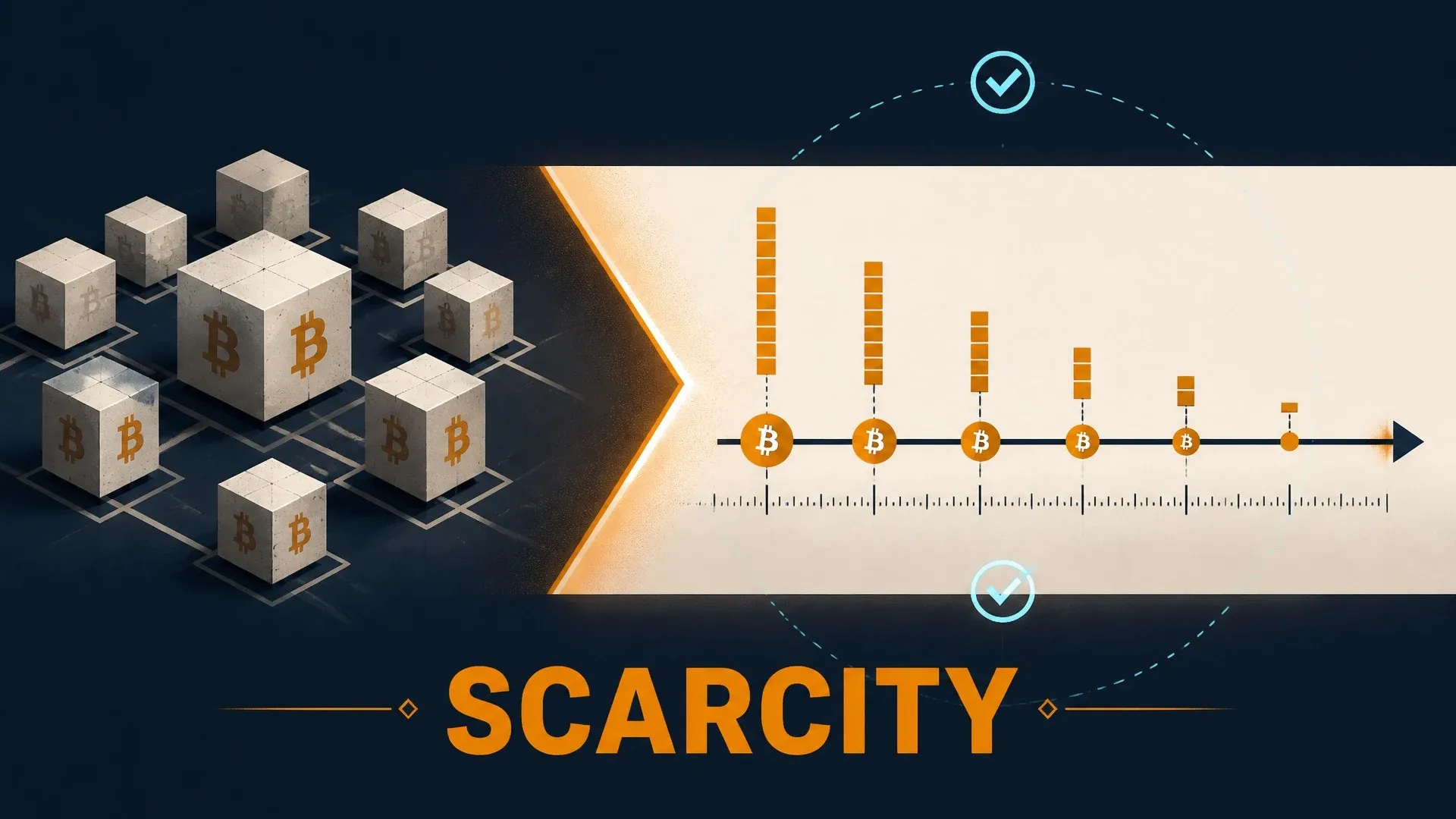
The limit is neither a physical law nor one company’s promise. It is a software rule checked by nodes. People can propose different software, but no developer can make everyone adopt it. A supply increase would only define the same network if a sufficiently broad ecosystem accepted compatible rules; dissenting nodes could continue enforcing the old ones.
Lost keys do not cause replacement coins to be issued. The corresponding outputs remain visible but may be permanently unspendable. That can reduce practical supply without changing the issuance ceiling.
A rule change can also split communities rather than automatically replacing one network. If incompatible groups continue validating different histories, the result may be two assets and two sets of rules. The familiar Bitcoin identity is therefore maintained through an interaction among software, infrastructure, market conventions, and the choices of people who run nodes. “The code says 21 million” is accurate but incomplete: the code matters because a wide network keeps choosing to enforce it.
The design has real costs and limits
Limited block space means fees can rise when demand is high. Base-layer settlement is not instant, free, private by default, or reversible. Public addresses are pseudonyms, yet transaction flows are public and can sometimes be connected to real identities. Custodial exchanges add convenience by holding keys for customers, but then control depends on the custodian.
Proof of work also consumes substantial energy and specialized hardware. Supporters view that external resource cost as the anchor securing history; critics question its environmental cost and social value. Mining pools can concentrate block production and potentially censor transactions, although hashing power alone cannot create valid signatures or rewrite consensus rules.
Bitcoin’s achievement is not perfect money. It is a system in which strangers can converge on a scarce digital ledger without appointing one permanent operator. Whether BTC is a sensible asset for any person is a separate financial decision, shaped by price volatility, custody risk, regulation, taxes, and the possibility of permanent loss.


