Short answer
The answer in plain English
AI is a category of machine-based systems that infer outputs from inputs using learned or constructed models. Machine learning adjusts a model from examples; inference uses it. The surrounding software turns predictions into actions, so usefulness depends on the task, evidence, and consequences of errors.
Why it matters
What to understand
A spam classifier illustrates the full chain: input preparation, a model score, a threshold, and an action. Training changes numerical parameters, while inference applies the model to an input. Language models can generate useful text by learning relationships among tokens, but fluency alone establishes neither accuracy nor consciousness. Evaluation must follow the complete system and its effects on people.
Visual guide
How the pieces fit together


Start with the task, then look for the model
An email arrives and disappears into a spam folder. Somewhere in that process, a model assigned it a score. Other software decided what score was high enough to move the message. That small distinction explains a great deal about artificial intelligence: the model produces an output, while the surrounding system gives that output a consequence.
AI is a broad category of machine-based systems that infer outputs from inputs. Those outputs can be predictions, recommendations, decisions, or generated content. The model may incorporate explicitly constructed knowledge, patterns learned from data, or a combination. There is no requirement that it possess a human-like mind.
The useful questions are concrete. What goes in? What comes out? How was the connection between them built? Who decides what happens next? Those questions apply to a photo classifier, a language model, and a recommendation system, even though their designs differ.
Why examples can be easier than instructions
Ordinary software works well when a procedure can be specified precisely. A calculator does not need thousands of examples to learn addition. A developer can implement the arithmetic directly.
Recognizing a cat is harder to describe as a complete procedure. Pointed ears also occur on other animals. Whiskers may be hidden. A photograph can show a curled-up cat, a silhouette, or half a face behind furniture. Adding another handwritten exception rarely solves every variation.
Machine learning changes how part of the procedure is built. Developers supply examples and a learning method. The method adjusts a model so that inputs tend to produce useful outputs. A cat classifier can learn statistical regularities without a programmer specifying every combination of fur, pose, lighting, and background.
The resulting knowledge is usually distributed across numerical parameters. It is not necessarily a tidy list of concepts that a person can read. Different combinations of values influence how strongly features affect the result.
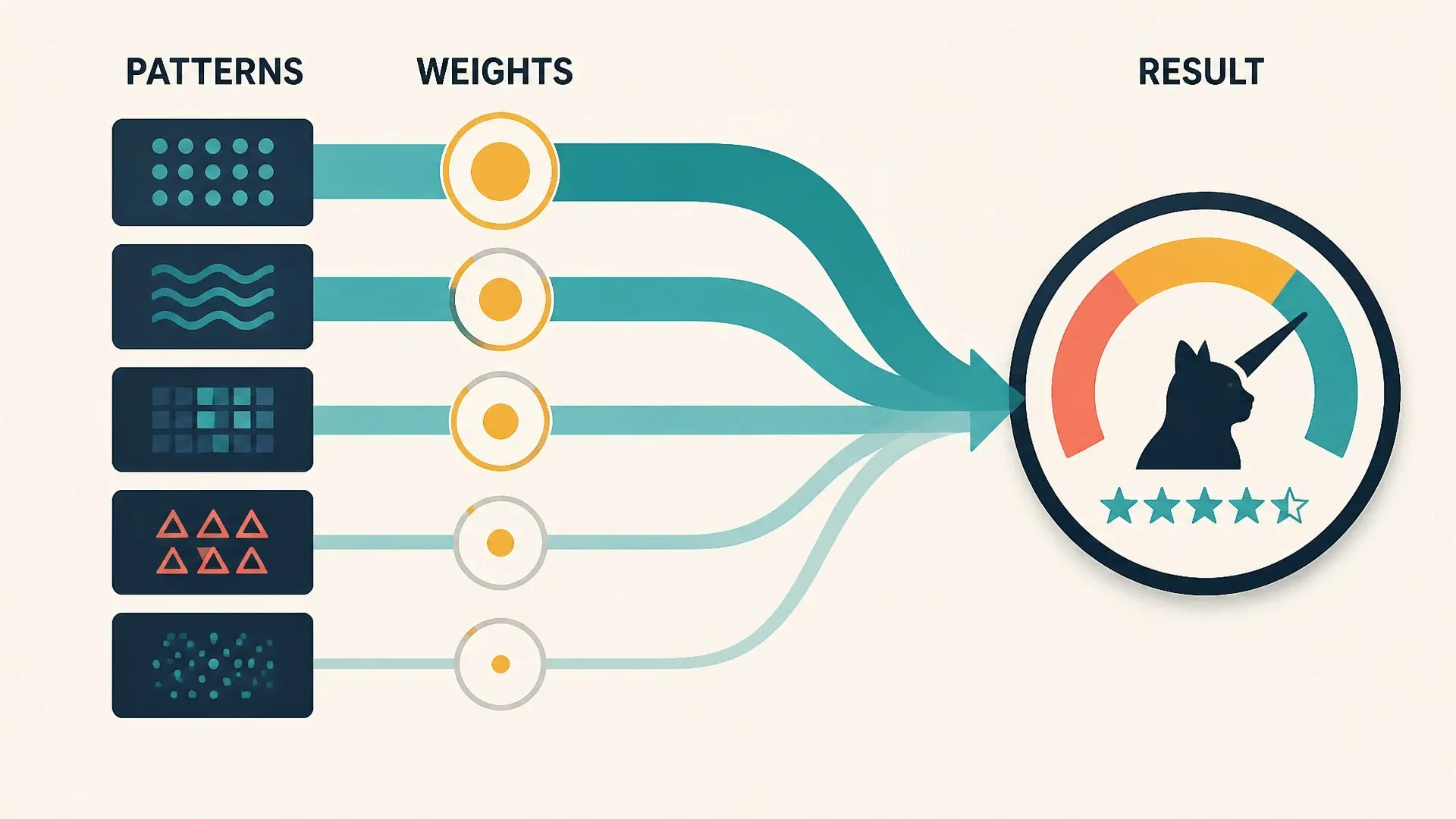
Weights shape how input patterns affect an output. This illustration simplifies a process distributed across many numerical values.
Training changes the model; inference uses it
In a common training setup, the model makes a prediction and compares it with a target. A loss function assigns a numerical penalty to the error. An optimization method then changes parameters in a direction expected to reduce that penalty.
For neural networks, backpropagation calculates how changes in parameters affect the loss. An optimizer uses that information to update the weights. Repeating the process across many examples can improve performance, although reducing training error does not by itself prove the model will work on unfamiliar cases.
Inference is the use of the trained model on an input. An email classifier converts a new message into a numerical representation and produces scores. Inference does not necessarily update the model’s weights. A system can appear to learn during a conversation because it receives more context, even when the underlying model remains unchanged.
Both phases require computation. The separate article on the electricity used in AI training follows the physical work behind parameter updates and explains why serving a widely used model also consumes energy.
A prediction becomes a decision inside a product
Consider the spam example again. The model’s score is only one step. Software must receive the message, prepare its contents, run the model, interpret the output, and decide whether to move it. The interface must then let someone recover a legitimate message that was classified incorrectly.
A threshold creates a tradeoff. Moving more borderline messages can catch more spam but also hide more legitimate mail. A model cannot settle that tradeoff simply by producing a number. Product designers choose the threshold and the recovery process.

A classifier supplies scores; the surrounding email system applies a threshold and decides what to do with the message.
This is why an AI failure may originate outside the model. Poor input quality, unrepresentative data, an unsuitable objective, or a badly chosen threshold can all damage results. Conditions may also change after training. Evaluation needs to cover the complete workflow in which people will encounter the output.
Machine learning, deep learning, and generated text
The vocabulary describes overlapping categories. Machine learning is a major area within AI. Deep learning uses neural networks with multiple layers. Generative AI produces content, including text, images, audio, and code. A large language model is one kind of generative system.
Language models represent text as tokens, often words or pieces of words. Predicting tokens across many examples encourages a model to capture relationships involving grammar, subject matter, tone, formatting, and context. Those learned relationships help it generate useful summaries or explanations rather than merely complete familiar phrases.
Many modern language models use transformers. Their attention mechanism calculates relationships among parts of a sequence as the model processes it. A word’s interpretation can therefore depend on other words in the context rather than its position alone.
These mechanisms explain how useful text can emerge from numerical computation. They do not establish that the system has beliefs, feelings, or personal experience. Describing a mechanism and making a claim about consciousness are different tasks.
A convincing answer still needs evidence
A model can generate a plausible citation that refers to no real publication. It can present an incorrect statement with the same fluent tone as a correct one. Producing a continuation that fits a pattern is not equivalent to checking that every claim corresponds to reality.
Calling AI a copying database also misses something. Training material influences the parameters, and models can sometimes reproduce material, but outputs are generally produced by applying learned patterns rather than retrieving a complete stored answer. Novel wording still offers no guarantee of truth.
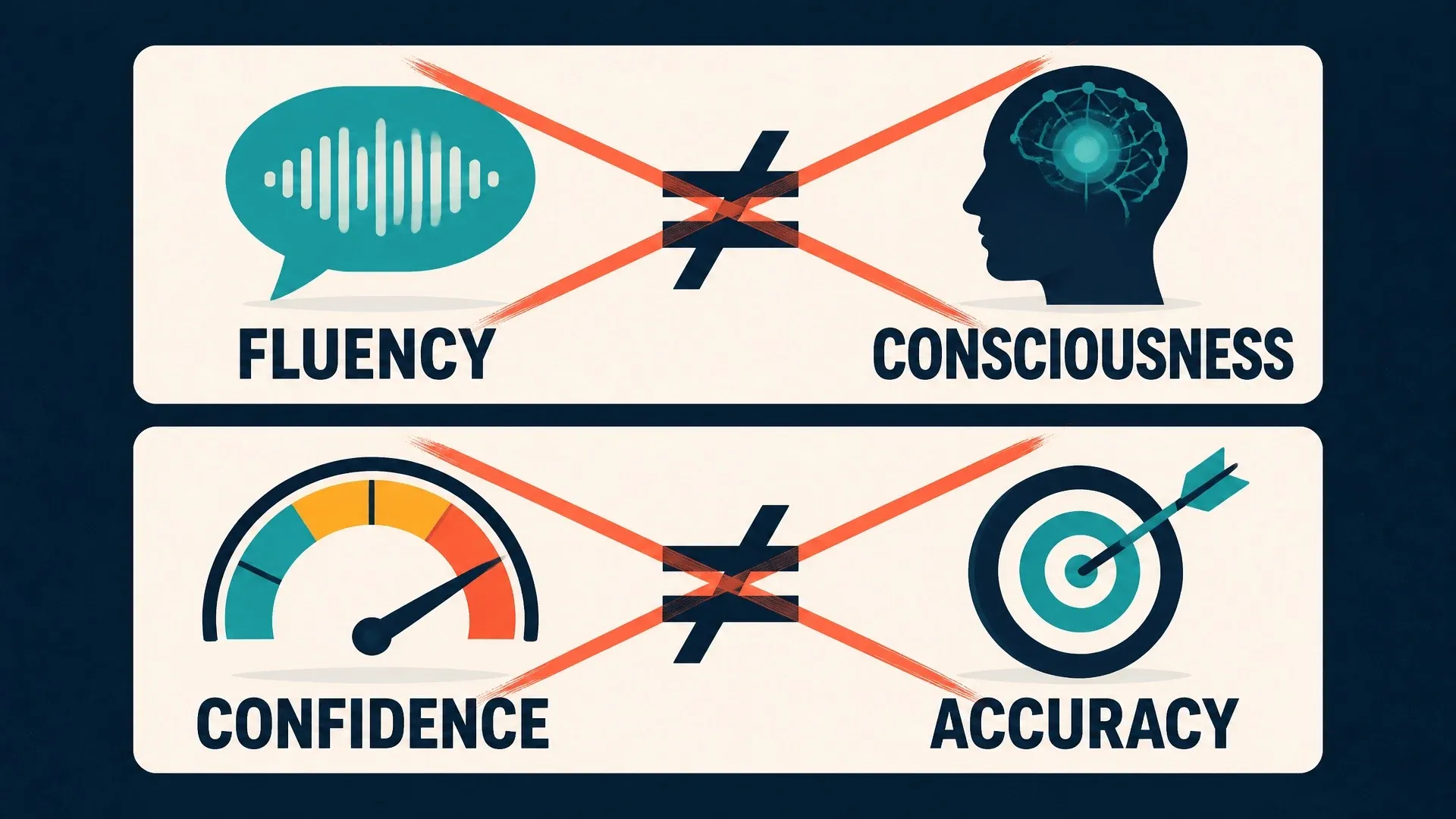
The style of an answer is weak evidence about its reliability. Accuracy must be evaluated against the task and the underlying facts.
The practical standard depends on consequences. An irrelevant song recommendation and a mistaken employment filter can have very different costs. Ask what evidence supports the system’s performance, which conditions were tested, how errors become visible, and who can challenge the result. Understanding AI begins with its inputs and model; judging whether it is useful requires following the output all the way to the person affected.
