Short answer
The answer in plain English
The debate changed because researchers could finally separate small size from youth. A nearly complete Hell Creek tyrannosaur was close to adult size and differed anatomically across much of its skeleton. A throat bone associated with the original Nanotyrannus skull also preserved near-adult growth tissue. Together, these results make a juvenile T. rex identity much harder to maintain, although some specimen placements and species boundaries remain open.
Why it matters
What to understand
For decades, small, lightly built tyrannosaurs could be interpreted as teenage T. rex because the best-known skeletons were still growing. The 2025 evidence added two missing comparisons — a near-mature, nearly complete small tyrannosaur and maturity evidence from the name-bearing Nanotyrannus skull. Anatomy, bone histology, and growth trajectories now support a distinct small lineage, while debates over Jane, genus boundaries, and T. rex growth continue.
Visual guide
How the pieces fit together


The old debate had an age problem
Nanotyrannus has spent decades caught between two explanations. One described a distinct, lightly built tyrannosaur that lived alongside Tyrannosaurus rex. The other described the same fossils as young rexes whose narrow skulls, long legs, and many teeth would change as they grew.
The juvenile hypothesis had a strong point: young animals are not miniature adults. Bone proportions, skull depth, muscle attachments, and ecological role can all change during growth. Jane, a partial small tyrannosaur skeleton discovered in Montana, was still growing when she died. A 2020 osteohistology study interpreted Jane and another specimen as immature T. rex, roughly in their early to middle teens.
What the debate lacked was a clearly near-adult animal that remained small. Without one, every slender specimen could be placed somewhere on a dramatic T. rex growth curve.
A nearly complete skeleton supplied the missing comparison
The Dueling Dinosaurs fossil includes a small tyrannosaur preserved beside a Triceratops. The arrangement does not by itself prove the animals died while fighting, but the tyrannosaur’s completeness is exceptional. Its skull, arms, vertebral column, pelvis, and legs can be studied as one individual rather than assembled from several partial specimens.
In October 2025, Lindsay Zanno and James Napoli reported their analysis in Nature. They identified the skeleton, NCSM 40000, as a near-mature Nanotyrannus lancensis rather than a juvenile T. rex.
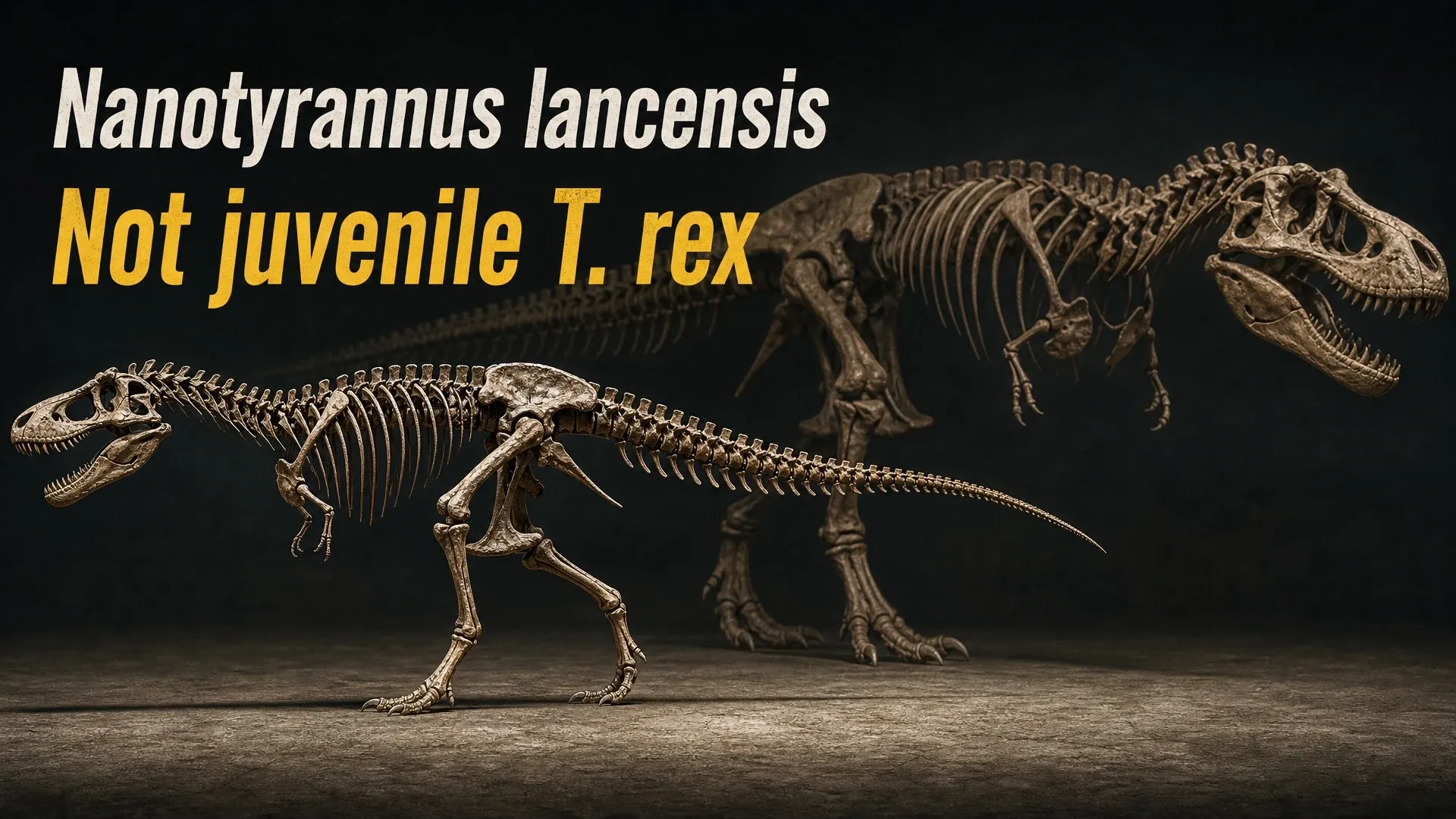
The 2025 interpretation treats the near-mature small skeleton as Nanotyrannus rather than an unfinished T. rex.
The first clue was its growth record. Annual growth marks in dinosaur bone can show whether tissue was still being deposited rapidly or slowing toward adult size. The animal had lived for roughly two decades, and the spacing of its later growth marks narrowed. Several bones also showed advanced fusion. It was not a small teenager poised at the beginning of an enormous growth spurt; it was a small animal approaching its final size.
Turning that trajectory into an adult T. rex would require growth to slow, nearly level off, and then accelerate again on a giant scale. That does not make the transformation logically impossible by itself, but it makes it a biological claim that needs evidence rather than the default explanation.
Whole-body anatomy is harder to dismiss as youth
Skull shape can change substantially with age, so the 2025 study did not rest on a narrow head or tooth count alone. It compared structures across the skeleton, including the forelimbs, tail, vertebrae, tooth arrangement, skull cavities, and pathways for nerves.
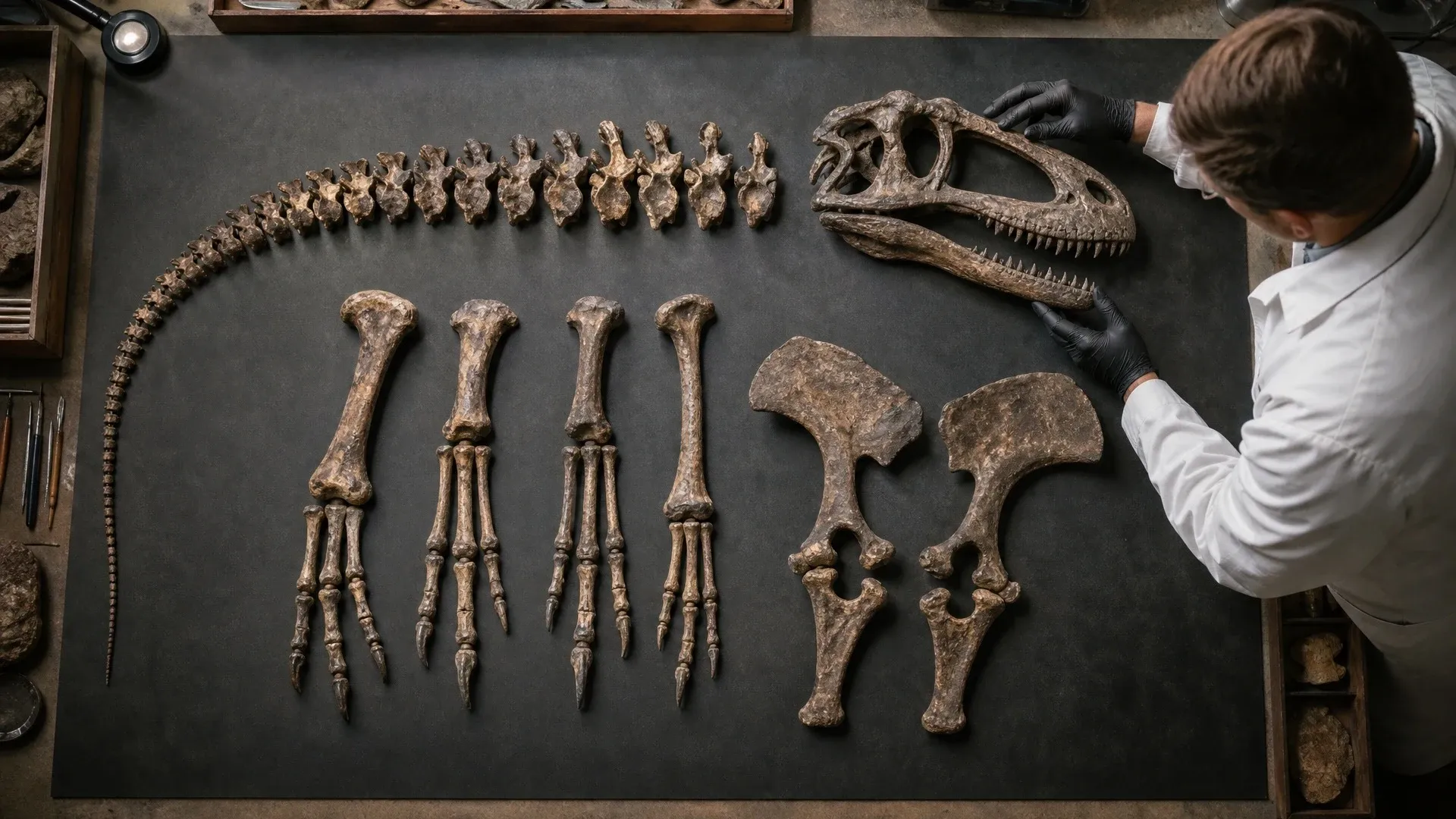
A nearly complete skeleton lets researchers test differences across the body instead of relying on skull shape alone.
Some features can reasonably become larger, rougher, or more reinforced as an animal matures. Others would need to disappear, reverse, or be reconstructed in unusual ways to produce the adult T. rex condition. Vertebral counts are especially useful because an animal does not normally remove sections of its backbone while growing. Internal skull passages are similarly constrained compared with the general outline of the head.
In the authors’ evolutionary analysis, these features placed Nanotyrannus on a different tyrannosaur branch rather than inside T. rex as a growth stage. The key was not one dramatic trait. It was a pattern spread across a nearly complete animal.
The original skull also turned out to be nearly mature
A second line of evidence mattered because the name Nanotyrannus lancensis is anchored to an older specimen, CMNH 7541. The small skull was described in 1946 and renamed Nanotyrannus in 1988. Even if NCSM 40000 represented a distinct small tyrannosaur, researchers still needed a convincing link to that original name-bearing fossil.
A small throat bone, the ceratobranchial, remained associated with the original skull. It forms part of the hyoid apparatus that supported tissues around the tongue and throat. Researchers tested whether this overlooked element could preserve a useful growth record.
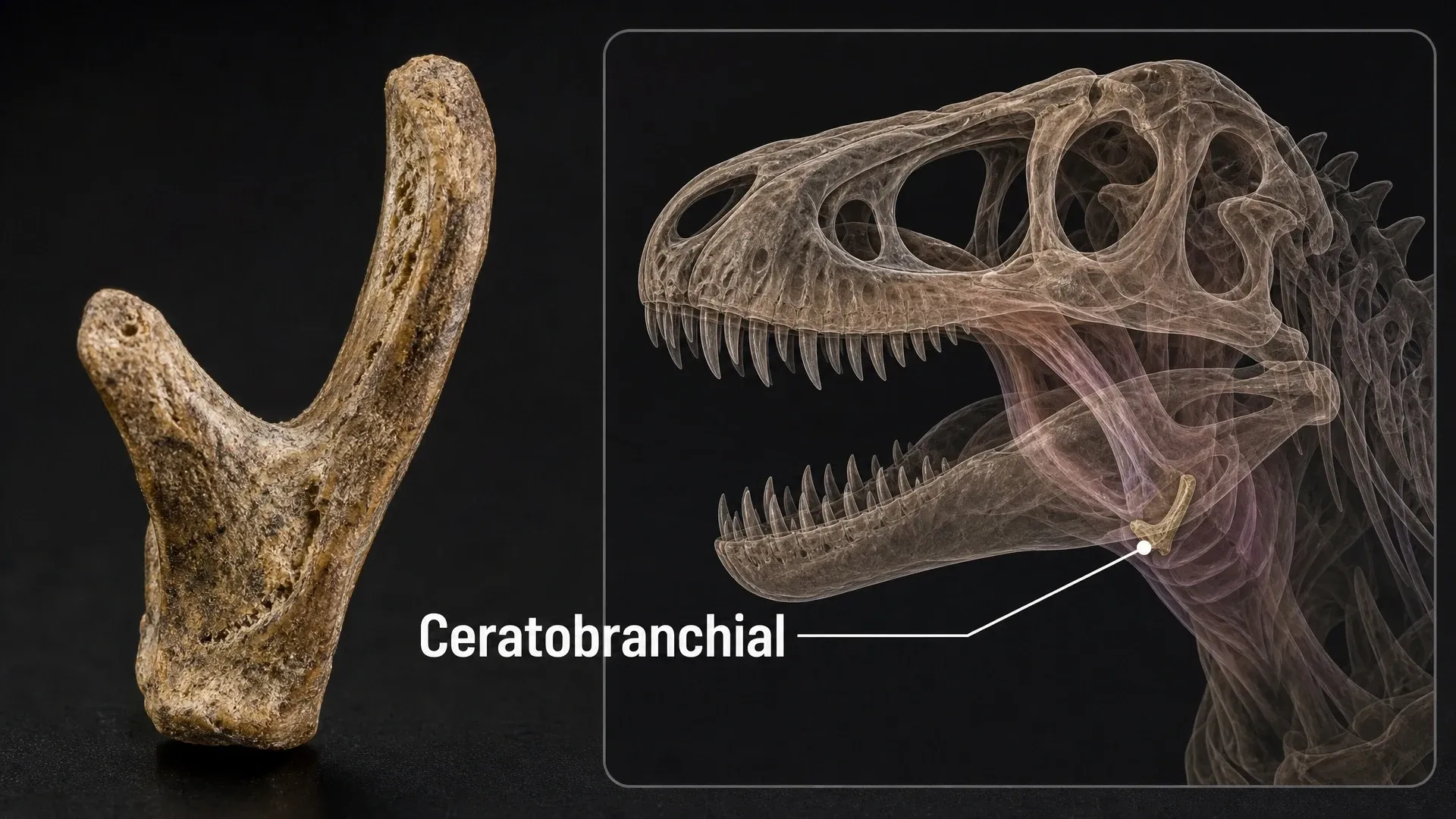
Histology from the overlooked ceratobranchial linked maturity evidence directly to the original name-bearing skull.
The thin section contained closely packed outer growth marks and an external fundamental system, a layer associated with growth slowing almost to a stop. The result, published online in Science in December 2025, indicated that the individual defining Nanotyrannus lancensis was mature or extremely close to maturity.
This closed an important identification gap. Shared anatomy connected the nearly complete skeleton with the Cleveland skull, while the throat bone showed that the skull was not simply from a rapidly growing baby.
What remains unsettled
Stronger evidence for a distinct small tyrannosaur does not make every related label final. Zanno and Napoli proposed that Jane belongs to a second species, Nanotyrannus lethaeus. Jane genuinely was immature, so separating closely related species is harder when the available animal had not reached its adult form.
Researchers can also agree that two animals were biologically distinct while disagreeing about whether the difference deserves a separate genus or species. Taxonomic ranks are human categories applied to branching populations through time. The exact position of Nanotyrannus on the tyrannosaur family tree can change as new characters and specimens are tested.
The safest conclusion is therefore narrower than “the debate is over.” The central burden shifted. Before 2025, supporters of Nanotyrannus had to explain why the better-known small skeletons looked immature. After 2025, the juvenile-T. rex model has to explain a near-mature small skeleton, a mature name-bearing skull, and anatomical differences across much of the body.
T. rex growth and Hell Creek ecology must be recalculated
If specimens assigned to Nanotyrannus are removed from T. rex growth samples, researchers must rebuild the early life history of the larger dinosaur from securely identified rexes. A 2026 expanded histology analysis found that T. rex may have grown more gradually and remained subadult longer than some older models suggested. That work does not automatically identify every unusual juvenile as Nanotyrannus, but it makes a single simple ladder from small hunter to giant adult less defensible.
Our guide to how dinosaur growth is reconstructed explains why annual marks, tissue organization, several bones, and several individuals are needed before a growth curve becomes reliable.
Hell Creek ecology changes too. Instead of one tyrannosaur occupying several predator niches as it aged, the formation may have supported at least two distinct tyrannosaur lineages. Adult Nanotyrannus was smaller and more lightly built than adult T. rex, so it probably pursued a different range of prey. That ecological role remains an inference from anatomy and body size, not direct observation.
The real advance was methodological. Youth and distinct identity can imitate each other when only small animals are known. One nearly complete skeleton and one overlooked throat bone gave researchers independent ways to measure maturity. Once age stopped being an assumption, the small tyrant could be tested as an animal in its own right.

