Short answer
The answer in plain English
Good work gets overlooked when the people making staffing, promotion, or budget decisions cannot clearly connect a person's effort to an outcome. Healthy visibility closes that information gap: it records what changed, explains why it mattered, and gives the right audience enough context to act. It is not a substitute for performance, and it does not require becoming loud or self-promotional.
Why it matters
What to understand
Performance creates value; visibility makes that value legible. The practical goal is to communicate outcomes, risks, and next steps in a form that teammates, managers, and senior leaders can understand and repeat accurately. A short weekly record and concise, audience-specific updates usually work better than constant broadcasting.
Visual guide
How the pieces fit together


The short answer
Good work does not literally speak. Someone has to notice it, understand it, connect it to a goal, and remember it when a decision is made. In a small team that chain may happen naturally. In a busy organization, it often breaks.
That is the difference between performance and visibility. Performance is the quality and usefulness of the work. Visibility is whether the people who depend on that work can see what changed because of it. Strong performance with no signal can disappear; a strong signal with weak performance eventually loses trust. A durable reputation needs both.
The practical answer is not to talk about yourself all day. It is to make real outcomes easy to understand and accurately repeat.
Why results vanish inside organizations
Your manager sees only part of your week. Their manager sees less. Promotion, staffing, and budget conversations may happen months after the work and in rooms where you are absent. Decision-makers reconstruct what happened from project updates, customer feedback, remembered incidents, and the examples other people can supply.
Some valuable contributions are especially easy to miss. Preventing an outage produces no dramatic rescue. Simplifying a handoff removes friction that everyone soon forgets existed. Mentoring a colleague improves somebody else’s output. Calming an unhappy customer may leave no artifact beyond the problem going away.
This creates an information problem, not proof that every workplace is fair. Visibility cannot guarantee recognition, and it will not repair a culture that rewards credit-taking over contribution. It can, however, reduce the chance that useful work remains undocumented and unintelligible.
Research also cautions against treating presentation as irrelevant. A meta-analysis of impression-management research found that such behavior is associated with interview and job-performance ratings, although the effect varies by tactic, evaluator, and study setting. That does not mean theatrical self-promotion is the answer. It means evaluators respond to signals, so the quality and honesty of those signals matter.
Make the value legible
Compare two updates:
I finished the customer-export task and attended six project meetings.
The new export removed a manual reconciliation step for Support. The team tested it on the three largest accounts, and the remaining decision is whether to enable it by default.
The second update is useful because it gives the reader a result, an affected group, evidence, and a next decision. It does not claim heroism. It helps another person understand the work quickly.
A simple framework keeps most updates grounded:
- What did you do? Name the contribution without assuming everybody remembers the project history.
- Why did it matter? Connect it to a customer outcome, team goal, reduced risk, faster process, or clearer decision.
- What should happen next? State the decision, dependency, owner, or follow-up that now matters.
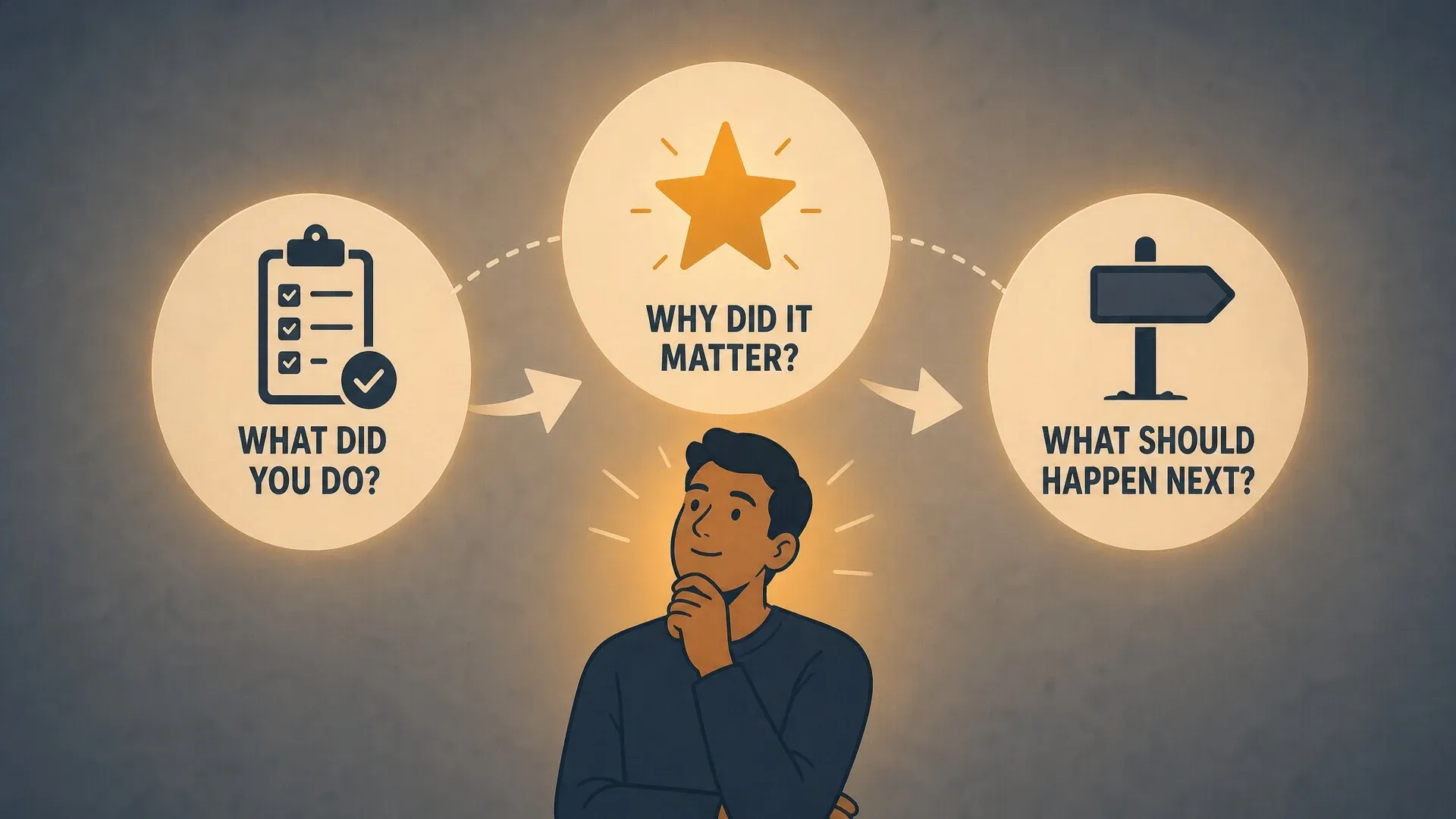
This structure works in a chat message, project note, email, or one-to-one. It is short enough to be read and specific enough to be remembered.
Translate for the audience
Visibility fails when one update is sent to everyone in the same form. A teammate may need implementation detail. A manager needs progress, tradeoffs, and risk. A senior leader often needs the business consequence in plain language.
Technical work makes translation especially important. “We migrated the cache” describes an activity. “The migration removed the failure mode behind last month’s checkout slowdown” explains why the activity matters. The technical detail still belongs in the project record; the outcome belongs in the decision-maker’s summary.
This is also why a manager’s advocacy matters. Managers regularly explain other people’s work when those people are not present. Give yours accurate material: the original problem, your contribution, the measurable or observable result, the people who helped, and any remaining uncertainty. Do not hand them an inflated claim they cannot defend.
Visibility without office theater
Healthy visibility has boundaries.
- Share credit by name when work was collaborative.
- Report risks early instead of hiding them until a dramatic rescue is required.
- Prefer outcomes to displays of busyness.
- Distinguish what you did from what the team accomplished.
- Keep evidence, but do not turn every minor task into an announcement.
A person who always appears during emergencies may become known as the person for emergencies. Building a checklist, clearer ownership, or a repeatable process is usually less theatrical and more valuable. Make that prevention visible too: describe the failure it removes and how the team will know the system is working.
Quiet people do not need to imitate the loudest colleague. Written summaries, thoughtful questions, dependable follow-through, and calm explanations all create visibility. Remote and hybrid work simply make these habits more intentional because fewer colleagues observe the work casually.
Build career memory before you need it
Review season is a poor time to reconstruct twelve months from memory. At the end of each week, record three items:
- one result you helped create;
- one problem or risk you helped prevent;
- one lesson about what matters to the team or customer.
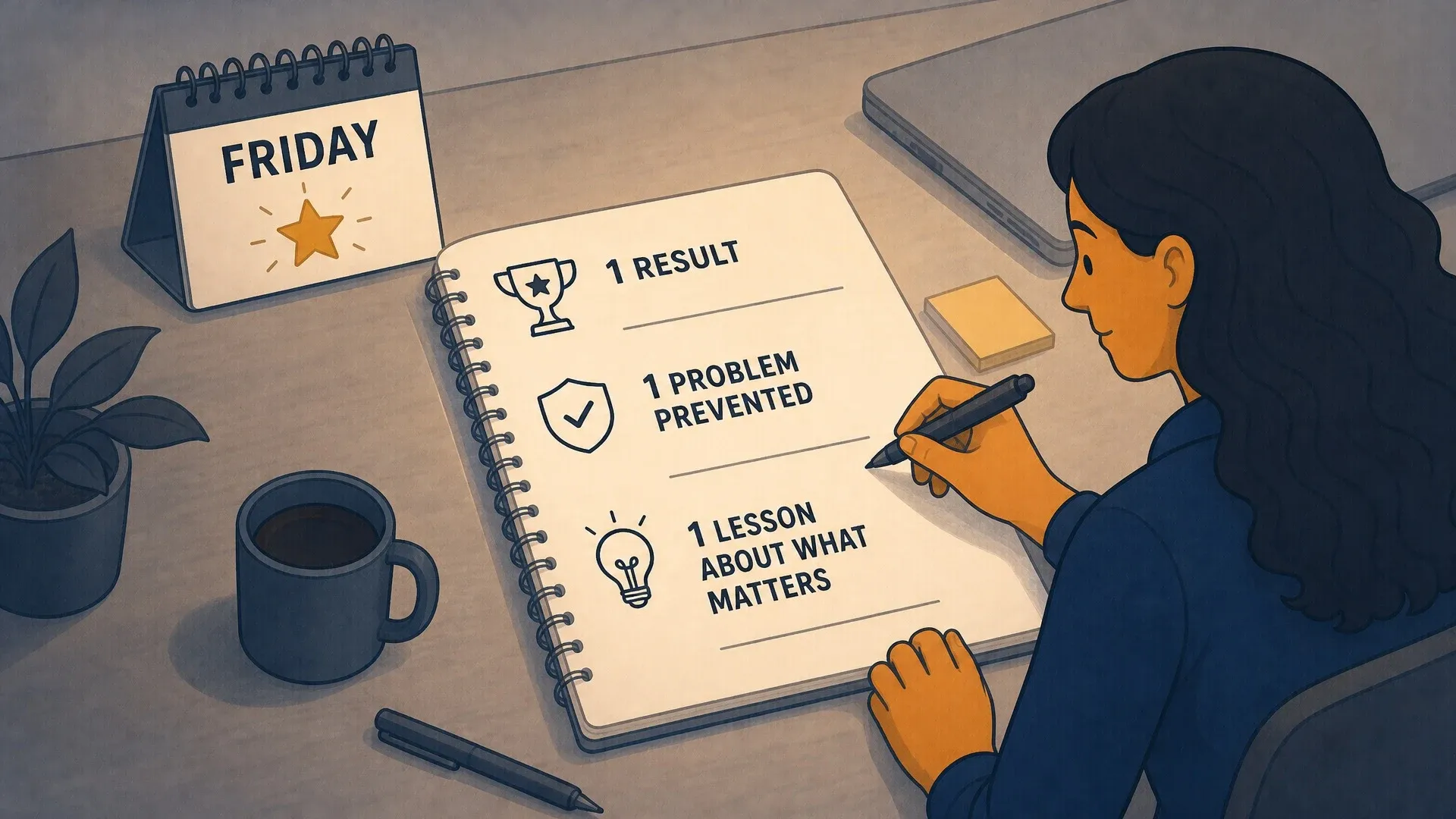
Keep the record factual. Save useful feedback, links to shipped work, before-and-after measures when they exist, and the names of collaborators. This is not a private trophy cabinet. It is a working memory that helps you prepare a one-to-one, write an honest self-review, notice repeated strengths, and spot work that no longer matches the team’s priorities.
Turn only the most important item into an update. A useful weekly note might be three sentences: what changed, why it matters, and whether input is needed. Consistency is more credible than a sudden flood of achievements before a promotion discussion.
What visibility can—and cannot—fix
Clear communication cannot make an unhealthy organization fair. If leaders routinely take credit, punish early warnings, or change promotion standards after the fact, document the pattern and protect your options. Visibility is not consent to endless unpaid “next-level” work.
In a healthier workplace, the effect is simpler. Teammates know where you can help. Managers have evidence instead of vague impressions. Risks surface sooner. Useful systems receive credit even when they prevent drama rather than create it.
Performance is still the foundation. Visibility is the communication layer that lets other people recognize, reuse, and support that performance. The goal is not to become impossible to ignore. It is to make the value of honest work difficult to misunderstand.