Short answer
The answer in plain English
A whale shark survives on tiny prey by eating concentrated clouds rather than isolated organisms. Its broad mouth takes in a large volume of water; filter pads retain plankton, eggs, and small animals while water exits through the gill slits. The shark can ram-feed while swimming or draw water in by suction, then travel between temporary feeding hotspots.
Why it matters
What to understand
The largest living fish is a true shark whose front end functions as a high-volume filter. Cross-flow around the filter pads helps concentrate food without behaving like a simple clog-prone sieve. A large body supplies a wide intake, spacious throat, and extensive filtering area. Whale sharks pair that machinery with seasonal movements, individual spot patterns, and slow growth that also makes losses from fishing and vessel strikes difficult to replace.
Visual guide
How the pieces fit together


A giant does not hunt one speck at a time
A whale shark can be as long as a bus, yet much of its food is made of plankton, fish eggs, and other small drifting animals. The apparent mismatch disappears once the unit of food changes. The shark is not searching for one copepod after another. It is finding water where currents, tides, spawning events, or upwelling have packed enormous numbers of small organisms into the same volume.
A wide mouth can process that patch as a single meal. The animal trades the rapid pursuit of individual prey for a large intake, specialized filtration, and the ability to travel between temporary concentrations.
It is a shark rebuilt around filtration
“Whale shark” describes scale and feeding strategy, not ancestry. The animal breathes through gills, has a skeleton made largely of cartilage, and carries dermal denticles on its skin. It belongs to the carpet-shark lineage rather than to the mammals that surface for air.
Its feeding anatomy looks unlike that of a familiar predatory shark. The broad, flattened head places a huge mouth at the front. Thousands of small teeth remain, but they are not the main apparatus for cutting prey. Behind the mouth, filtering structures associated with the gill openings separate food from the water flowing out.
Calling those structures a kitchen sieve is helpful only up to a point. A simple mesh that trapped every particle directly would clog. Water and suspended food instead move across and through the filtering surfaces in a way that concentrates prey inside the mouth while helping preserve flow. The shark can also disrupt or reverse the movement to clear accumulated material.
Two ways to move water
Ram feeding is the easiest mode to picture. The shark swims forward with its mouth open, and its movement forces prey-rich water inside. Cruising through a surface patch turns the entire body into the engine for a moving intake.
Whale sharks can also feed without relying only on forward speed. By opening and closing the mouth and expanding the throat, they can draw water in through suction. In a concentrated surface patch, an animal may hold a steep or nearly vertical posture and repeatedly gulp.
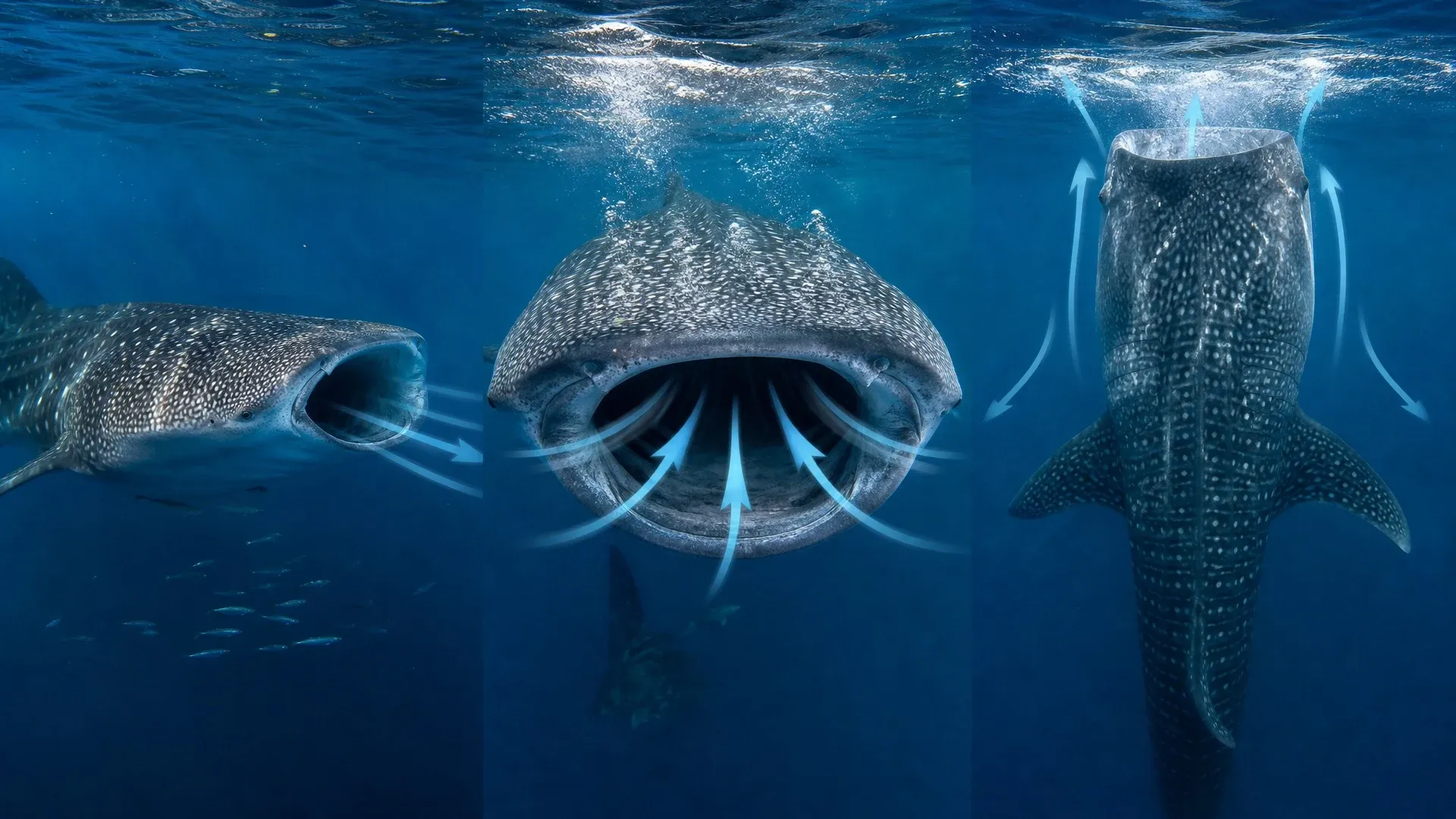
Forward swimming can drive ram feeding, while active mouth and throat movements also let a whale shark draw in water by suction.
The flexibility matters because food does not form the same kind of patch every day. One event may concentrate copepods and krill; another may supply coral spawn, fish eggs, larvae, small squid, or schooling fish small enough to enter the system.
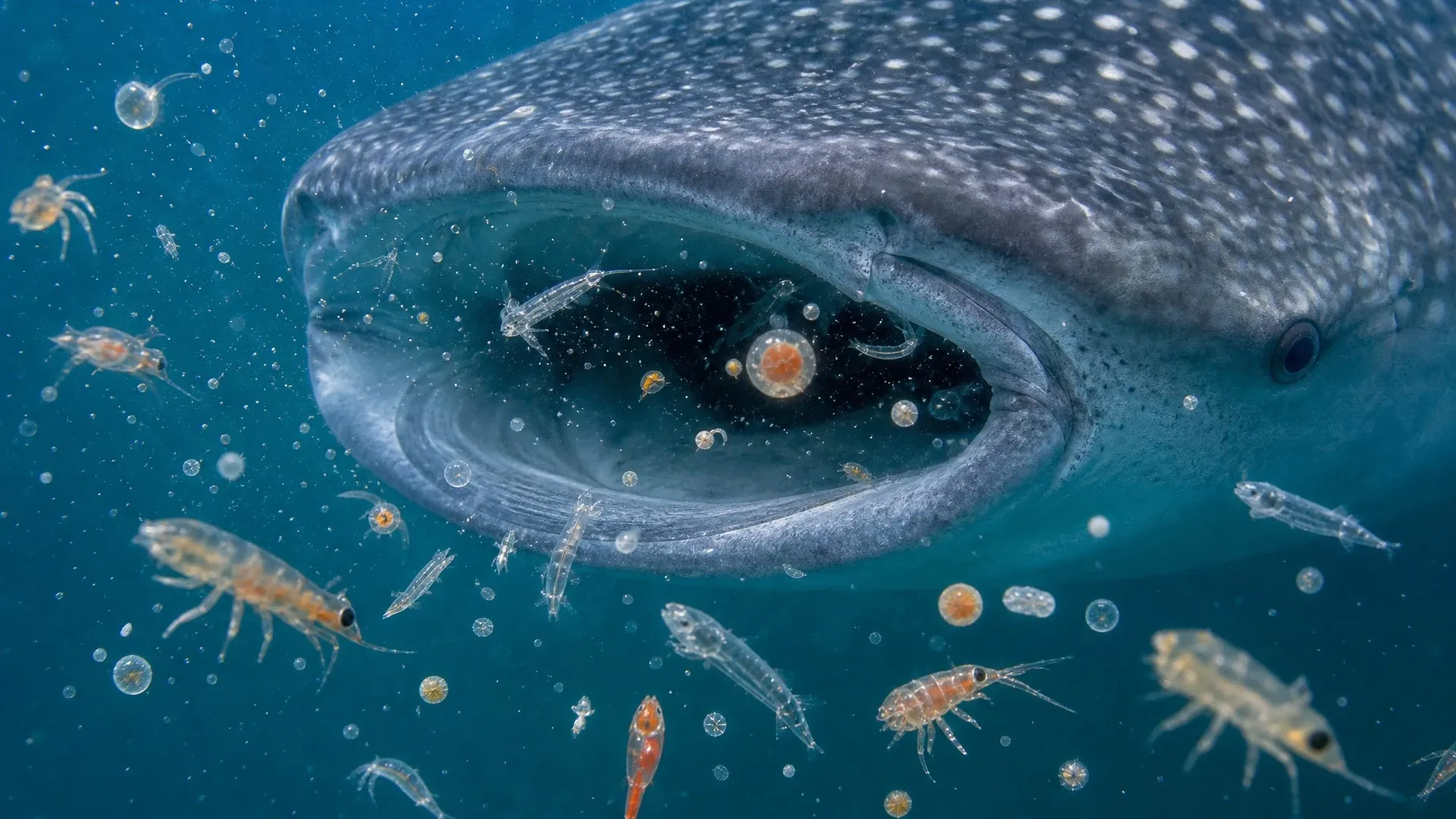
Plankton is an ecological category, not one species. The meal is a dense drifting community of tiny organisms.
Large size can improve the machinery
A large body raises energy needs, but it also expands the feeding apparatus. The mouth sweeps a broad corridor. The throat can handle a substantial flow. Extensive filtering area sits behind the intake, and steady swimming keeps the system moving through a patch.
That does not mean any empty-looking water contains enough food. The strategy depends on finding concentration. Seasonal feeding sites can act like temporary restaurants when local conditions produce a bloom or spawning event. Whale sharks arrive, feed while the opportunity lasts, and then disperse.
NOAA tracking work in the Gulf of Mexico illustrates how mobile the species can be. Tagged sharks used areas along the U.S. Gulf Coast, moved into Mexican waters, and in some cases traveled much farther. Those journeys are better understood as flexible responses to habitat and food than as one identical round trip followed by every individual.
Spots turn photographs into identity records
Pale spots and stripes cover the dark body. A section of that pattern behind the gills is distinctive enough for researchers to compare photographs and recognize the same shark later. Photo identification can therefore record a return without attaching a permanent physical tag.
Repeated sightings help reconstruct movement and estimate changes in size. Measurement remains difficult. A swimming shark curves its tail; camera angle and distance distort apparent length; a nearby diver offers scale but not precision. Researchers use calibrated methods such as paired lasers and stereo video, and may measure to a more consistent point on the tail rather than its moving tip.
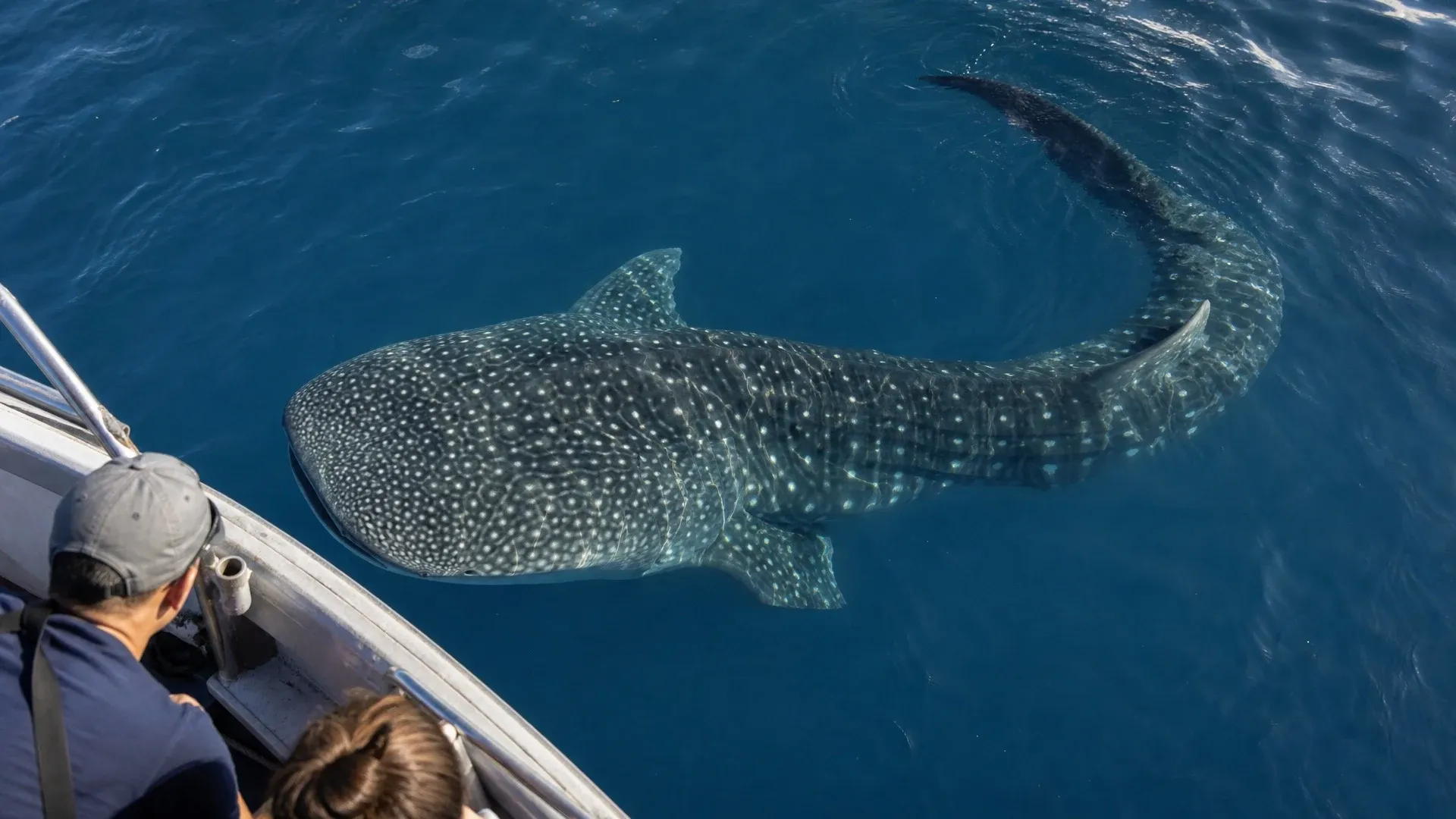
A flexing body, viewing angle, and distance make reliable length estimates harder than a diver-to-shark comparison suggests.
The biggest animals are especially hard to characterize because they are uncommon at many well-studied coastal gatherings. Those groups often contain juvenile males, while the largest mature females are seen less often. Exceptional historical length reports therefore mix genuine biological possibility with uncertainty in observation and measurement.
A slow life makes each loss matter
Whale sharks grow over decades. Scientists can examine bands in vertebrae, but interpreting them requires evidence about how frequently a band forms. Radiocarbon studies support annual deposition in examined animals and ages around half a century, while the maximum lifespan remains uncertain.
Slow growth changes the conservation arithmetic. An adult represents many years of survival through long movements, fishing activity, and ship traffic. Surface feeding places the shark in the same zone used by vessels, so a collision can remove an animal that a population cannot quickly replace.
The whale shark’s size is not a contradiction to its diet. It is part of the solution: a wide intake, large filtering system, and long-range movement convert food that is individually tiny into a harvest of millions. Water that looks empty to a diver can be a dense landscape of drifting life to a shark built to collect an entire cloud.


