Short answer
The answer in plain English
Hagfish slime works because a tiny jet of concentrated material becomes a large fiber-reinforced mucus network in moving seawater. Mucus creates the immediate obstruction, long protein threads help it resist being flushed away, and the predator’s own mouth and gill movements spread the mixture. The result is a temporary breathing emergency that usually forces the attacker to release the hagfish.
Why it matters
What to understand
Hagfish do not store a finished cloud of slime. Rows of skin glands hold compact mucus packets and microscopic coils containing surprisingly long protein threads. When a predator bites, nearby glands fire into its mouth. Seawater expands and mixes the ingredients, mucus restricts flow across the gills, and threads reinforce the blockage. The hagfish then knots its flexible body to wipe itself clean.
Visual guide
How the pieces fit together


The slime is assembled in the predator’s mouth
A hagfish looks poorly equipped for a close encounter with a shark. Its body is soft, it has no jaws, and there is no shell between its skin and an attacker’s teeth. Its defense is hidden in rows of glands along both sides of the body.
When a predator bites, glands near the contact point eject a small amount of concentrated, milky material. That local response matters. The hagfish does not need to flood the surrounding water or empty every gland. It puts the ingredients directly into the mouth that is holding it.
The spectacular cloud seen in underwater footage is therefore not stored inside the animal. It is assembled after release. The hagfish supplies a compact construction kit; seawater supplies almost all of the final volume.
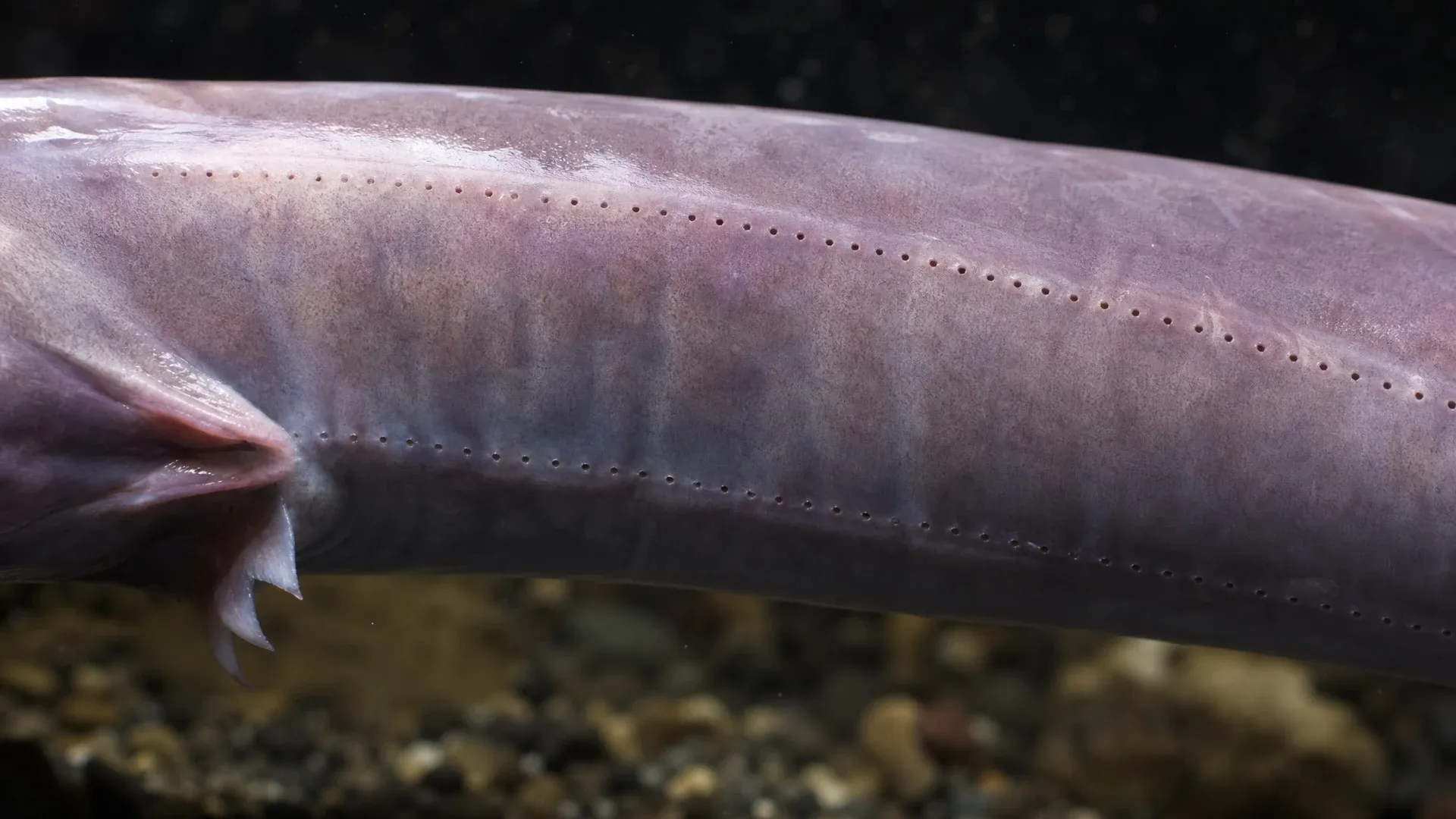
Slime pores line both sides of the body, allowing glands near a predator’s bite to discharge without emptying the entire defensive supply.
Two cell products do different jobs
The gland material combines products from two unusual cell types. One releases packets containing mucins, large molecules with strong water-binding properties. The other releases tightly packed coils, or skeins, each holding a single long protein thread.
Once the packets meet seawater, they swell and release mucus. Calcium, magnesium, and the water’s overall ionic strength affect how well the material forms. At the same time, water movement pulls the skeins apart. A coil roughly a tenth of a millimeter long can contain a thread about 10 to 15 centimeters long. The fiber was already manufactured inside the cell; it is merely being unpacked at remarkable speed.
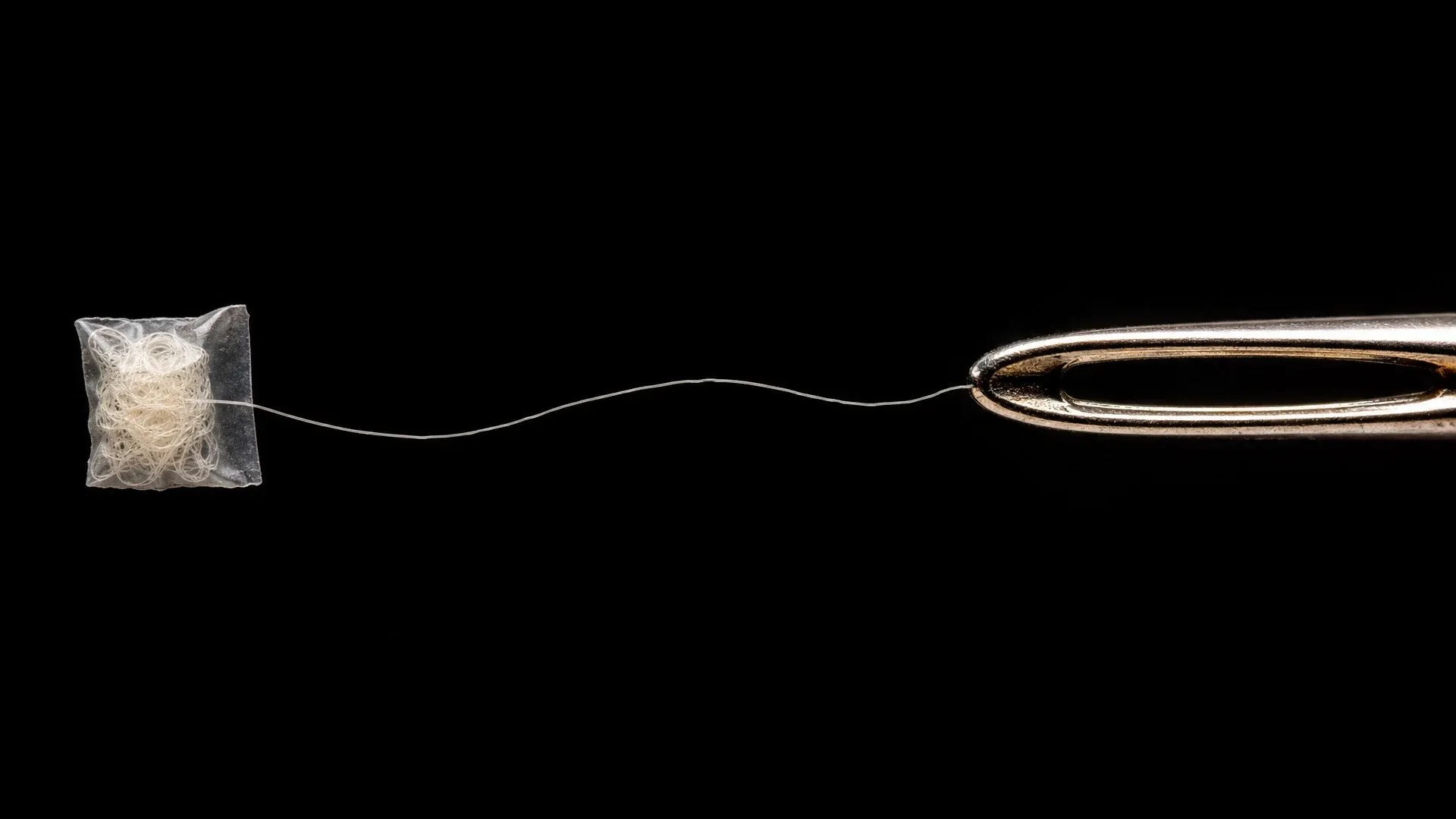
Each microscopic skein packs a thread many times longer than the coil that stores it; moving seawater pulls the fiber outward.
A struggling predator helps the process. Biting, suction, head movement, and the pumping of water through the mouth distribute fresh exudate and unfold many skeins. Within a few hundred milliseconds, mucus and fibers spread through a much larger volume than the discharged material alone could occupy.
Measurements cited in the research describe native slime with only about 35 milligrams of mucus and thread solids per liter. Reports that it can trap roughly 26,000 times its own weight in seawater sound impossible only if the cloud is imagined as stored mucus. It is better understood as a sparse network that captures and reorganizes water already present.
Why gills are the perfect target
Fish gills exchange gases across a large, delicate surface while water moves through narrow spaces. That design makes them efficient for breathing and vulnerable to a material that resists flow.
Experiments with model filters and real gill tissue separate the two components’ roles. Mucus produces most of the immediate clogging. Threads alone do little to block flow. But mucus without reinforcing threads is easier to wash away. Whole slime survives repeated flushing because the fibers hold the obstruction together.
In simple terms, mucus closes the filter and threads make the closure harder to rinse clean. The defense does not need to kill the attacker. It only needs to create enough breathing difficulty that holding the hagfish becomes the worse option. Deep-sea recordings show sharks and bony fishes releasing hagfish while forcefully working their gill arches, behavior consistent with an urgent attempt to clear the blockage.
Calling the material venom would miss the mechanism. There is no toxin acting on nerves or damaging tissue. The effect is mechanical. Nor is the network permanent: useful mixing helps it deploy, while sufficiently strong or prolonged turbulence can eventually damage it. The material is tuned for the short, violent interval during an attack.
The hagfish has to escape its own defense
A cloud capable of interfering with fish gills also surrounds the animal that released it. Hagfish solve that problem with their exceptionally flexible bodies. They form a knot, pass part of the body through it, and slide the tightening loop along the skin.
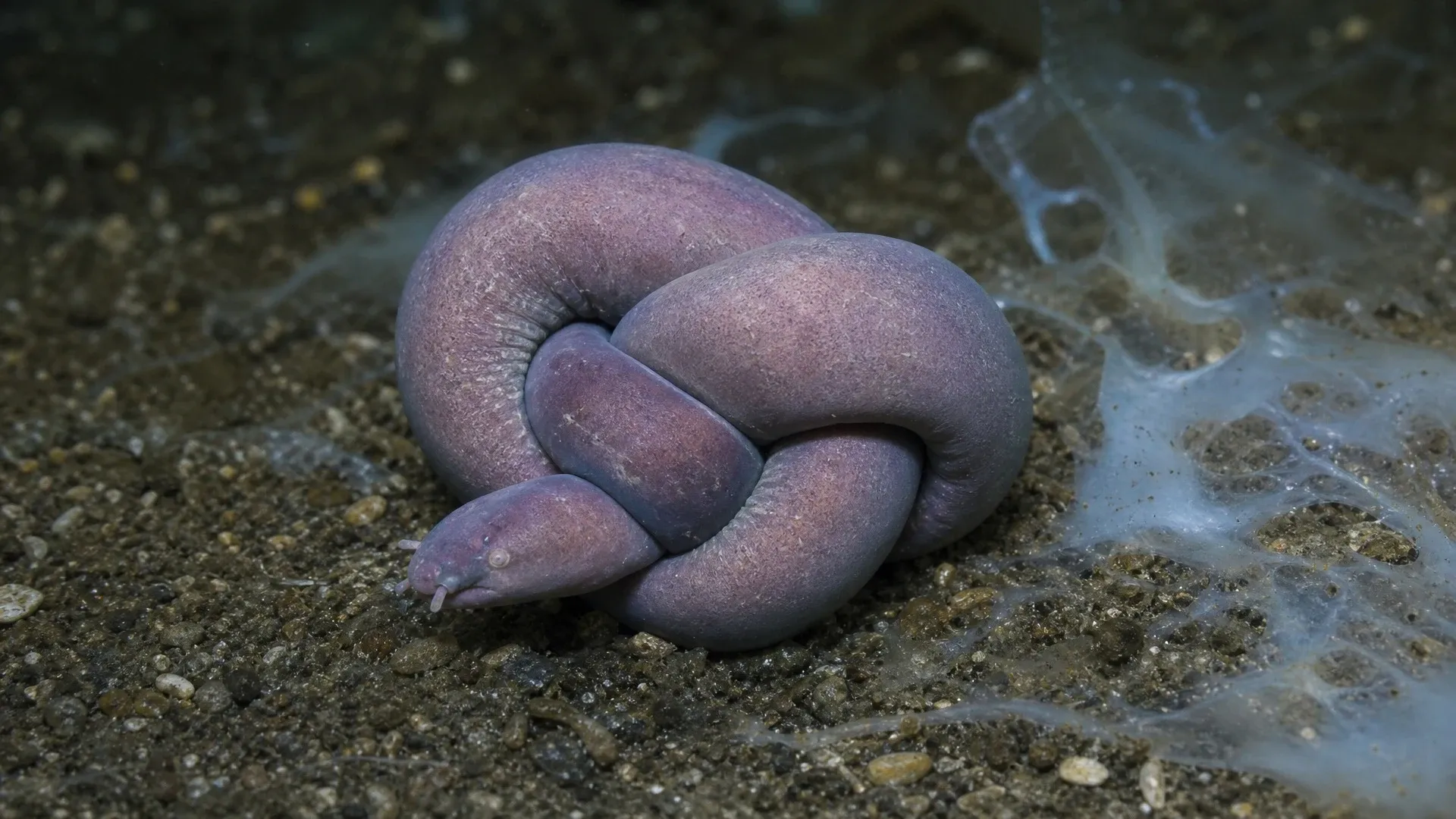
Sliding a body knot from tail toward head works like a moving scraper, removing slime that would otherwise remain on the hagfish.
Knotting is not only cleanup. A hagfish can use the same movement for leverage while feeding or to escape a confined space. It lacks opposable jaws but has keratinous dental plates that grip and rasp. Bracing a knot against food lets the head pull in the opposite direction.
The animal must also manage a limited supply. Experiments in Atlantic and Pacific hagfish found that fully emptied glands took roughly three to four weeks to refill. A localized discharge preserves material in untouched glands for another attack.
An evolutionary material system, not one miracle molecule
Research on hagfish skin suggests that the defense may have developed from ancestral secretions containing both adhesive mucus and protective epidermal threads. Concentrating those cell types inside muscular glands would turn a passive coating into a directed, explosive response.
That history helps explain why the material is difficult to imitate. Its performance does not come from one substance. It depends on compact storage, seawater chemistry, the timing of mucus release, rapid thread deployment, and just enough movement to mix everything without destroying the network.
For engineers, the interesting lesson is efficiency: a tiny mass of stored solids can become a large temporary barrier exactly where it is needed. For the hagfish, the benefit is more immediate. It does not overpower a predator. It briefly changes the hydraulics inside the predator’s mouth until letting go becomes the fastest way to breathe normally again.