Short answer
The answer in plain English
Some tardigrades survive drying by retracting into a compact tun, losing almost all body water, and reducing metabolism until it is nearly undetectable. As the animal dries, protective molecules including CAHS proteins help stabilize membranes and other cell structures. Water can later reverse the process, allowing metabolism and repair to restart. This is a temporary survival state called anhydrobiosis, not death, immortality, or proof that an active tardigrade can tolerate every extreme.
Why it matters
What to understand
A tardigrade's famous toughness depends on timing, species, physical state, and exposure length. The active animal needs a film of water. Drought-tolerant species can prepare for water loss by becoming a tun and locking vulnerable cell structures into a more stable dry state. That same protective toolkit helps explain some resistance to vacuum and radiation, but it has limits. Heat, rapid drying, accumulated damage, and long storage can still kill the animal or prevent recovery.
Visual guide
How the pieces fit together


The survival trick is a controlled pause
Tardigrades are often introduced as animals that can survive anything. The better explanation begins with what they cannot do. An active tardigrade is an aquatic animal, even when it lives in moss that looks dry. It needs a microscopic film of water around its body to walk, feed, exchange gases, and reproduce.
When that film disappears, some species do not remain active and simply endure. They change state before dehydration becomes fatal. The legs pull inward, the head retracts, and the body contracts into a compact, wrinkled form called a tun. As water continues to leave, metabolism falls until it is nearly undetectable. This drought-triggered form of cryptobiosis is called anhydrobiosis.
A tun is not dead and it is not functioning normally. It is a prepared biological system with most ordinary activity suspended, preserving enough structure for life to resume if water returns.
Why drying is more dangerous than emptying a container
Water is not passive cargo inside a cell. Proteins depend on it to maintain useful shapes, membranes depend on it to remain organized, and dissolved substances depend on it to stay at workable concentrations. Rapid water loss can make proteins unfold or clump, membranes leak or fuse, salts concentrate, and reactive molecules damage DNA.
That is why drying an ordinary animal is not like draining a bottle. It removes the medium in which the animal’s chemistry and structures work. A tardigrade must protect those structures while its cells shrink and their contents become crowded.
Some organisms rely heavily on the sugar trehalose for dry-state protection. Several well-studied tardigrades contain little of it. Their alternative toolkit includes antioxidants, repair systems, physical changes in the tun, and unusual proteins found in tardigrades.
CAHS proteins build temporary supports
CAHS stands for cytoplasmic abundant heat-soluble. In a hydrated cell, these proteins are flexible rather than locked into one rigid shape. As water leaves and the proteins become more concentrated, they can assemble into reversible fibers and gel-like networks. Research on CAHS protein assembly suggests that this transition can stiffen cells and slow molecular movement during stress.
In a drier state, CAHS proteins can also contribute to glass-like material that immobilizes vulnerable structures. The point is not to keep the cell operating as normal. It is to restrict damaging movement and preserve organization while normal chemistry is largely paused.
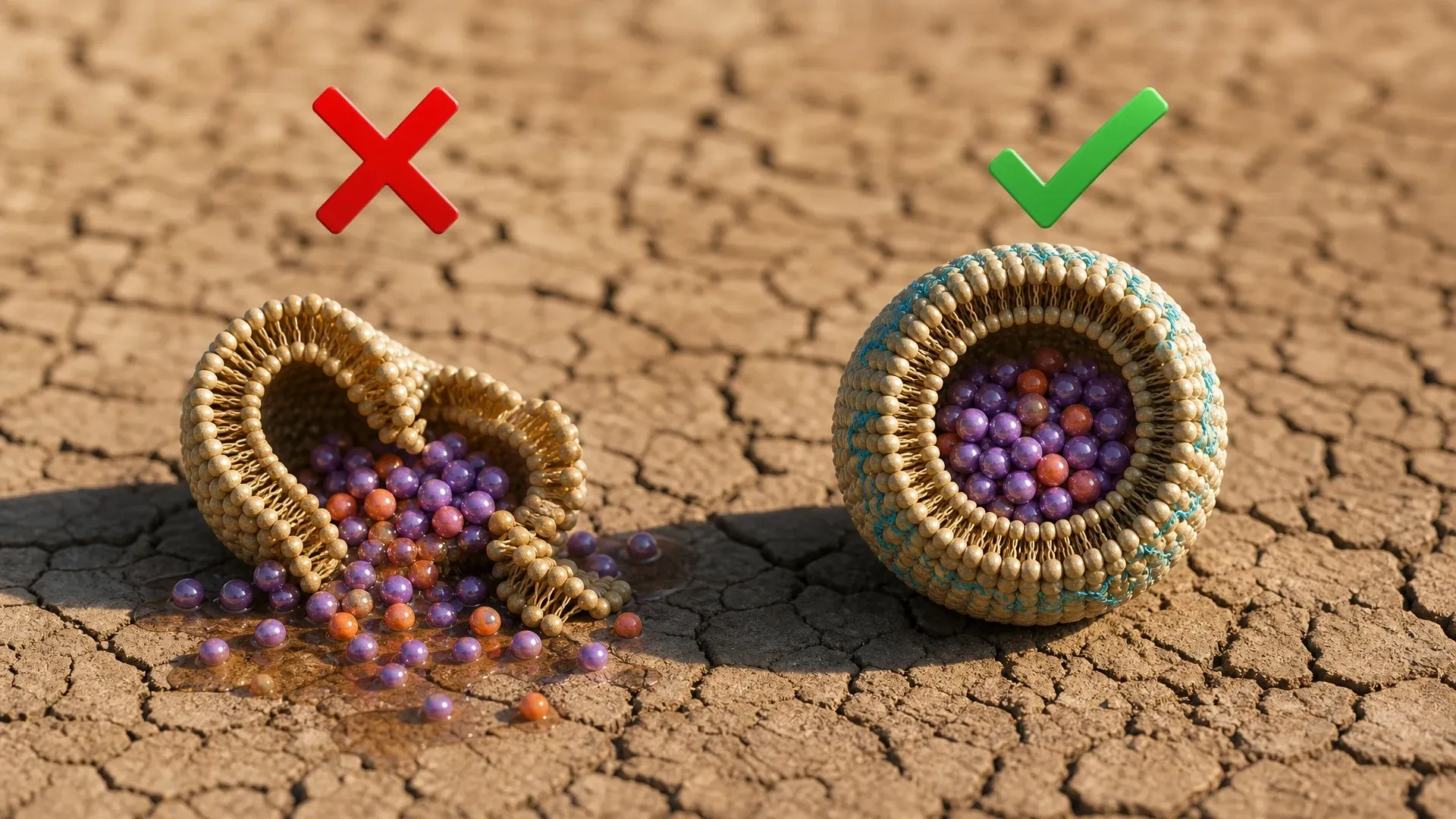
A 2026 synthetic-cell experiment tested how one CAHS protein behaves in model membrane compartments. Under drying stress, the protein changed structure, reinforced the membrane, and helped retain material inside. A synthetic compartment is not a whole tardigrade, so the result does not make one protein a complete explanation. It does show a plausible protective mechanism in a controlled system.
Rehydration reverses the preparation
If water returns under survivable conditions, the tun absorbs it and expands. The legs emerge, protective networks dissolve or reorganize, metabolism restarts, and repair systems address damage accumulated during drying and storage.
This is not resurrection. A dead cell has lost the organization needed to restart. A successful tun preserves that organization in a low-activity state. Recovery can still fail if drying happened too quickly, preparation was incomplete, storage lasted too long, or accumulated damage exceeded the animal’s repair capacity.
Space and radiation reveal the toolkit—not immortality
Dried tardigrades really have survived direct exposure to space. In the 2007 FOTON-M3 mission, dormant animals endured vacuum in low Earth orbit, and some recovered after rehydration. The reported experiment also showed that ultraviolet radiation sharply reduced survival. They endured a limited exposure; they did not crawl, feed, or reproduce in vacuum.
Radiation tolerance also varies by species and condition. One relevant protein is Dsup, short for damage suppressor. It binds to nucleosomes—the structures around which DNA is packaged—and experiments reported by eLife found that it protects DNA from highly reactive hydroxyl radicals.
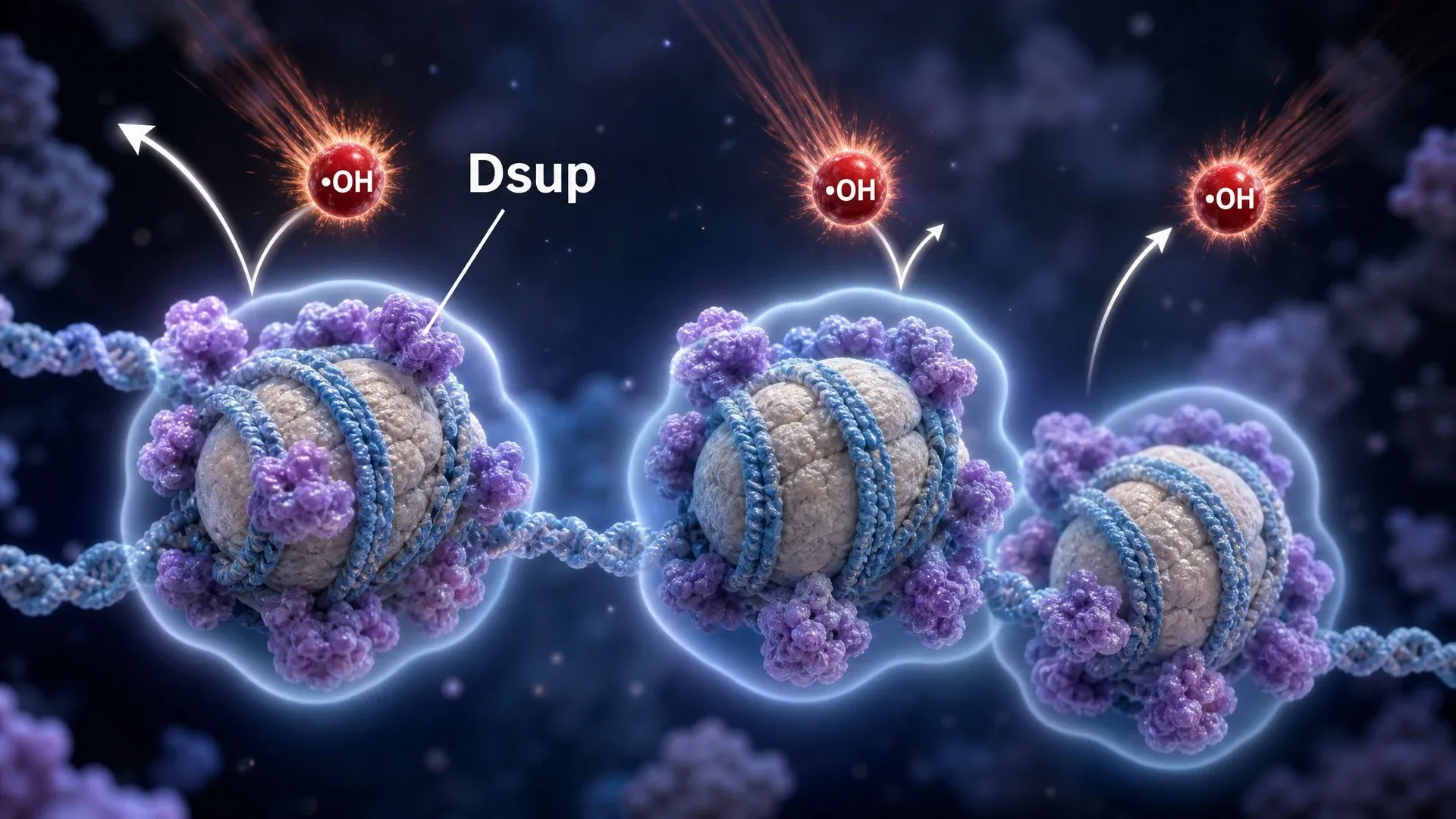
Dsup is not a universal force field. Antioxidants, DNA repair, and other defenses also matter, and different tardigrades do not use identical combinations. Some radiation resistance may be a useful side effect of systems that evolved for drying, because desiccation also creates oxidative stress and DNA damage.
Heat exposes the limits quickly
The strongest correction to the “indestructible” story is heat. In one thermotolerance study, active Ramazzottius varieornatus exposed for 24 hours had an estimated 50% mortality temperature near 37°C. Dry tuns tolerated much higher temperatures for short periods, but their estimated midpoint fell substantially when exposure lasted 24 hours instead of one.
Those results make four details essential whenever an extreme-survival claim appears: the species, whether the animal was active or in a tun, the surrounding humidity, and the exposure time. A short laboratory challenge is not a permanent habitat. Survival does not guarantee fertility or freedom from damage.
The adaptation solves a small, frequent disaster
Tardigrades did not evolve cryptobiosis for spacecraft or radiation machines. The recurring danger was closer to home: the thin water corridor around a grain of soil disappears, moss dries between rainstorms, or a temporary pool freezes or evaporates.
Tun formation buys time, but it creates no energy and no offspring. The animal spends stored resources to preserve a chance of restarting later. Evidence reviewed in a study of long-term anhydrobiosis also shows why spectacular century-long revival stories deserve caution: survival generally declines with storage time, and the best records depend on well-documented conditions.
The accurate version is more interesting than the myth. A tardigrade is not invulnerable. It survives certain extremes by sensing the loss of its watery world, reorganizing before that world disappears, and becoming dry and almost biologically silent until suitable conditions return.