Short answer
The answer in plain English
Cities emerged from a long, branching history rather than one march toward progress. Bipedal hominins appeared millions of years before Homo sapiens; stone tools predate our genus; and human groups survived by sharing knowledge across generations. Agriculture later concentrated food and people, allowing specialization, accounting, institutions, and large settlements. The decisive advantage was cumulative culture: useful ideas could outlive the individual who discovered them.
Why it matters
What to understand
Human evolution resembles a bush with many coexisting species, not a ladder aimed at modern people. Upright walking freed hands but did not instantly produce technology. Tools extended the body, fire and cooperation supported expensive brains, and symbols let information accumulate. Homo sapiens spent most of its existence as hunter-gatherers. Farming began independently in several regions and brought larger populations alongside harder labor, disease, inequality, and administrative demands.
Visual guide
How the pieces fit together


There was no ladder leading to us
A person in a concrete tower is connected to early hominins by roughly seven million years of branching evolution. The path was not a steady climb from primitive ape to modern city. Many human relatives coexisted, adapted in different ways, and disappeared. Evolution had no skyline in mind.
The oldest possible hominins still had small brains and strong climbing adaptations. Sahelanthropus, Orrorin, and later australopiths offer incomplete evidence about how often they stood and walked. By 3.6 million years ago, the Laetoli footprints show a form of upright walking that already looks strikingly familiar.
Bipedalism may have reduced the cost of moving, helped individuals see across open ground, or made carrying food and infants easier. No single explanation accounts for every stage. Useful traits often persist because they solve several problems.
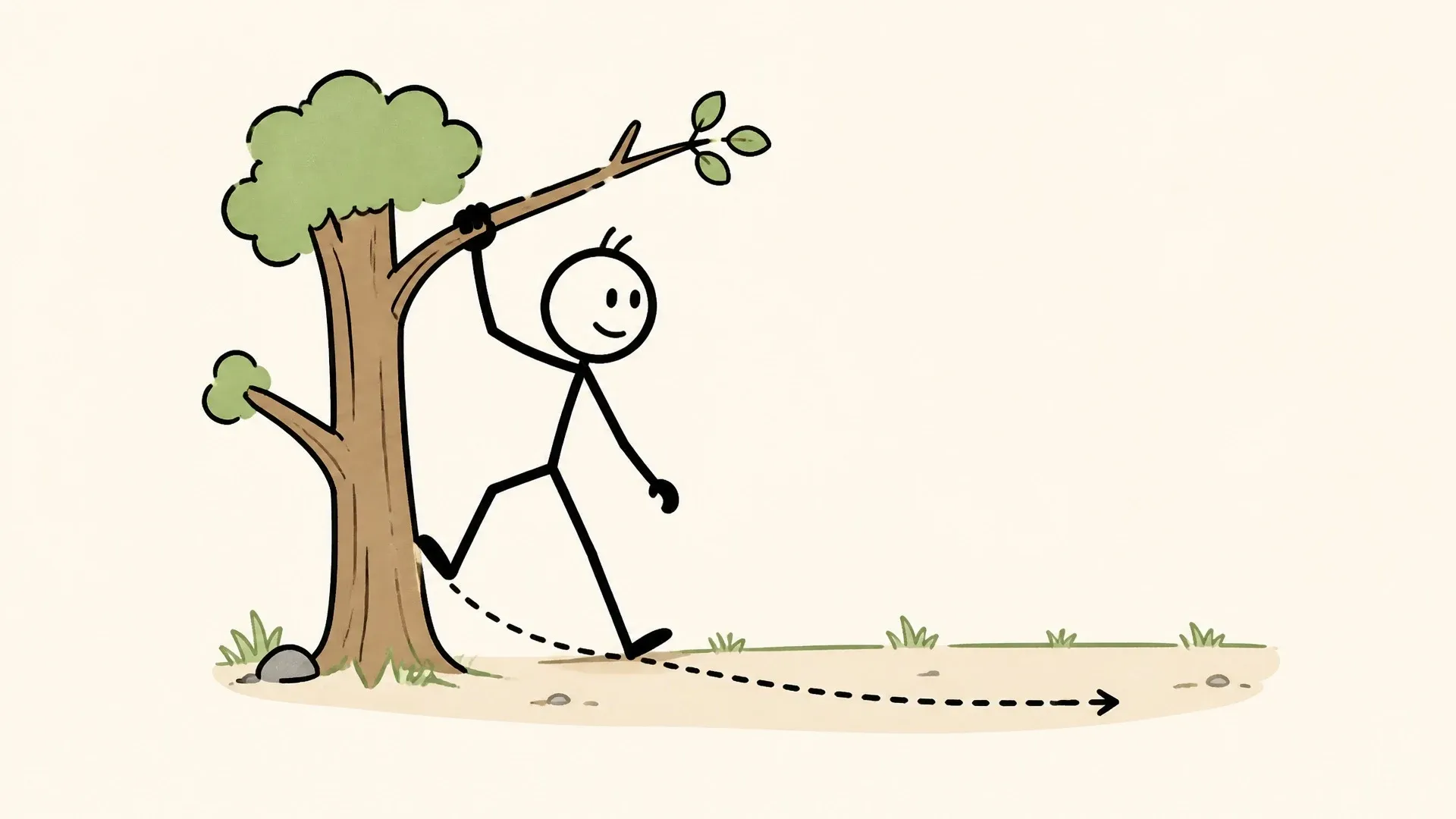
Bipedalism emerged gradually while early hominins still retained useful climbing adaptations.
Tools came before our genus
Free hands did not immediately create systematic technology. Many animals use objects as tools. The consequential change was a growing tradition of selecting materials, making forms, teaching techniques, and depending on the result.
Stone artifacts at Lomekwi in Kenya date to about 3.3 million years ago—older than the earliest known Homo fossils. Later sharp flakes and battered bones show how stone extended the body. A hand can grip and strike; a prepared edge can slice meat, cut plants, and shape wood.
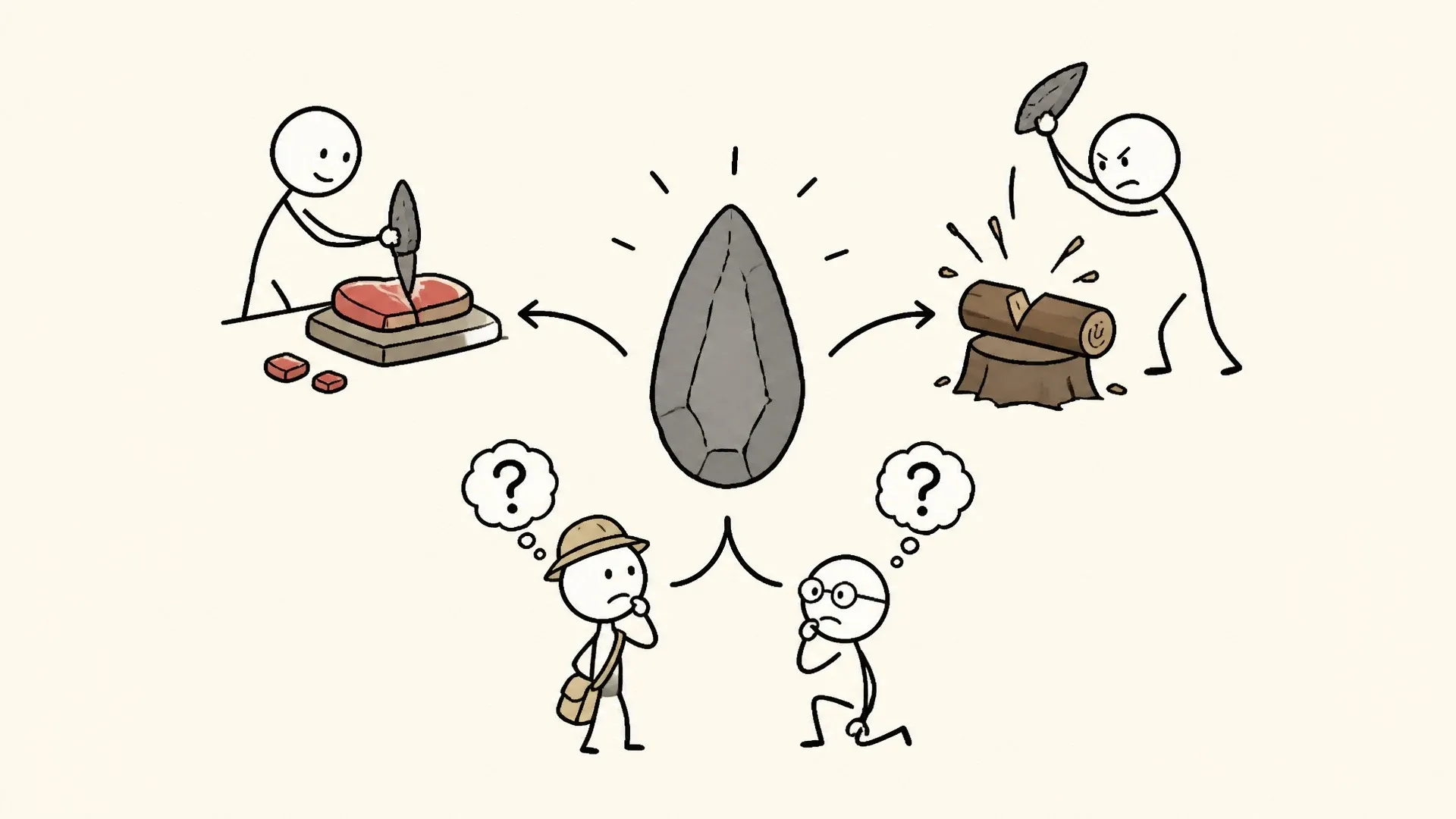
A prepared stone edge extended what hands and teeth could do, even when archaeologists cannot assign one exact purpose.
Homo erectus appeared by around two million years ago with longer legs and a body better suited to sustained travel. Populations spread beyond Africa into parts of Eurasia, probably following water, food, and usable habitat rather than setting out on a conscious continental migration.
Acheulean handaxes required controlled sequences of strikes and some idea of a desired shape. Fire eventually added warmth, protection, food processing, and a place for groups to gather. The timing of regular fire control remains debated, which is a useful reminder that archaeological timelines are estimates built from scarce preservation.
Brains worked because groups did
Larger brains consume a great deal of energy. Human children also remain dependent for an unusually long time. Those costs make sense only inside a social system that shares food, protection, teaching, and care.
Brain size alone does not explain human success. Neanderthals had brains as large as ours on average. The powerful combination included memory, dexterous hands, planning, cooperation, language, and social learning. Knowledge could be spread across the group rather than stored in one exceptional individual.
Homo sapiens emerged in Africa roughly 300,000 years ago. Fossils at Jebel Irhoud in Morocco combine modern-looking faces with more archaic braincase shapes. They fit a picture in which populations across Africa separated, reconnected, and changed over time—not one fully formed species appearing at a single point.
Our species also met and interbred with other humans. Neanderthal and Denisovan ancestry survives in many people today. The family tree repeatedly reconnects where older diagrams drew clean branches.
Symbols made knowledge cumulative
Pigments, beads, engravings, specialized tools, exchange networks, and burials appear at different places and dates. There was no morning when behavior suddenly became modern. Symbols gradually made identities and absent things discussable. Language let a warning, route, technique, or story survive the person who learned it first.
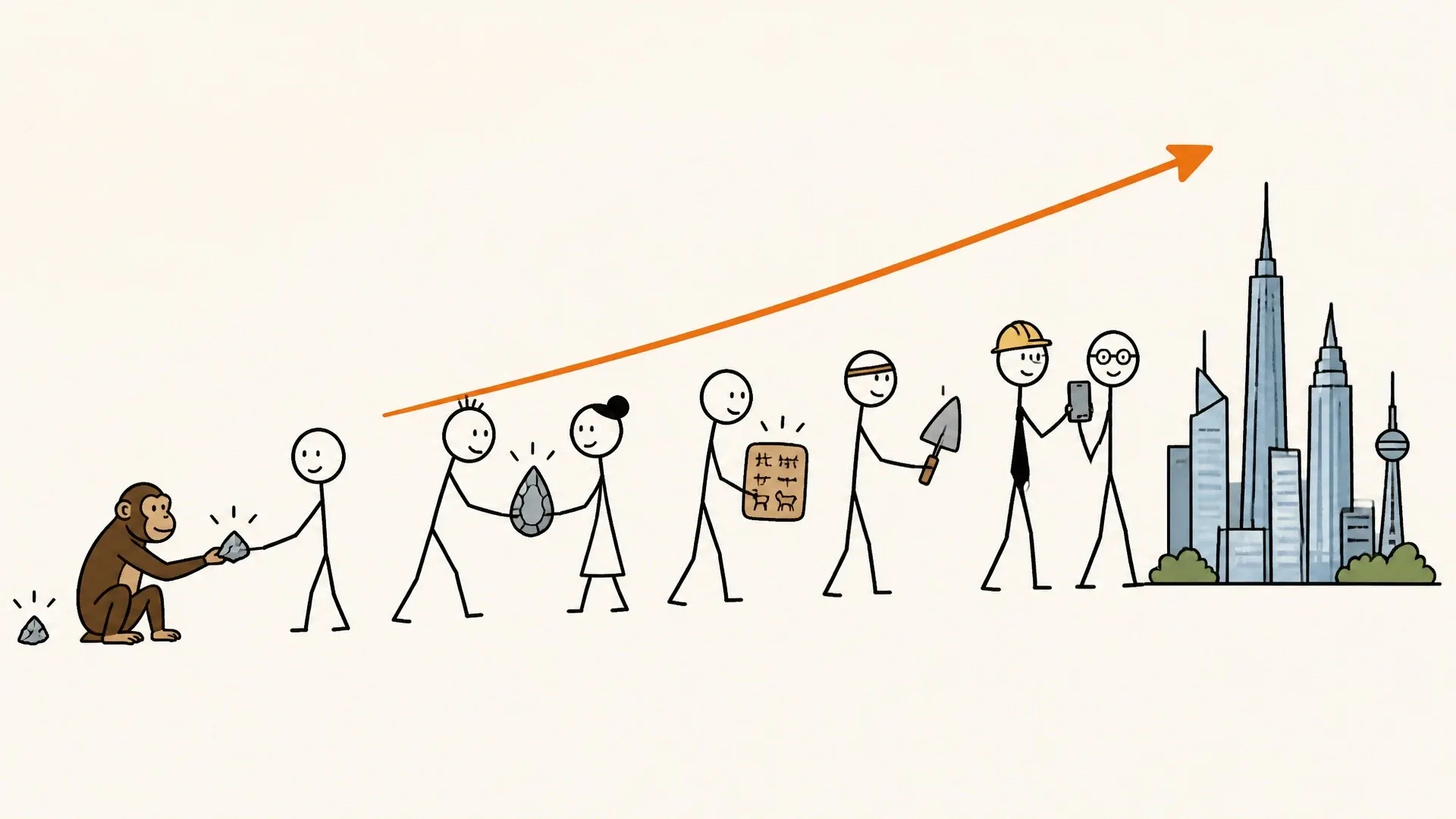
Cumulative culture lets each generation begin with more shared knowledge than one person could discover alone.
This is how a tropical primate entered deserts, cold grasslands, islands, mountains, and eventually Arctic environments without waiting for genes to grow a new body each time. Clothing, shelter, fire, boats, and social networks moved faster than biological adaptation.
Farming was a trade, not an upgrade button
For most of Homo sapiens’ history, people hunted, gathered, fished, and managed wild resources with detailed ecological knowledge. Beginning roughly 12,000 years ago, some communities relied more heavily on cultivated plants and managed animals. Agriculture developed independently in several regions rather than spreading from one inventor.
Farming could support larger, denser populations and stored surpluses. It also brought repetitive labor, crop-failure risk, infectious disease, inequality, and disputes over land. Permanent settlements required storage, coordination, rules, and accounting. Surplus supported builders, potters, traders, priests, soldiers, and administrators who did not all produce food directly.
By the late fourth millennium BCE, Uruk in southern Mesopotamia had monumental buildings, extensive trade, specialized work, and early written records. Much of the surviving writing concerns goods and rations. After millions of years, writing’s early urban job was inventory.
Compress seven million years into one calendar and Homo sapiens appears only in the final weeks; farming and cities arrive in the last hours. Urban life did not erase ancient human nature. It scaled the same hands, cooperation, status sensitivity, curiosity, and knowledge-sharing until stone flakes became institutions and skylines.