Short answer
The answer in plain English
Fona was probably adapted to spend part of its life underground, although no definite Fona burrow has been found. Expanded muscle attachments around its shoulders, a reinforced pelvis, powerful hind limbs, and compact clusters of articulated skeletons all fit a semi-fossorial animal. Each clue is inconclusive alone; the case comes from their agreement.
Why it matters
What to understand
Fona was a dog-sized plant-eating dinosaur from Cretaceous Utah, not a mole-shaped specialist. Its skeleton suggests it could move soil, while its unusually complete and tightly grouped remains suggest rapid burial in protected spaces. Paleontologists therefore describe it as semi-fossorial and keep stronger claims—such as shared dens or family groups—open.
Visual guide
How the pieces fit together


The strongest answer is a combination, not a smoking gun
No fossil comes with a label saying what its owner did. For Fona herzogae, there is not even an unmistakable tunnel surrounding the bones. The argument that this small Cretaceous dinosaur spent time underground is built differently: several anatomical traits point toward moving soil, and an unusual preservation pattern suggests that bodies were buried in confined, protected spaces.
That distinction matters. Paleontologists are not claiming that one oversized claw proves a burrowing lifestyle. Fona did not have the exaggerated forelimbs of a mole, and it was still a long-legged animal able to travel and feed above ground. “Semi-fossorial” is the useful term: digging and underground sheltering were probably important parts of its life without defining every hour of it.
Fona lived on a wet Utah floodplain
Fona was a dog-sized, plant-eating ornithischian that lived roughly 99 million years ago. Its fossils come from the Mussentuchit Member of the Cedar Mountain Formation in Utah, rocks formed near the beginning of the Late Cretaceous.
The setting was not the exposed red landscape visitors see in Utah today. Rivers crossed a warm floodplain, with wet ground, vegetation, and repeated sediment movement. Fona shared that environment with larger herbivores and predators. An underground refuge could have offered shelter from heat, storms, floods, or attack, but the fossils do not identify one particular reason for digging.
The shoulder records the pull of missing muscles
Muscle rarely survives as a fossil, so researchers study the surfaces where it attached. Fona’s shoulder girdle and upper arm had expanded ridges and roughened areas associated with strong muscles. Those muscles could have drawn the arm backward—the useful part of a scratch-digging stroke that rakes loosened soil away from the body.
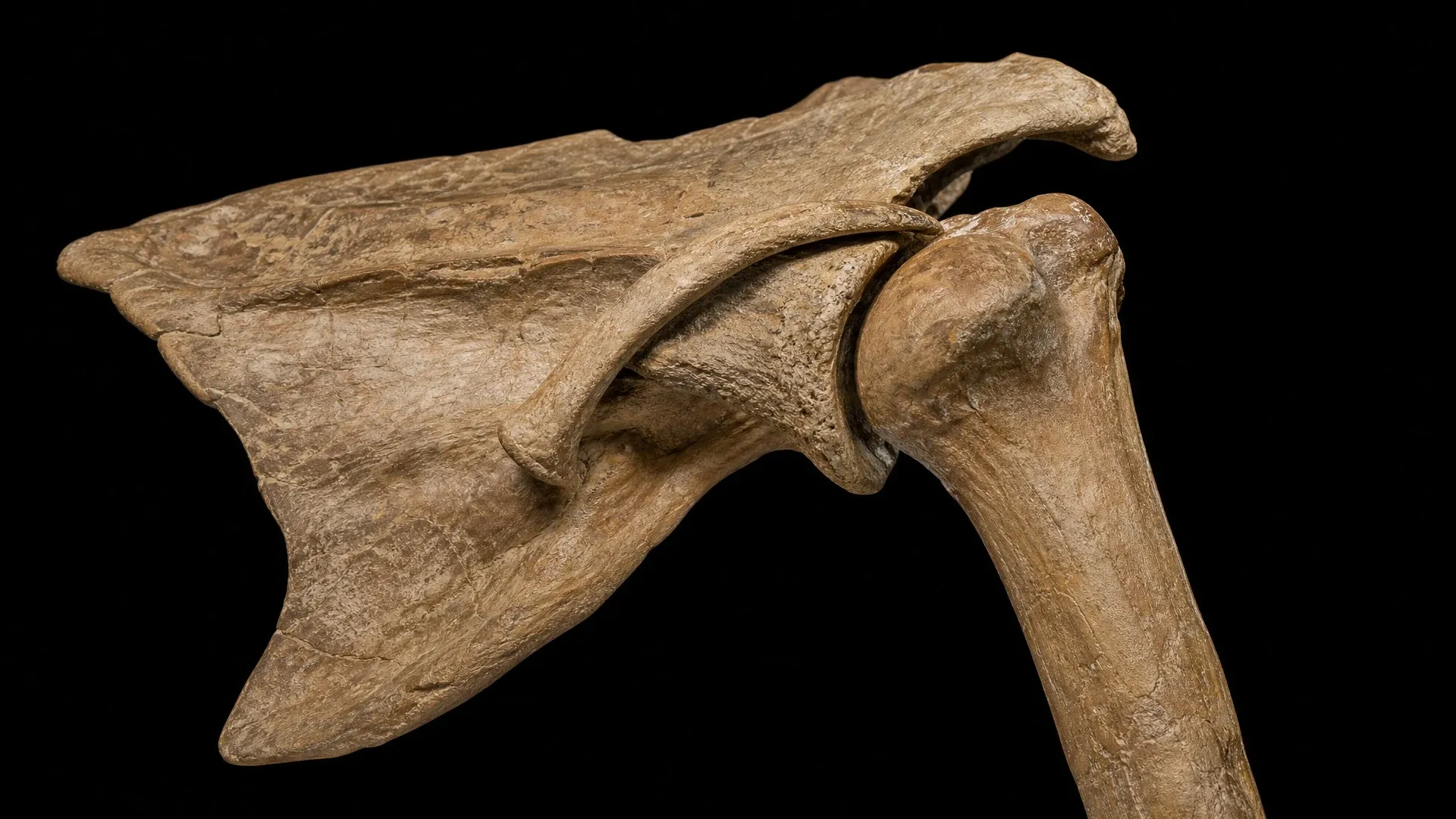
Shoulder and upper-arm attachment surfaces help researchers reconstruct how strongly the forelimb muscles could pull during a digging stroke.
Strong arms are supporting evidence, not a verdict. The same region of the skeleton can be shaped by locomotion, feeding, defense, or other repeated loads. The more persuasive question is whether the rest of the body forms a coherent digging system.
Fona’s pelvis adds that second line of evidence. Several pelvic parts were fused, and the vertebrae attached to the hips formed a broad, reinforced unit. A rigid trunk and pelvis would help transmit force instead of twisting while an animal pushed against packed soil. Large muscle attachments around the hips and lower legs, combined with relatively large hind feet, suggest that the rear limbs may also have helped shift earth.
This is a less familiar body plan than a front-heavy badger. It is not mechanically impossible: living two-legged animals can kick or rake soil backward with their hind feet. The comparison shows a workable motion, not a frame-by-frame reconstruction of Fona’s behavior.
Why researchers stop short of calling it subterranean
Some features pull the interpretation in the other direction. Fona’s forelimbs were relatively short, its elbows did not show every trait expected in an extreme digging specialist, and stiffening structures along the back and tail may have made narrow turns awkward. Its long tail and runner-like proportions still belonged above ground.
A shelter does not have to be a tight, permanent tunnel. A short sloping passage, a widened chamber, or an enlarged opening could suit an animal that foraged outside and retreated below when needed. This middle ground explains why semi-fossorial is more precise than either “ordinary surface dinosaur” or “dinosaur mole.”
The skeletons may preserve the missing shelter indirectly
Small, delicate skeletons usually come apart quickly on an open floodplain. Scavengers disturb them, water sorts the bones, and weather breaks exposed material down. Fona is unusual because several specimens preserve connected sections, compact body-sized patches, or multiple individuals close together.
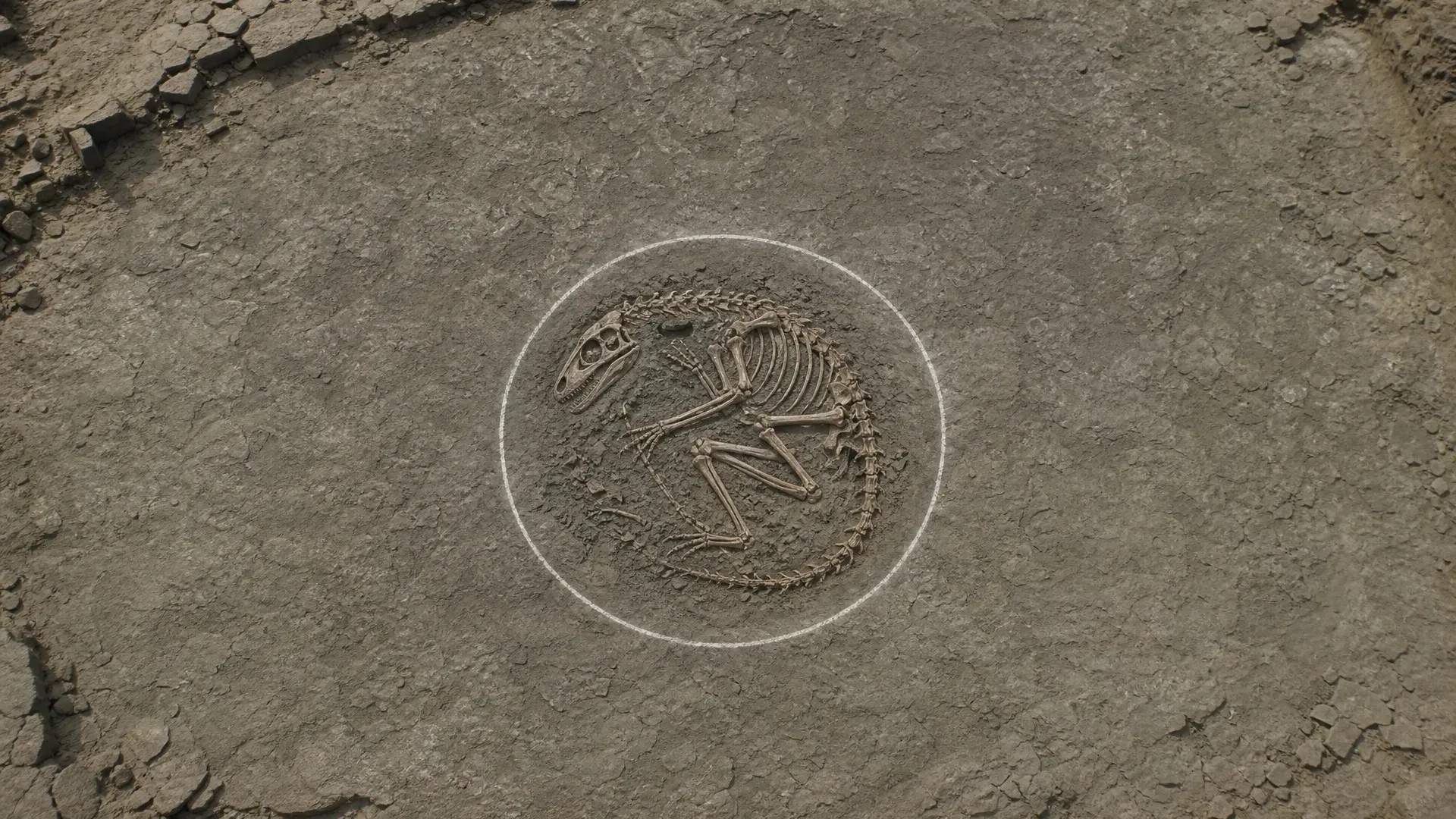
Connected bones concentrated in a small area are easier to explain if burial happened before scavengers, water, and weather scattered the body.
One especially complete animal was preserved chest-down with the forelimbs spread beside it. The posture does not show the animal actively digging. It does imply that burial happened before the body was widely disturbed. A collapsed chamber or sediment-filled den could protect a carcass and keep its bones together.
That possibility fits the broader mechanics of how dinosaurs become fossils: rapid burial interrupts the destruction that normally removes or scatters a small body. In Fona’s case, the animal’s own shelter may have created a better path into the fossil record.
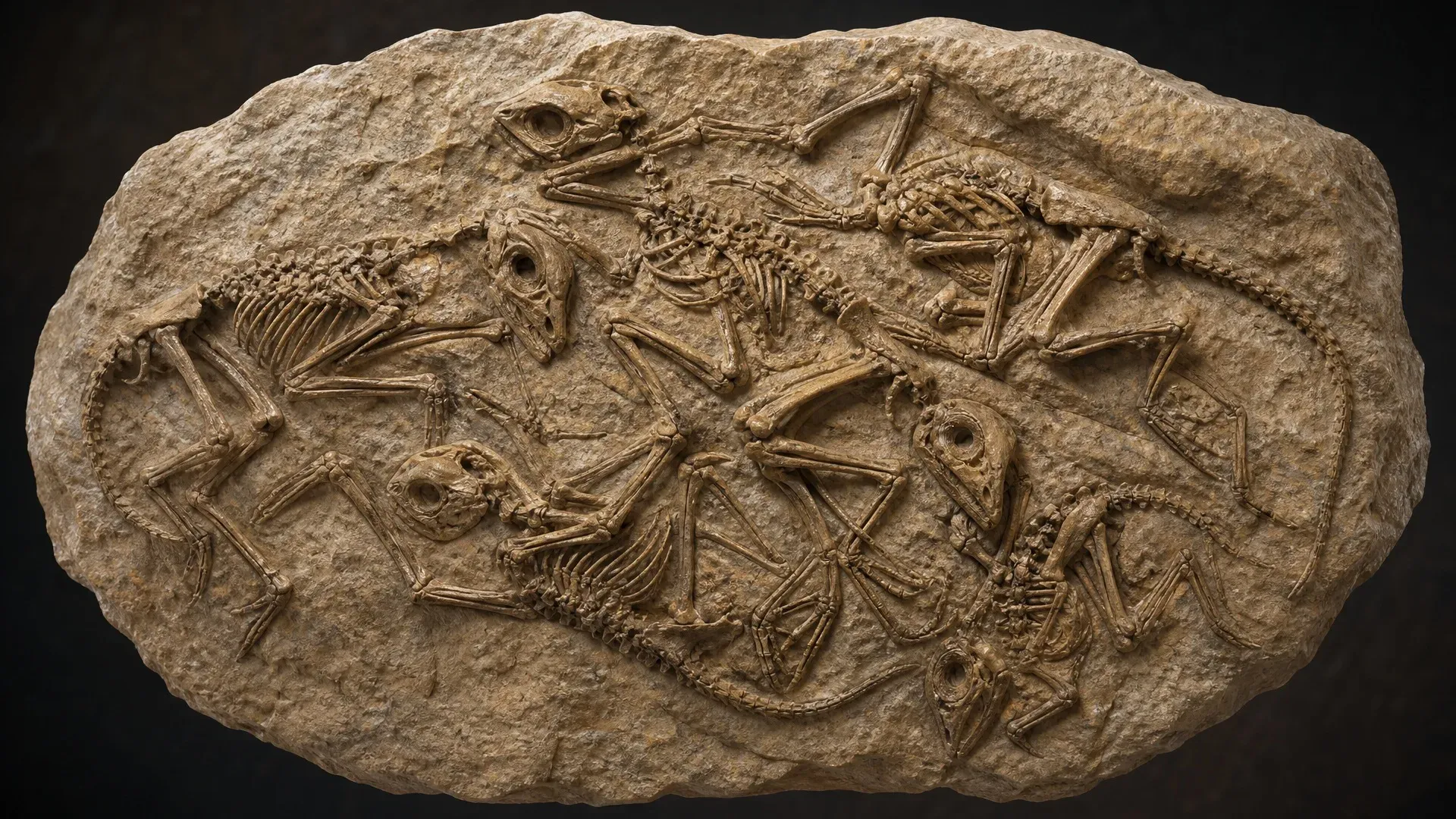
Repeated tight groupings invite a shelter interpretation, but they do not by themselves prove social behavior or a shared den.
The vanished outline of a burrow remains the central uncertainty. Floodplain sediment can be churned, compressed, and altered until a chamber wall disappears. Yet clustered remains can also form through water transport or repeated use of one place for reasons unrelated to shelter. Preservation supports the burrowing case because it agrees with the anatomy, not because it excludes every alternative.
A relative provides the direct comparison
Fona’s close relative Oryctodromeus supplies evidence that small ornithischian dinosaurs really could occupy burrows. An adult and two juveniles were found in the expanded chamber of a fossil tunnel in Montana. Fona shares relevant pelvic reinforcement and limb-muscle adaptations with that relative.
Evolutionary proximity makes the comparison informative, but it does not transfer behavior automatically. It establishes that burrowing was possible within this branch of dinosaurs. Fona’s own anatomy and preservation still have to support the conclusion independently—and they do, with appropriate caution.
What the evidence cannot tell us yet
Several appealing stories remain open. Closely grouped animals might have shared shelters, formed family groups, or entered the same space at different times. Fona may have excavated a complete tunnel, enlarged a natural opening, or reused another animal’s den. Its shelter might have reduced heat, predator, flood, or storm risk.
None of those details is settled. The defensible conclusion is narrower and more useful: Fona had a body capable of forceful interaction with the ground, and its remains repeatedly entered the fossil record in ways compatible with protected underground spaces. Anatomy describes capability. Preservation records circumstance. A burrowing relative shows precedent. Together they make semi-fossorial behavior the best current explanation without pretending that the missing burrow has been found.
