Short answer
The answer in plain English
A dinosaur becomes a fossil only if destruction is interrupted early, usually by rapid burial. Sediment shields some hard tissue, groundwater can add minerals to bone pores, and the surrounding deposit eventually becomes rock. The fossil must then survive pressure, chemistry, uplift, and erosion long enough to be exposed and recognized. Most dinosaurs miss at least one link in that chain.
Why it matters
What to understand
Fossilization is not a timer that automatically turns bone into stone. It is a selective sequence that starts with what happens to a carcass, continues through burial and mineral change, and ends with a narrow discovery window at the surface. That sequence also biases the fossil record toward hard parts, certain habitats, and unusually favorable events.
Visual guide
How the pieces fit together


Fossilization starts by interrupting destruction
Time does not preserve a dinosaur by itself. Left at the surface, a carcass is pulled apart by scavengers, consumed by microbes and insects, weathered by sunlight and rain, and scattered by water. Even bone eventually cracks, dissolves, or is ground into fragments.
A fossil therefore begins with an interruption. Mud, sand, ash, or a debris flow has to cover at least part of the animal before ordinary destruction removes it. Rapid burial is especially helpful because it hides remains from surface weather and many scavengers. It may also change the oxygen and chemistry around the carcass. But burial is a better chance, not a guarantee.
This is why the fossil record is selective from its first moment. An animal that dies in a depositional setting—a river channel, floodplain, lake margin, dune field, or ash fall—has better odds than one left on exposed upland ground. Hard teeth and bones usually outlast skin, organs, and muscle. Exceptional soft-tissue fossils exist precisely because the required conditions are unusual.
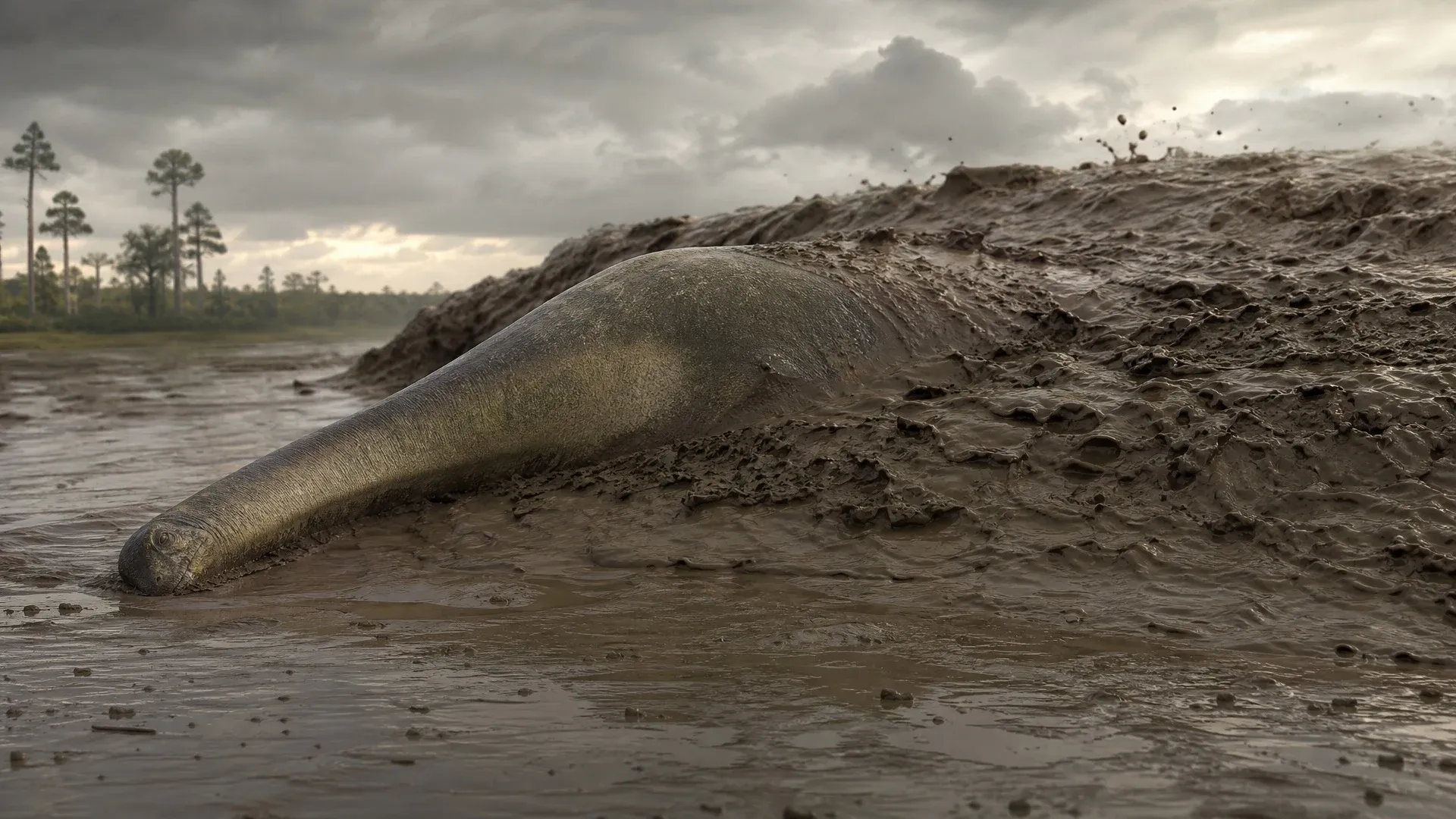
Burial must arrive before weather, scavengers, and decay dismantle the remains; even then, preservation is only beginning.
The mess around a skeleton is evidence
Taphonomy is the study of what happens from an organism’s death through burial and discovery. It turns an incomplete or disordered skeleton from a disappointment into a record of events.
A river can pull limbs from a torso and sort bones by size or density. Scavengers may leave tooth marks. Sun-exposed bone develops weathering cracks. The direction and abrasion of fragments can indicate transport. A nearly articulated skeleton and a mixed bone bed may contain the same species, yet describe very different journeys.
Context matters as much as the specimen. Paleontologists record a fossil’s position, orientation, rock layer, and relationship to nearby remains because removing a bone without that information erases part of its history.
The Late Jurassic Morrison Formation offers a useful example. At Dinosaur National Monument, river activity accumulated bones in a channel deposit. More than 1,500 bones are visible in the quarry wall, but they are not a frozen herd. Separated elements, scavenging evidence, and the mixture of animals show a deposit assembled through decay, transport, and burial over time.
Bone and sediment change together
After burial, more sediment accumulates. Pressure compacts the layers, while minerals carried by water cement grains together. Loose mud, silt, and sand become sedimentary rock around the remains.
Bone already contains mineral crystals, but it is not solid throughout. Microscopic spaces once held blood vessels and living tissue. Groundwater can move through those pores and deposit additional minerals. This process—permineralization—may make the fossil denser while preserving its three-dimensional structure and even details of the original tissue architecture.
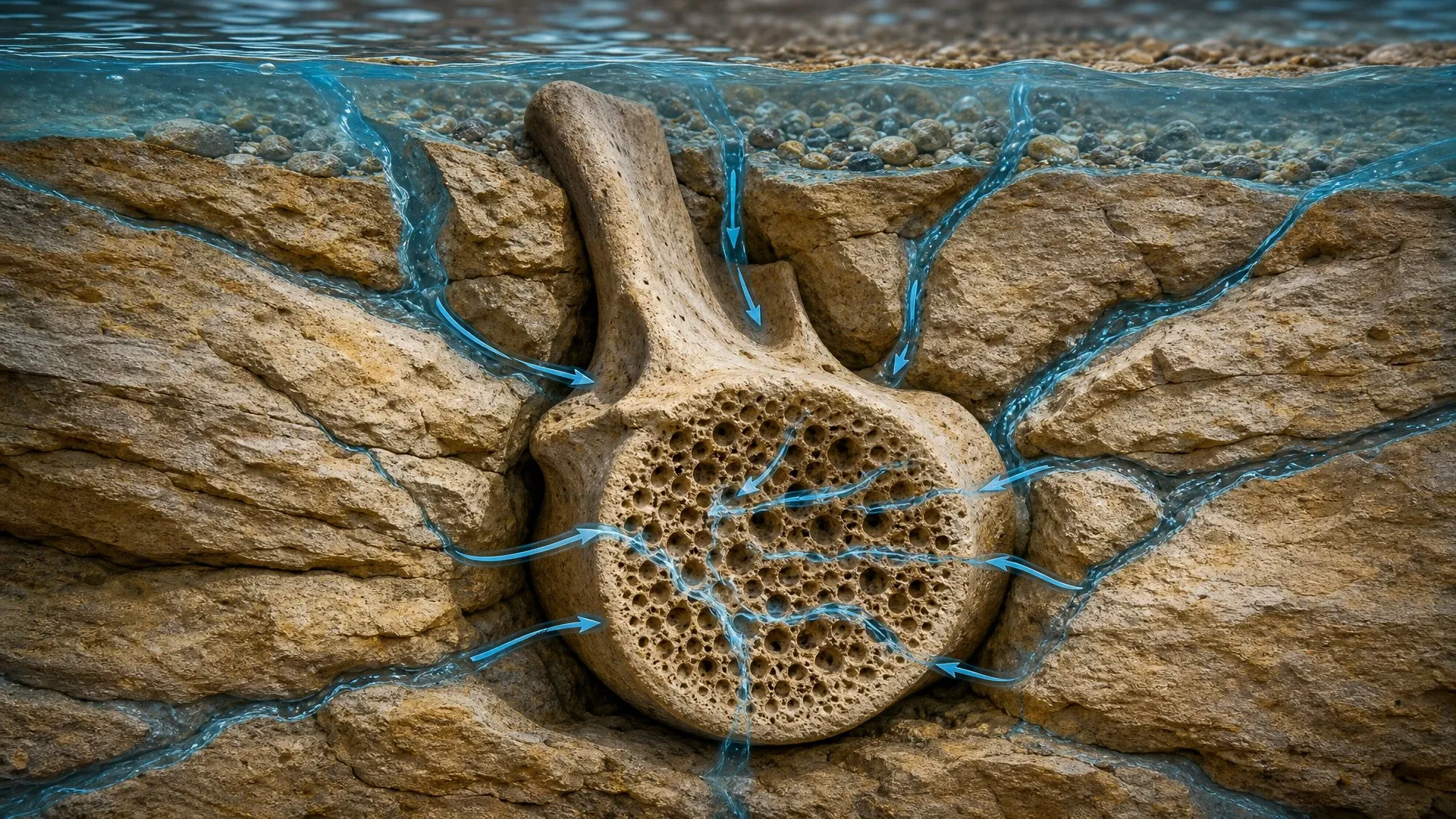
Mineral-bearing groundwater can move through bone pores and leave crystals inside them without replacing every part of the original bone.
Permineralization is often confused with replacement. They are not identical. Permineralization adds minerals to open spaces; replacement happens when original material dissolves and another mineral takes its place. Both can occur in one specimen, but a fossil is not necessarily a bone-shaped rock in which every original molecule has vanished.
Those surviving structures can remain biologically useful. Researchers can examine fossil bone microstructure to reconstruct how dinosaurs grew. Color, by contrast, usually reflects surrounding minerals and sediment rather than the animal’s appearance in life.
Burial can preserve, distort, or erase
The underground stage creates new hazards. Pressure can flatten a delicate skeleton. Groundwater may dissolve bone and leave a hollow mold; later sediment or mineral deposits can fill that cavity to form a natural cast. Deeper burial can expose rock to heat and pressure strong enough to damage microscopic features or destroy the fossil entirely.
This is also why museum fossils may be heavy, cracked, or distorted rather than pristine bones. Our guide to original fossils and museum casts explains why exhibitions sometimes use replicas while keeping the altered original available for research.
Not every fossil preserves a body. A footprint begins as an impression in soft ground while the dinosaur is alive. If the surface firms before another layer covers it, the track may survive as a mold or a filled cast. Nests, eggs, burrows, bite marks, and coprolites can preserve behavior that no skeleton records.
Sometimes the trace itself disappears while the body preserves an indirect clue. The compact skeletons of Fona, a dinosaur adapted for life underground, show how anatomy and burial context can support a burrowing interpretation even without a definite tunnel around the bones.
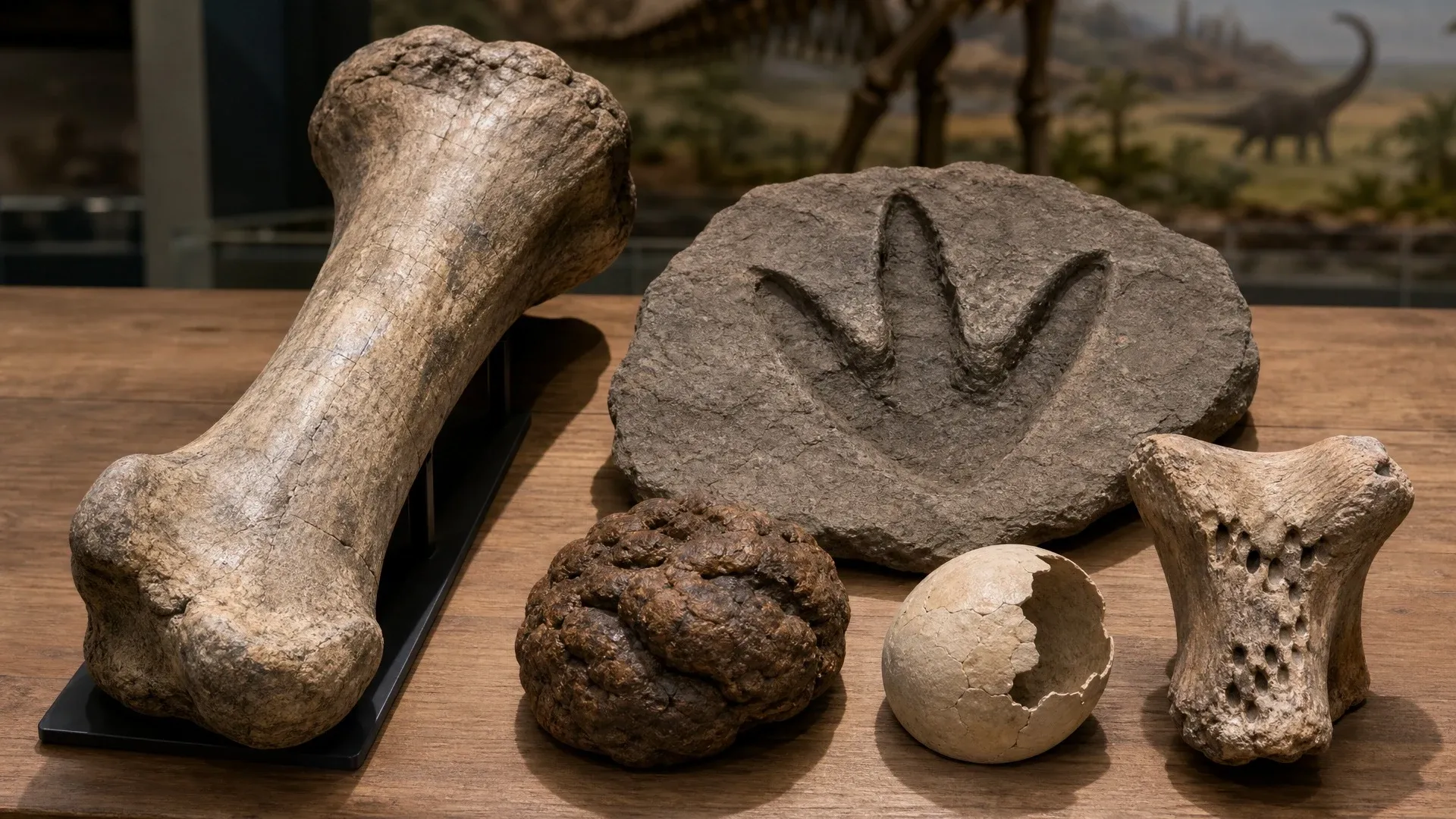
Body fossils preserve anatomy; trace fossils such as tracks, eggs, burrows, and coprolites preserve activity and behavior.
Discovery requires a narrow surface window
A well-preserved fossil can remain inaccessible for millions of years. Tectonic uplift may raise and tilt the sedimentary layers. Rain, rivers, wind, ice, and temperature changes then strip away overlying rock.
Erosion helps and threatens at the same time. Too little leaves the fossil hidden. Enough exposes an edge. Too much breaks it apart and carries it away. Paleontologists use geology to search rocks of the correct age and environment, then examine exposed surfaces for fragments emerging from an outcrop.
Once found, a large specimen may be removed inside a plaster-and-fabric field jacket with some surrounding rock intact. In the laboratory, preparators open the jacket, remove matrix gradually, stabilize fractures, and document features that were invisible in the field. The scientific object is not just the cleaned bone; it is the bone plus its location, surrounding geology, preparation record, and comparison with other specimens.
The same preservation logic appears in other landscapes. In the Cretaceous Gobi, water and sudden sediment movement created very different burial opportunities within a region often reduced to the word “desert.” Habitat and geology decide which deaths have any chance to enter the record.
Every fossil records two histories
A dinosaur fossil tells us something about an animal, but it also records the improbable path that made evidence survive: destruction slowed, burial arrived, mineral and sediment changes preserved useful structure, later geology returned the rock toward the surface, and someone recognized it before erosion finished the job.
That filter shapes everything paleontologists can count. The absence of a fossil does not prove an animal was absent, and a spectacular deposit does not represent an unbiased census. Fossils are rare survivors of a long sequence—not ordinary remains that simply became old enough.


