Short answer
The answer in plain English
An AI image generator converts a prompt into numerical conditioning, starts from random noise, and repeatedly predicts how that noisy state should change to better match patterns learned during training. In many current systems, this denoising happens in a compressed latent space rather than directly in full-resolution pixels. The prompt guides the direction of each step, while the seed supplies the initial randomness, so the same words can produce different compositions.
Why it matters
What to understand
Diffusion models learn the reverse of a deliberate noising process. At generation time, they begin with noise and take a sequence of denoising steps. A text encoder represents the prompt, cross-attention connects words to image features, and guidance strengthens the difference between a prompt-conditioned prediction and a less-conditioned one. The model is sampling a plausible image, not uncovering a hidden picture or following a pixel-perfect instruction.
Visual guide
How the pieces fit together


The image is built, not revealed
A diffusion image generator does not search a database for the closest picture, and it does not find a castle already concealed inside television static. It starts with a random numerical state and repeatedly transforms it. Each step makes the state a little more consistent with patterns the model learned and with the text or other controls supplied for this run.
That distinction explains both the power and the unreliability. The system can combine familiar visual relationships into a new composition, but it is choosing among plausible possibilities. It is not executing a specification with the certainty of a graphics program.
Training teaches a denoising problem
The core training idea is easier to understand in the forward direction. Take a real training image and add a small amount of random noise. Repeat until its structure is almost gone. Because the training process knows how much noise was added, a neural network can be taught to predict that disturbance at different noise levels.
Generation runs the learned process in the other direction. It begins from noise, predicts a cleaner state, takes a step toward it, and repeats. Early steps settle broad composition: where the main masses, horizon, or subject might be. Later steps resolve edges, textures, lighting, and small features.
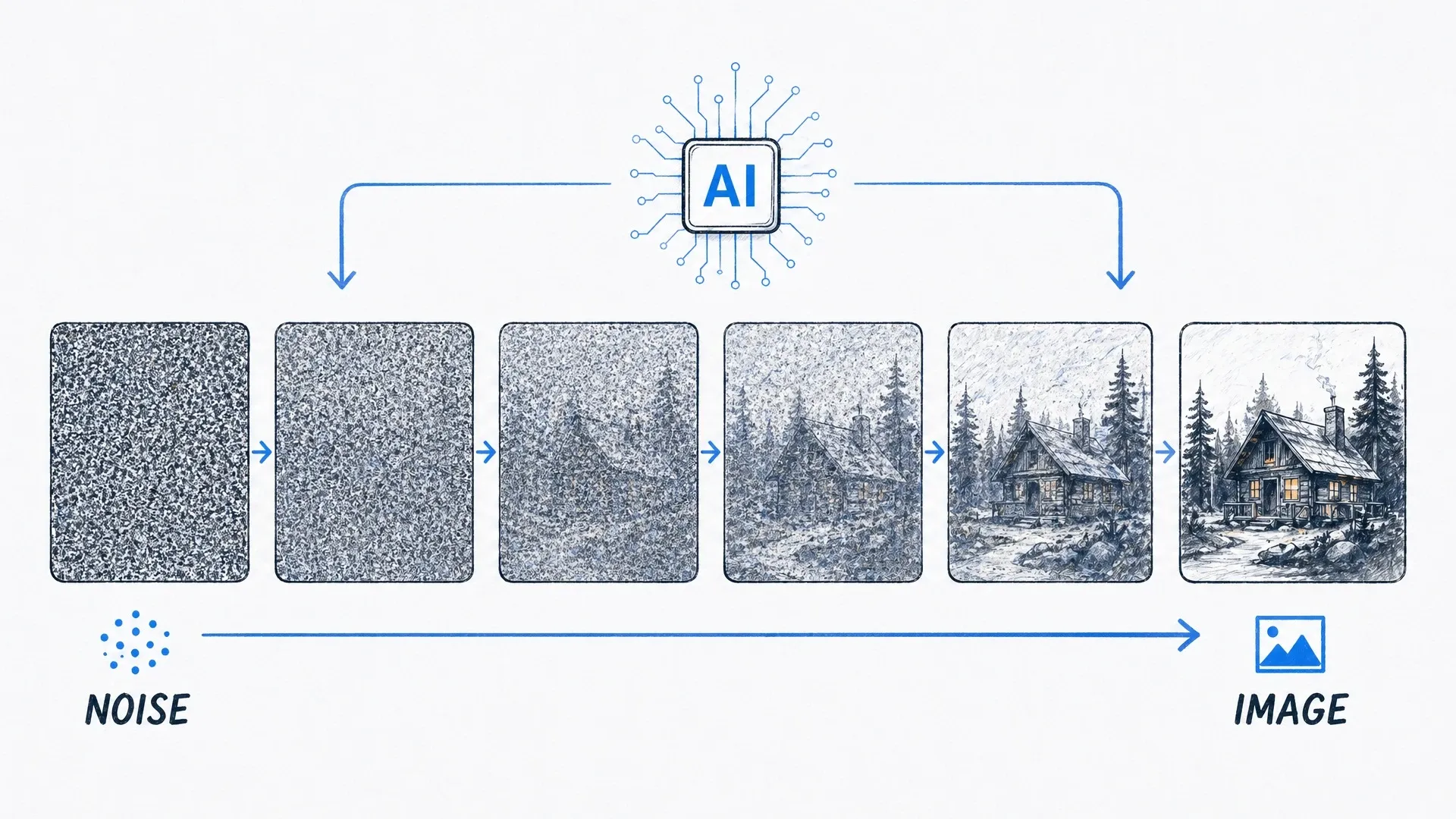
Sampling begins with noise and moves through many intermediate states; no finished picture is concealed in the first frame.
The original denoising diffusion paper formalized this as a probabilistic generative process. A practical tool may use a different sampler or a reduced number of steps, but the useful mental model remains sequential refinement rather than a single act of drawing.
The prompt becomes conditioning
Text first passes through an encoder that represents words and their relationships as numbers. Those numbers do not amount to a dictionary definition of every term. They locate the prompt within relationships learned from paired language and visual data.
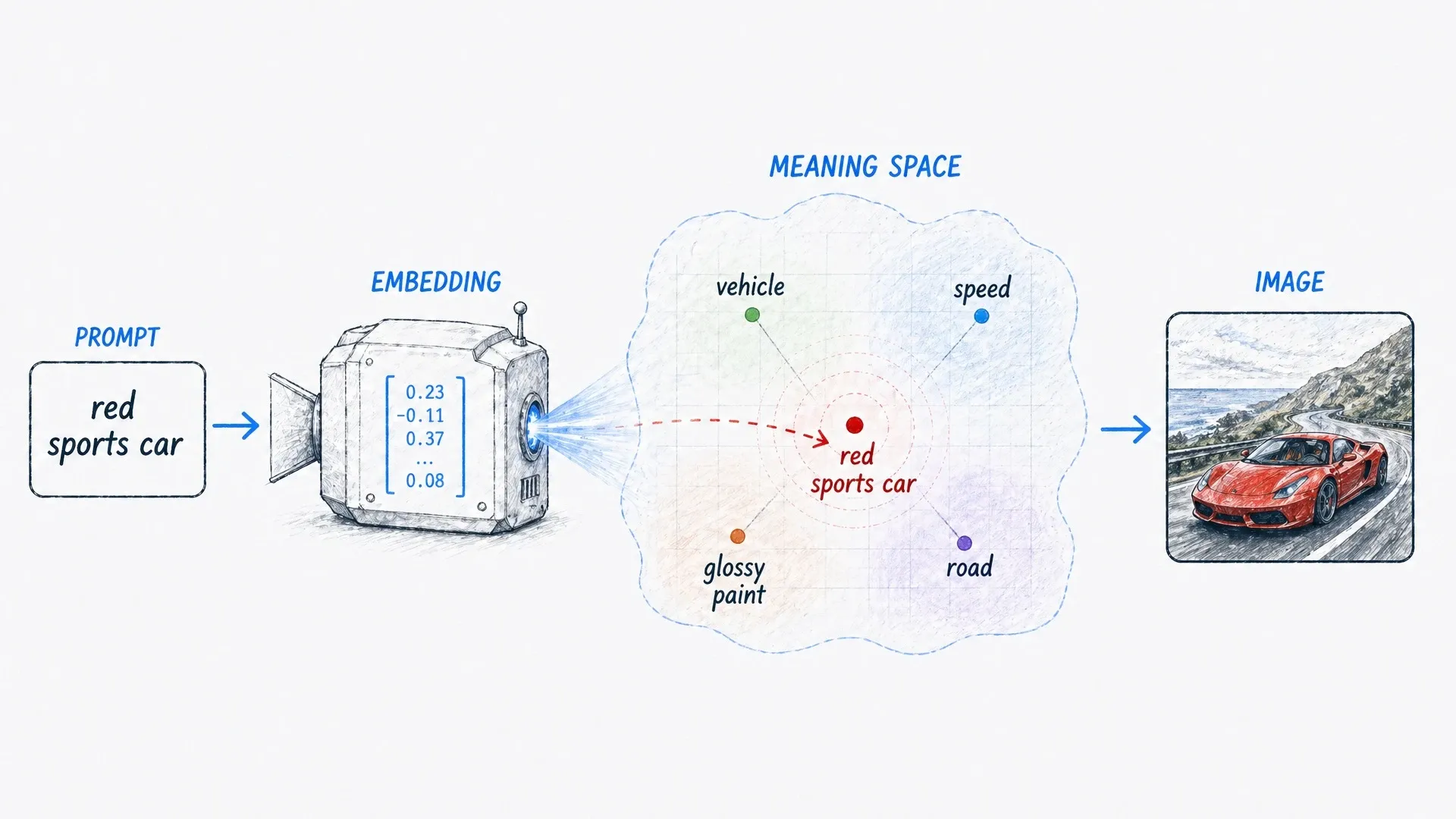
The prompt is converted into a numerical representation that conditions the denoising network rather than issuing literal drawing commands.
In latent diffusion systems, cross-attention lets image features refer to that text representation while denoising. Words such as “red sports car,” “rainy street,” and “wide-angle photograph” can influence subject, setting, and appearance. They still leave many choices unstated: the exact car, camera height, reflections, background, and position in the frame.
This is why a prompt behaves more like a collection of pressures than a line of code. Adding a detail changes the probabilities; it does not reserve a precise group of pixels.
Guidance strengthens the prompt signal
A conditional model can estimate how the image should change given the prompt. A less-conditioned or unconditional estimate shows a more general direction. Classifier-free guidance combines those estimates so the sampling path leans harder toward features associated with the prompt.
The guidance scale therefore has a trade-off. Too little guidance may produce a coherent image that neglects requested details. More guidance often improves adherence. Too much can push the sample into oversaturated, brittle, or repetitive territory and reduce diversity. The classifier-free guidance paper describes this balance between sample quality and variety.
Negative prompts in tools that support them provide another conditioning signal. They can discourage learned associations, but they are not a reliable eraser for every unwanted object or error.
Why many systems work in latent space
Running every denoising step over a large pixel grid is expensive. Latent diffusion first uses an encoder to compress an image into a smaller representation that preserves important visual structure. The diffusion process works there, and a decoder converts the result back into pixels.
The latent diffusion research also shows how cross-attention makes this compressed process useful for text and other conditioning inputs. Compression cuts computation, though the decoder can introduce its own limitations. “Latent space” is therefore not a secret gallery of complete images. It is a learned numerical representation in which useful visual features can be manipulated more efficiently.
Seeds control randomness, not the whole recipe
A seed initializes the random number generator that produces the starting noise. Keeping it fixed can help reproduce a composition when the model, prompt, sampler, step count, dimensions, guidance, and software behavior also stay fixed. Change one of those ingredients and the same seed may no longer yield the same image.
Changing only the seed gives the model a different starting trajectory through its learned possibilities. That is why one prompt can produce many valid layouts without the model becoming inconsistent in the ordinary sense.
Editing adds stronger constraints than text alone
Text leaves geometry ambiguous. Image-to-image generation begins with visual structure as well as a prompt. Inpainting limits regeneration to a mask, while the surrounding pixels provide context. Outpainting asks the model to extend beyond an existing border.
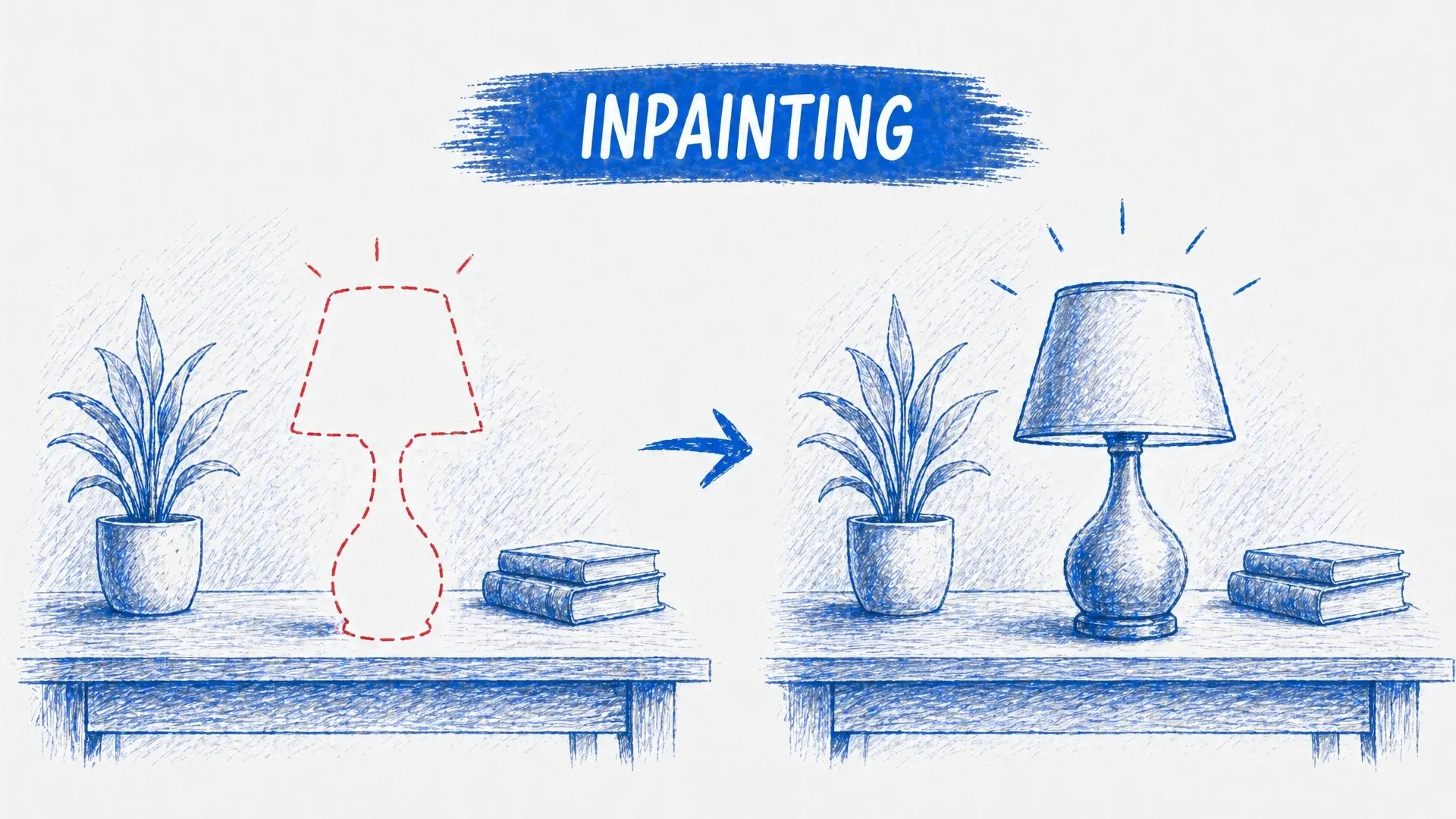
Inpainting applies the same generative idea to a selected region while the unmasked image supplies surrounding context.
Other controls can condition pose, edges, depth, or layout. These do not replace denoising; they narrow the set of acceptable paths. The more exact the task, the more useful an explicit structural control becomes.
Plausible pixels still need inspection
A generated image can be visually convincing and factually wrong. The model predicts appearance, not historical truth, engineering feasibility, or brand compliance. It may create inconsistent text, impossible reflections, malformed small objects, or a plausible scene containing the wrong evidence.
Human work therefore moves to specification, selection, verification, and editing. The generator can produce drafts quickly. Deciding whether a draft is accurate, lawful to use, visually coherent, and fit for its purpose remains a separate job.
The shortest accurate description is this: text conditions a learned denoising process, randomness supplies a starting state, and repeated predictions turn that state into one plausible image. It feels like a brush only because the complicated machinery is hidden behind a prompt box.