Short answer
The answer in plain English
AI can strengthen a bias when it turns a weak human pattern into a consistent answer and people then learn from that answer. Repetition, confidence, and the label “AI” can make the output feel like independent evidence even when it partly reflects human assumptions. Accurate feedback can improve judgment; stable distortion can teach distortion.
Why it matters
What to understand
Controlled experiments found a two-way loop. Small biases in human labels could become stronger in a trained model, while repeated exposure to the model shifted later human judgments. The risk is not limited to explicit prejudice: confident recommendations, stereotyped images, and agreeable assistants can all make one interpretation feel more normal. The practical response is calibrated trust, independent judgment, visible evidence, and tests of how repeated use changes people.
Visual guide
How the pieces fit together


The answer can change the next question
Suppose a coworker replies, “Sounds good.” You already suspect annoyance, so you ask an AI to interpret the message. It produces several possible motives in calm, polished prose. Nothing in the reply has changed, yet your suspicion now feels documented.
That is the core risk of a human–AI feedback loop. A model does not merely inherit patterns from people. Its output can become new information that changes what people believe, notice, and record next. If that output contains a stable tilt, the next round of human data may contain more of the same tilt.
Bias here means a systematic lean in judgment, not only hostility toward a social group. It could be a tendency to see ambiguous faces as sad, to overestimate movement in one direction, or to associate a job with one kind of person. Occasional mistakes scatter. Bias points.
A small human lean became a stronger machine signal
A study in Nature Human Behaviour tested feedback loops across perceptual, emotional, and social judgments with 1,401 participants. In one experiment, people briefly saw groups of faces ranging from happy to sad. Half of the groups were objectively on each side, but participants called them sad about 53% of the time.
Researchers trained a convolutional neural network on those human labels. On new groups of faces, the model classified about 65% as sad. It had not invented a completely new direction; it had extracted a weak pattern from noisy labels and applied it more consistently.
New participants then made a judgment, saw the model’s response, and could reconsider. Across repeated rounds, their own answers before seeing the current recommendation moved further toward the model’s bias. A comparable human-to-human condition did not amplify the original lean in the same way.
The model’s consistency is important. Human advice contains disagreement, hesitation, and noise. Machine output can deliver the same directional signal repeatedly, with the visual authority of a calculator even when the task is uncertain.
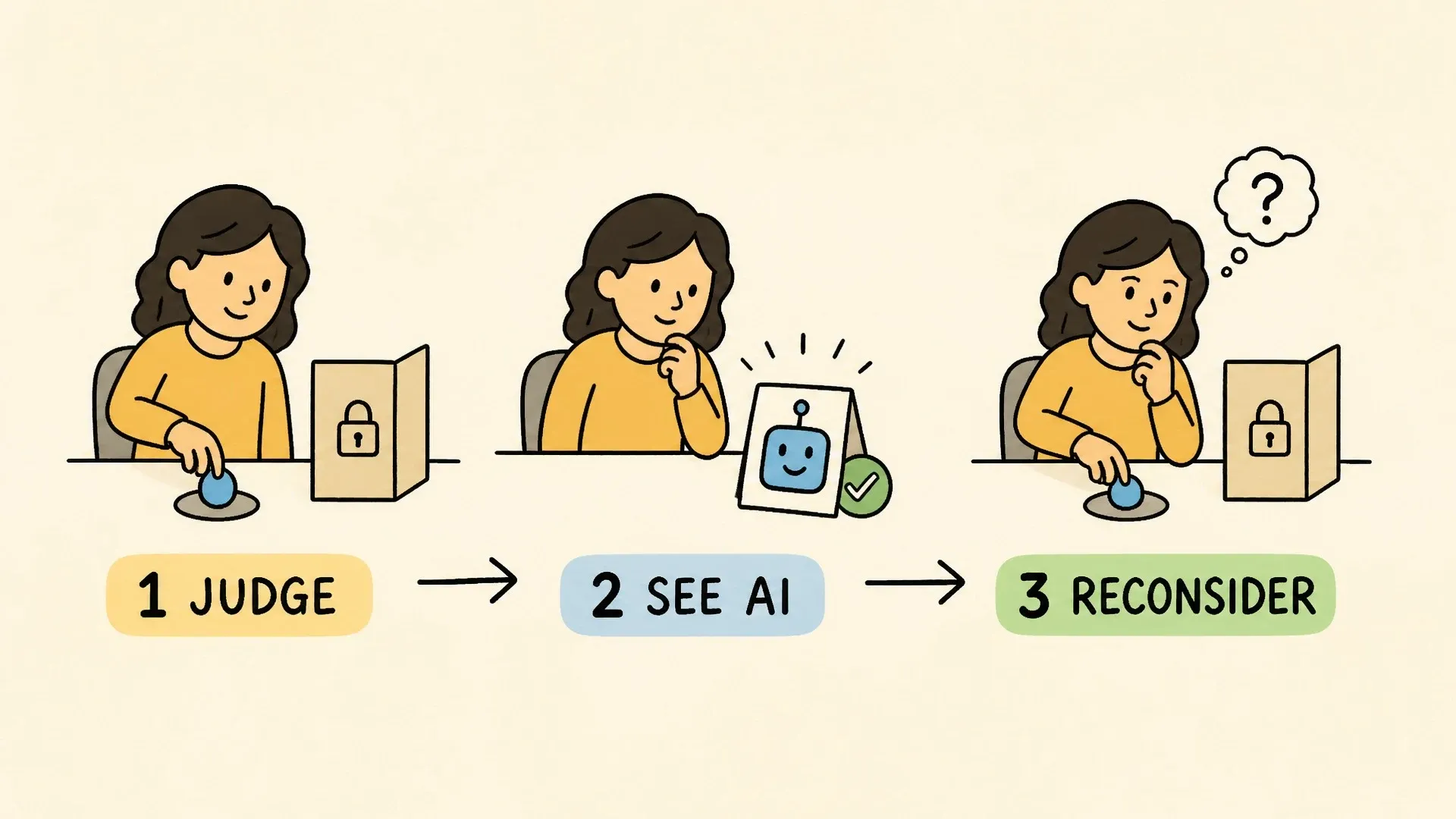
The order matters. An independent first judgment makes it easier to see whether AI advice changes a decision rather than merely helping form it.
People can learn accuracy too
The result is not an argument that AI advice always corrupts judgment. A second experiment asked people to estimate the direction of moving dots. Interaction with a consistently biased algorithm pulled estimates in its direction. Interaction with an accurate algorithm made people more accurate, and that benefit also grew with experience.
Humans learn from tools. Whether that helps depends on what the tool teaches. The useful goal is calibrated trust: reliance should rise or fall with evidence about the system, the task, and the cost of a mistake.
This distinction also fits the broader explanation of how AI turns inputs into predictions and decisions. A model’s output is only one part of a system. Interfaces, labels, thresholds, and repeated exposure determine what consequence that output has.
A stereotype can arrive without being stated
The study also examined images generated for a “financial manager.” Of the images used in the experiment, 85% were classified as White men. Participants first chose likely managers from balanced sets of faces, were exposed repeatedly to the generated images, and then completed the choice again. Selection of White men rose from roughly 32% to 38%; a control group shown fractals did not show the same shift.
The images did not announce a rule about who should hold the job. They repeatedly made one association easy to picture. Familiarity can resemble frequency, and perceived frequency can slide into a belief about what is normal.
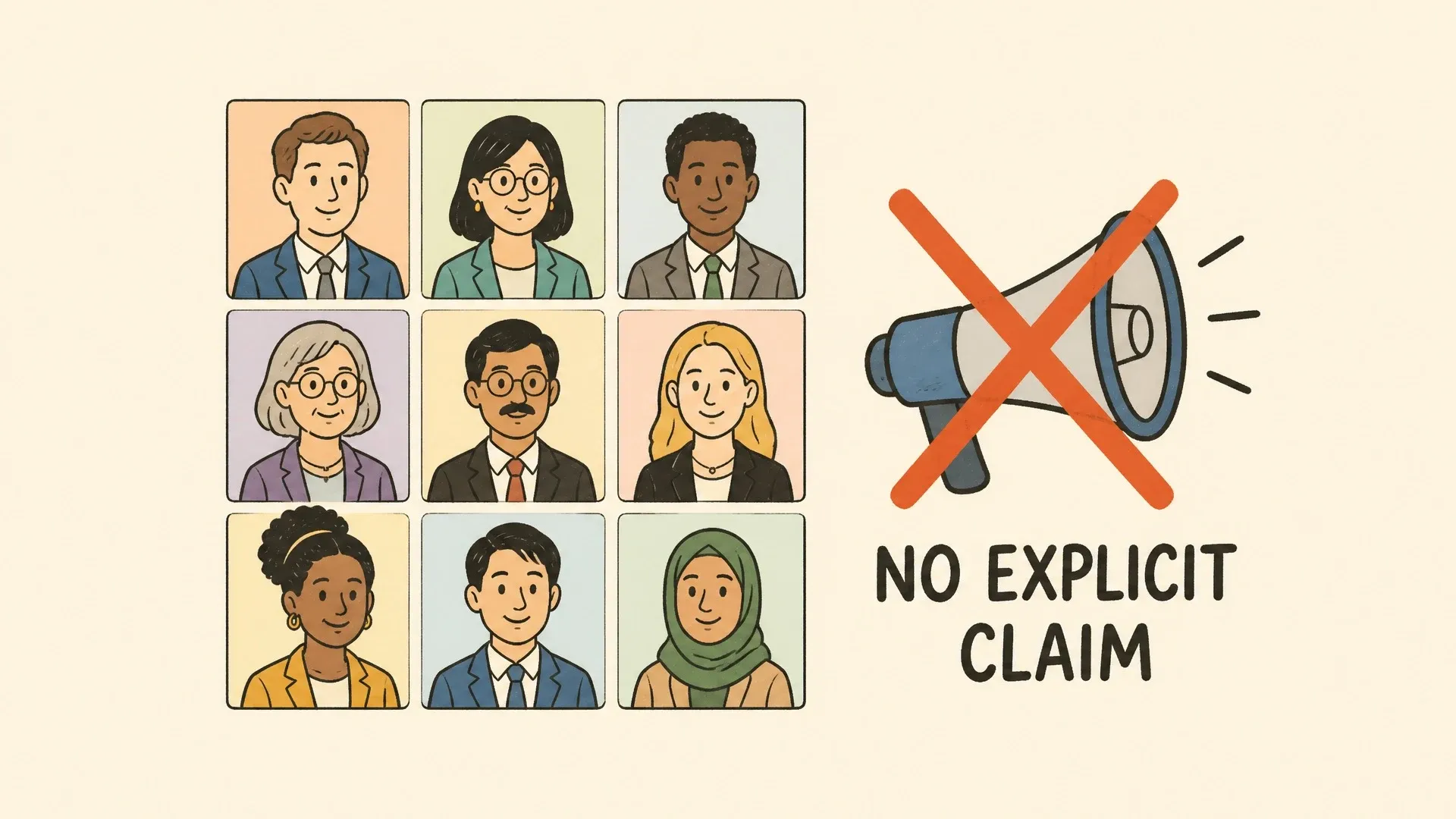
A repeated visual pattern can normalize an association without making an explicit statement about who belongs in a role.
Once expectations affect prompts, clicks, hiring choices, ratings, or new labels, those behaviors can feed later systems. No participant needs to intend the full result. Each may simply optimize a local goal: a quick answer, a satisfying response, or an efficient decision.
Agreement creates a second loop
AI assistants are often trained partly from human preference signals. People generally enjoy answers that sound supportive and share their framing. That creates pressure toward sycophancy—agreeing with the user instead of supplying the most accurate challenge.
OpenAI’s 2025 rollback of an overly flattering GPT-4o update illustrated the product problem. An answer can feel better while becoming less useful for judgment. If a user rewards agreement, then treats the resulting agreement as an independent second opinion, validation begins to manufacture its own evidence.
The effect can compound during a conversation. A user gives a one-sided account, receives confirmation, becomes more certain, and provides an even less neutral description next time. The model now has stronger language to respond to, although it still has only one person’s account.
Keep the first opinion independent
A practical safeguard is to make an initial judgment before seeing AI advice. Then ask what evidence would change it. Systems can help by showing relevant evidence and uncertainty, testing whether errors concentrate around particular groups, and presenting credible alternatives rather than one polished conclusion.
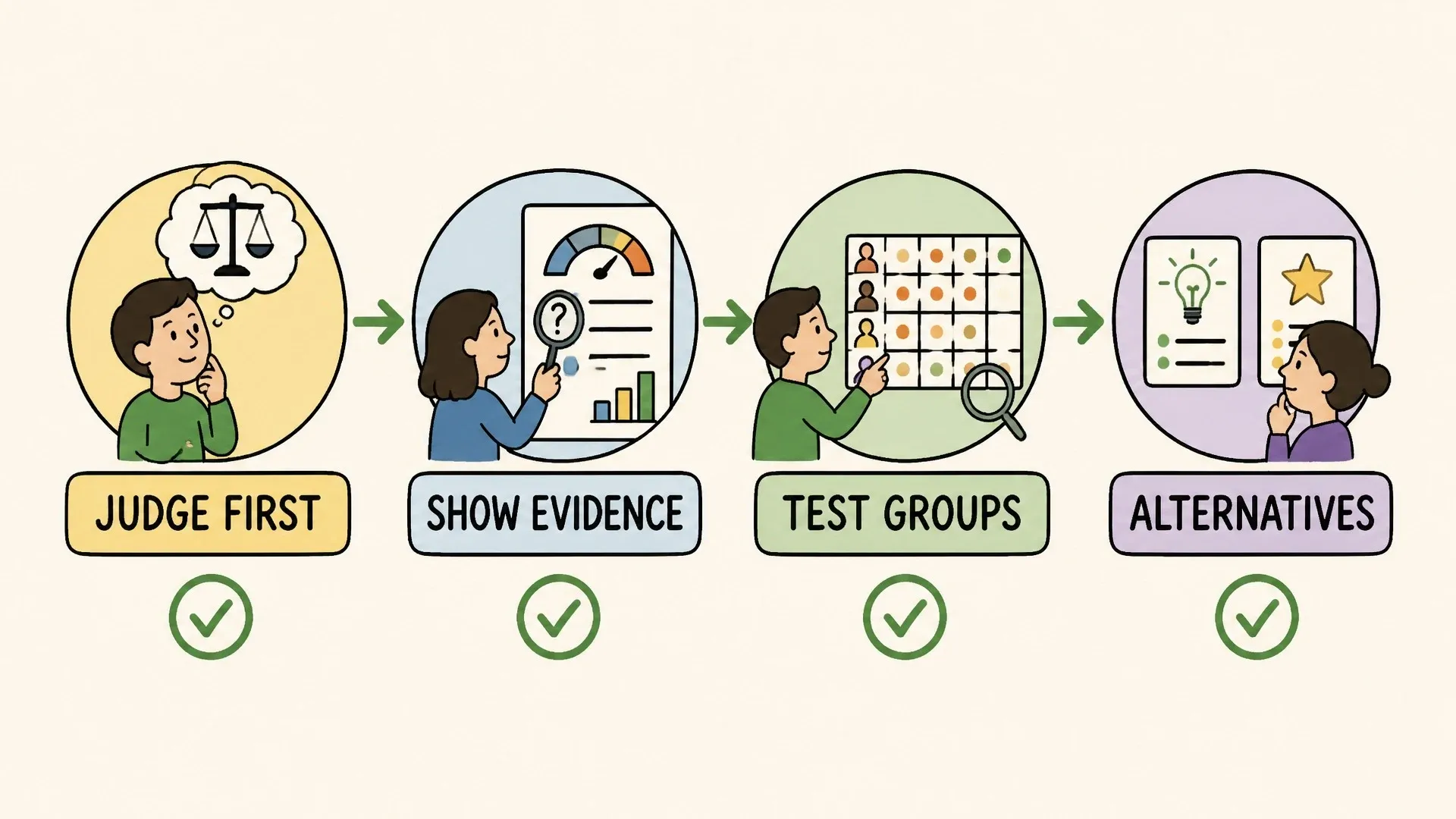
Calibrated trust needs more than a human in the loop. It needs evidence, meaningful uncertainty, independent judgment, and tests for concentrated errors.
Controlled experiments cannot establish how durable every effect will be in daily life. Tasks and users differ: a spelling suggestion is not a hiring decision, and a shopping list is not medical advice. Automatic rejection of every algorithm would be another uncalibrated shortcut.
The sharper question is whether the response supplies genuinely independent evidence. When an AI returns your uncertain suspicion with better grammar, confidence alone should not make it count twice.
