Short answer
The answer in plain English
The EU AI Act can require covered providers to mark synthetic outputs and certain deployers to disclose AI-generated or manipulated content, but it cannot make those signals indestructible. Visible notices can be cropped, metadata can be stripped, and watermarks can weaken after repeated editing. The practical answer is a layered provenance system—not one universal label that always survives.
Why it matters
What to understand
Article 50 separates duties for AI-system providers from duties for people and organizations using those systems. The technical layer may combine metadata, signed provenance records, watermarks, fingerprints, and external records. Each answers a different question, and none proves that the content itself is true.
Visual guide
How the pieces fit together


A label is only as durable as the file’s journey
The EU can require a company to attach an AI disclosure at the moment content is created or published. It cannot freeze that content in place. A picture may be downloaded, recompressed by a platform, sent through a messaging app, cropped into a meme, or captured in a screenshot. Each step can discard information that the previous file carried.
That is why the useful question is not simply whether AI content has a label. It is which signal was added, who is expected to read it, and what happens when the media leaves the original service.
What Article 50 actually separates
Article 50 of the EU AI Act creates several transparency duties rather than one warning sticker for every use of AI. Providers of systems that generate synthetic text, images, audio, or video must make covered outputs detectable in a machine-readable way. The law asks for methods that are effective, interoperable, robust, and reliable as far as technically feasible.
Deployers—the people or organizations applying an AI system—have different duties. Deepfakes generally need a disclosure that the content was artificially generated or manipulated. AI-generated text published to inform the public about matters of public interest can also require disclosure when there has not been meaningful human review and editorial responsibility.
Context changes the treatment. Ordinary editing that does not substantially alter the input is not equivalent to generating a deceptive synthetic scene. Artistic, fictional, satirical, and similar works can use disclosures designed not to spoil the experience. The rules also address direct interaction with certain AI systems and exposure to emotion-recognition or biometric-categorization systems.
The important point is narrower than the headline: the law assigns duties to particular actors in particular situations. It does not declare every AI-assisted file suspicious.
Visible disclosure and machine-readable marking
A visible notice is for a person. It might be text, an icon, or a platform label stating that media was generated or modified with AI. A machine-readable mark is for software—a platform, verification service, researcher, or regulator inspecting the file or an associated record.
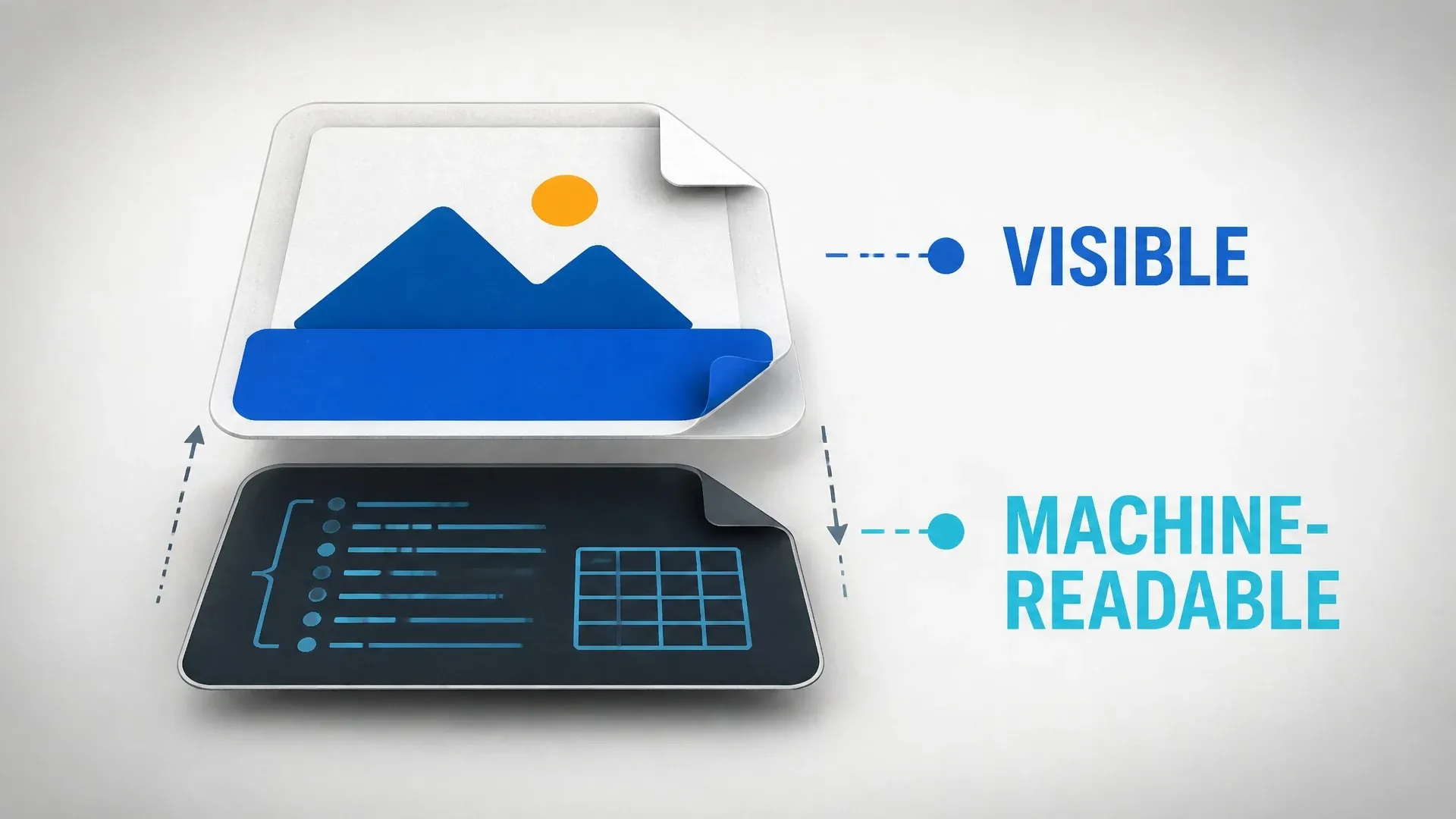
The two layers solve different problems. A visible notice communicates immediately but can be cropped, covered, or lost when a platform overlay is not included in a download. An invisible record can carry more detail, but most viewers will never see it unless software exposes it.
Metadata is useful—and easy to lose
Metadata stores information alongside a file. It can name the tool involved, describe an edit, record a creation time, or state that AI generation occurred. Because it does not have to alter the picture or sound, it can carry a detailed history without changing the viewing experience.
Basic metadata is fragile. Social networks and messaging services often rebuild media files. Changing formats can leave fields behind. A screenshot creates a new image from the visible pixels and usually does not reproduce the attached data. The content survives while its administrative history disappears.
Signed provenance makes changes visible
C2PA Content Credentials add cryptography to provenance information. A credential can record claims about origin, editing tools, and generative-AI use. A cryptographic hash binds those claims to a particular file state, while a digital signature lets verification software check who signed the record and whether it changed afterward.
This makes the record tamper-evident, not impossible to remove. Someone may strip a credential or create a fresh unsigned copy. What should be difficult is secretly changing the signed file while keeping the original credential valid.
C2PA also describes ways to recover provenance through external records and soft bindings such as fingerprints or watermarks. That matters when ordinary distribution separates a file from its embedded manifest.
Watermarks put a signal inside the content
An invisible watermark hides a detectable pattern in the media rather than only attaching data beside it. Image watermarks distribute a signal through pixels; audio and video systems can spread one across samples or frames. Text watermarking may bias a model toward certain otherwise plausible token choices so that a detector can recognize a statistical pattern across a sufficiently long passage.

No watermark is invulnerable. A stronger signal may become noticeable or degrade the media. A subtler signal may vanish after aggressive cropping, repeated compression, noise, re-recording, translation, or heavy rewriting. Text is especially difficult when the sample is short or has been thoroughly paraphrased.
Why the system needs several layers
Metadata carries detail. Signatures reveal whether signed information still matches the file. Watermarks may survive transformations that remove metadata. Fingerprints and external repositories may reconnect a modified copy to an earlier record. These are complementary tools, not competing candidates for one perfect label.
Imagine a signed, watermarked image moving across the internet. The first platform preserves its credential but compresses the pixels. A user then takes a screenshot, removing the attached record. Another person crops the screenshot and places it inside a video. The watermark may remain detectable for a while, but each transformation weakens the evidence and complicates the chain of custody.
The strongest design therefore preserves provenance at each handoff: generators create it, editing tools update it, platforms retain and display it, and verification tools can retrieve it. If one ordinary upload destroys the record, the system never becomes infrastructure.
Missing does not mean human; signed does not mean true
A compliant provider can mark its own output. It cannot force every model, editing tool, or malicious actor to cooperate. A missing label can mean human-made content, but it can also mean that a marker was removed, lost, never added, or created outside the covered system. Treating absence as proof of authenticity would turn an imperfect transparency signal into a dangerous shortcut.
The reverse mistake is just as important. A valid Content Credential can support a claim about who signed a file and whether its recorded history was altered. It does not establish that the scene is accurate or that the statement inside it is true. Provenance addresses origin and modification; fact-checking addresses reality.
The EU’s real leverage is coordination
Europe does not need to invent an indestructible mark to influence the wider internet. A large market can push major generators, creative tools, and platforms toward common practices. A globally consistent system may be simpler than maintaining incompatible European and non-European media pipelines.
The less optimistic outcome is fragmentation: proprietary detectors that cannot read one another’s marks, platforms that strip competitors’ metadata, vague notices that people stop noticing, and uncooperative systems producing unmarked content. The difference will depend on interoperability and preservation more than on the design of any single icon.
AI labels will sometimes disappear. A realistic transparency system accepts that failure and leaves overlapping evidence behind. Its job is not to make deception impossible. It is to give digital media a better chance of carrying an inspectable history through creation, editing, and distribution.