Short answer
The answer in plain English
An Edmontosaurus mummy preserved a sub-millimeter clay template around its hind feet. That template shows broad, wedge-shaped keratin sheaths extending well beyond the short toe bones, with flat undersides and a fleshy heel pad. They were hoof-like dinosaur coverings, not a horse foot and not surviving original keratin.
Why it matters
What to understand
Bones alone made Edmontosaurus toes look too short. Two Wyoming specimens preserved a clay mask of the external surface, allowing researchers to separate the internal toe bones, the living keratin sheaths, and the mineral template left after those tissues decayed. CT scans and a hadrosaur footprint support a three-toed, padded hind foot whose broad coverings helped meet the ground.
Visual guide
How the pieces fit together


The bone was only the core
The end of an Edmontosaurus toe bone looks broad and blunt. Traditional reconstructions wrapped it in a modest nail-like cap. A remarkable mummy from Wyoming shows that the visible foot continued much farther.
Around each of the three hind-toe bones was a larger wedge-shaped covering with a flattened underside. The central one measured about 15 centimeters long—roughly twice the length of the ungual, the terminal bone inside it. Researchers describe these coverings as hooves because of their broad, weight-bearing form.
That word needs care. Edmontosaurus did not have a horse’s one-toed foot or the complete limb anatomy of an ungulate. Its coverings were dinosaur structures reached from a different evolutionary starting point.
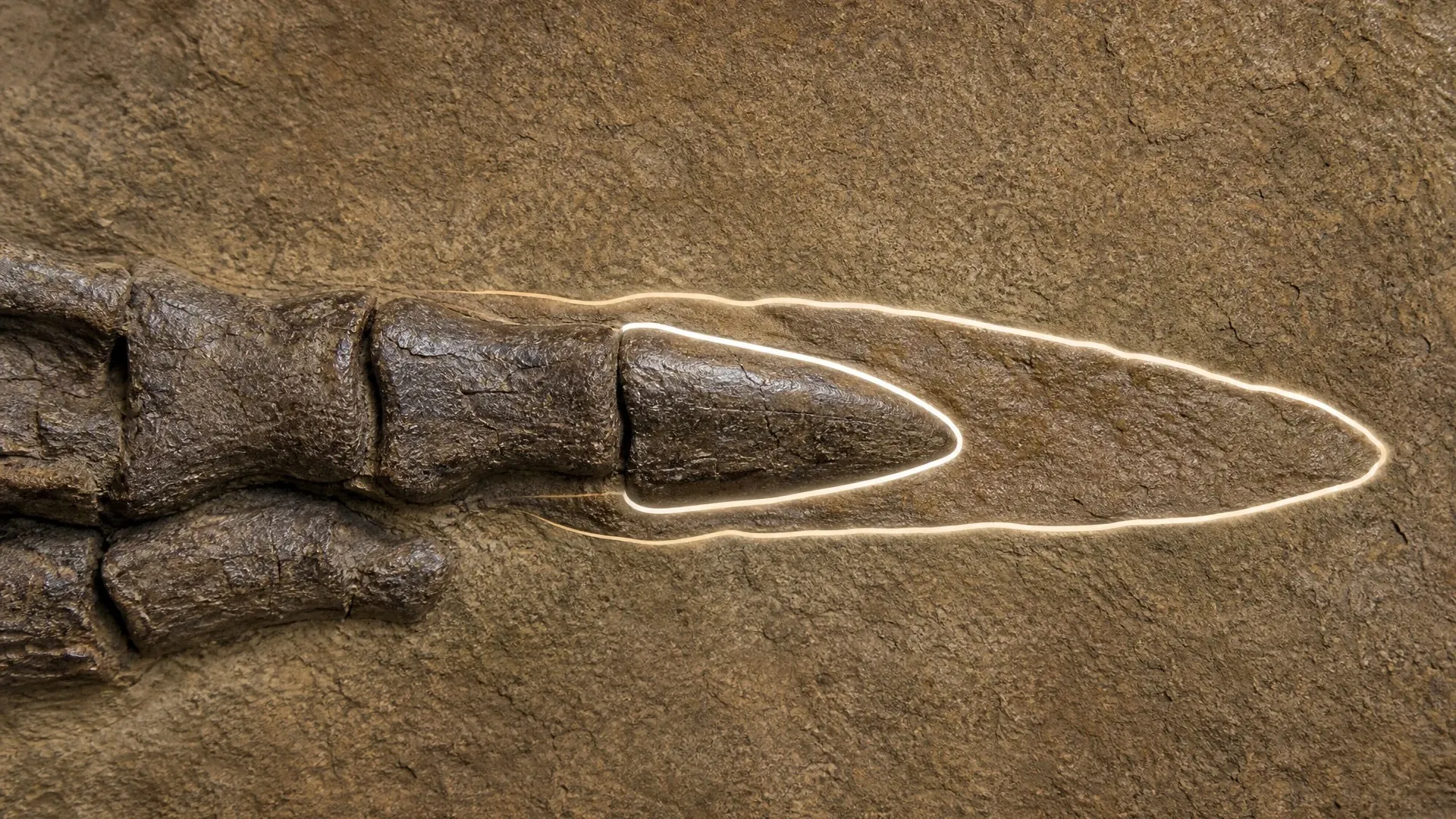
The ungual is the internal support, not the complete toe. The living sheath extended well beyond the end of the fossilized bone.
Three layers of evidence, not one preserved hoof
The discovery is easy to misunderstand because “dinosaur mummy” sounds like an ancient carcass retaining dried tissue. The two Edmontosaurus annectens specimens—nicknamed Ed Junior and Ed Senior—do not preserve original skin or 66-million-year-old keratin.
The fossils instead separate three layers. Fossilized bones form the internal framework. In life, keratinized sheaths surrounded the toe ends. After burial and decay, an extraordinarily thin clay layer retained the outside shape of those sheaths.
Chemical and microscopic tests found no original organic material in the clay template or adjoining sediment. The evidence is still unusually direct: a three-dimensional mineral boundary marks where the living surface had been.
This case adds a rare route to the broader process described in how dinosaur fossils form. Ordinary fossilization favors hard tissue. Here, the soft exterior vanished, but its boundary altered the sediment precisely enough to record scales, wrinkles, tail structures, and toe coverings.
A dry carcass, a flood, and a microscopic coating
Both specimens came from the Lance Formation of east-central Wyoming, near sites that produced famous Edmontosaurus mummies in the early twentieth century. Historical photographs, letters, and local geology helped researchers relocate this compact “mummy zone.”
Their proposed sequence begins with a carcass exposed during dry conditions. As it lost moisture and decayed, skin tightened and deeper tissues disappeared. Hollow spaces formed inside external structures such as the toe sheaths.
Floodwater then transported or buried the remains in sand. Sediment entered the body and the cavities left by decaying structures. A microbial film across the surface attracted fine clay particles from wet sediment. The particles accumulated in a layer less than one millimeter thick.
Original tissue later broke down completely, leaving the clay boundary between sediment inside and outside the body. The result is neither preserved flesh nor an ordinary flat impression. It is a thin external template.
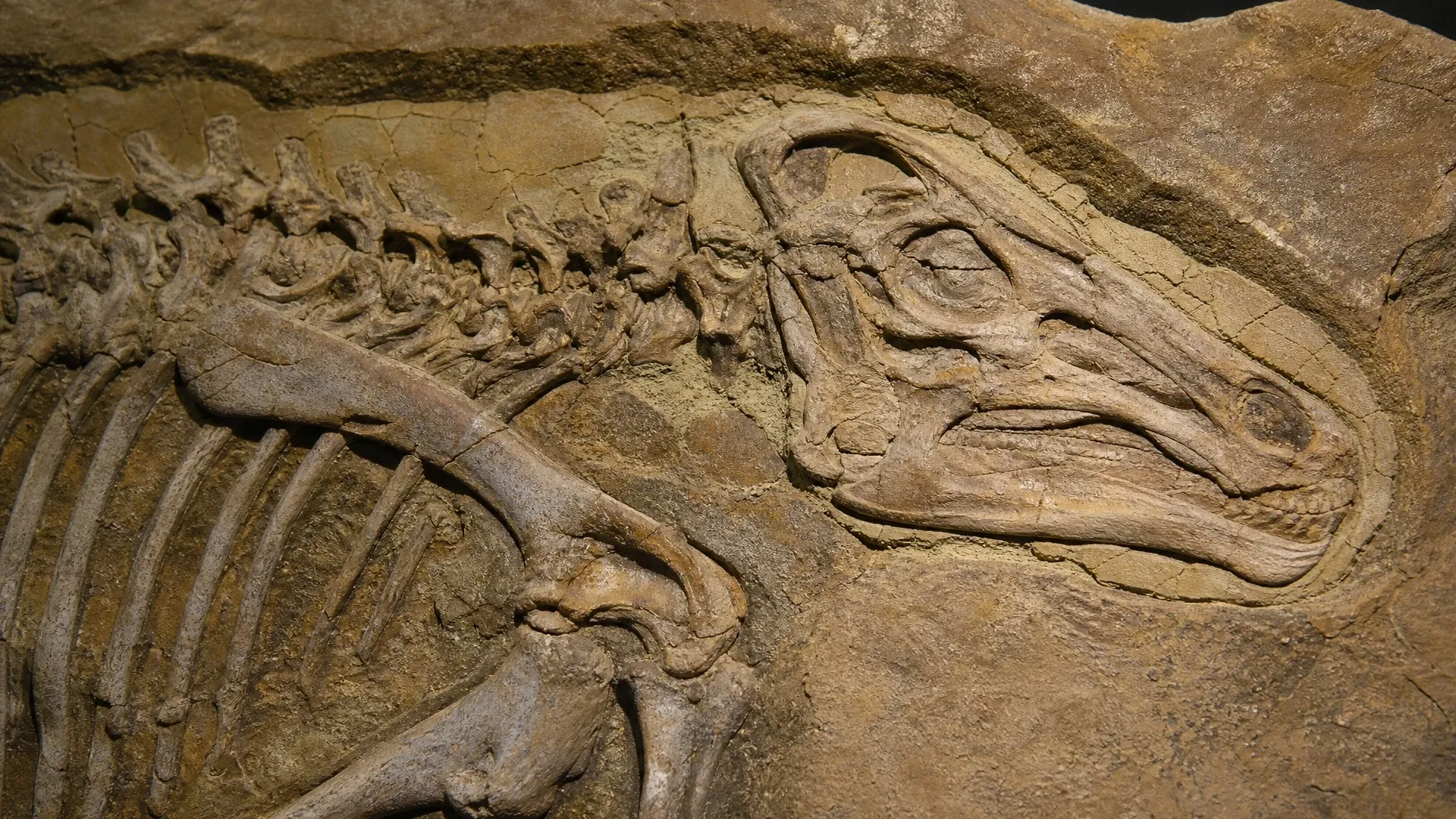
The mummy preserves a thin mineral boundary where the living surface once lay, even though the original skin and keratin disappeared.
What the completed hind foot looked like
Edmontosaurus had three main weight-bearing toes on each hind foot. Their unguals were broad and spade-shaped rather than narrow hooks. The templates reveal wedge-shaped sheaths around them, with flattened undersides and outer ridges. A shallow depression beneath one covering was compared with the frog of a horse hoof.
The similarity stops at the external solution. Horses carry weight on one highly specialized central toe; cattle divide it between two. Edmontosaurus used three toes and retained a large fleshy heel pad behind them.
CT scans identified rounded pads below the digits and a crease separating them from the heel. Researchers compared the reconstructed anatomy with a well-preserved hadrosaur footprint from the same general interval. The track was not made by either mummy, and it cannot be assigned to Edmontosaurus with absolute certainty. It nevertheless records the right kind of hadrosaur foot: toe ends, pads, and a broad heel impression align with the reconstruction.
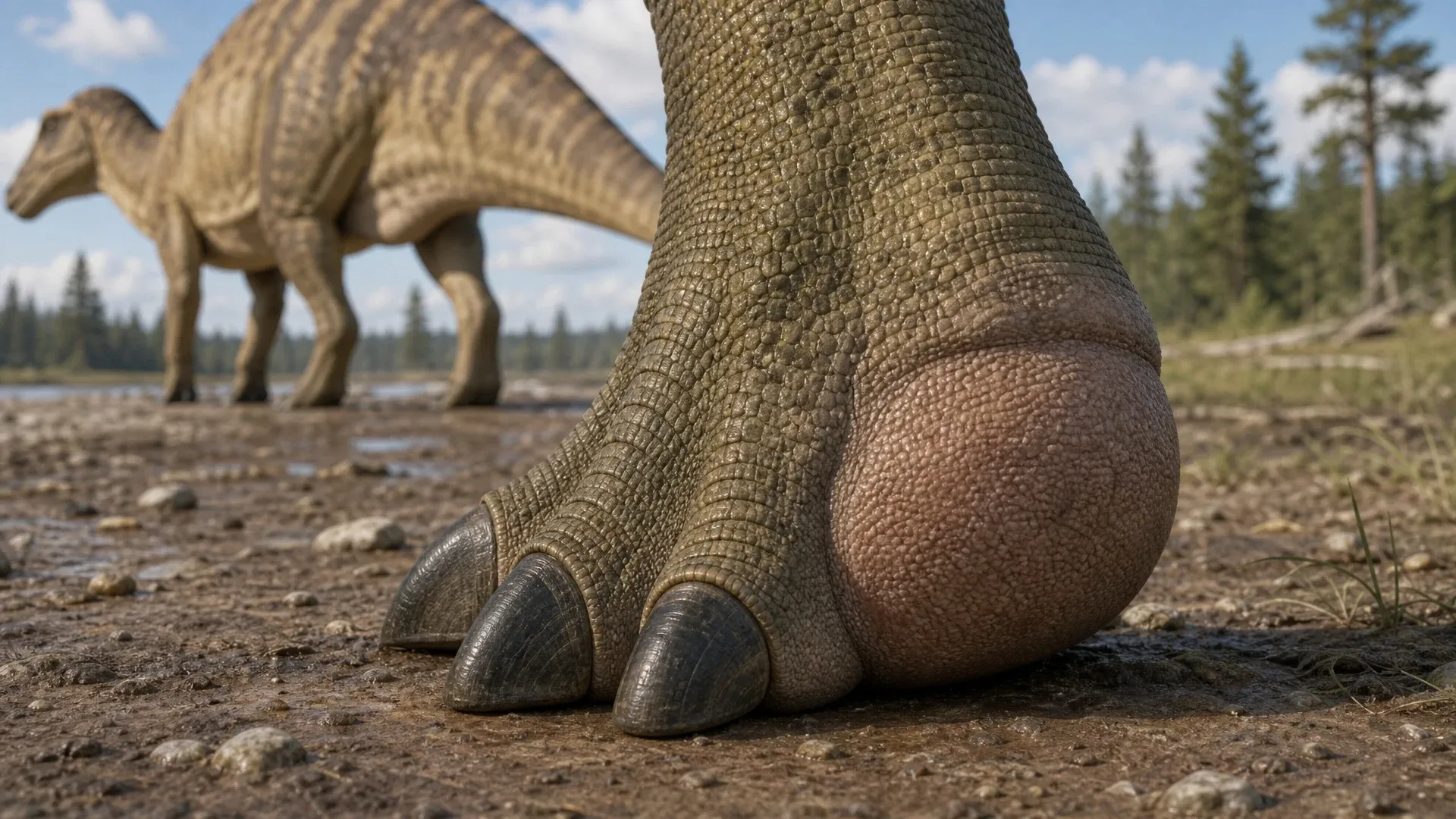
Weight passed through the broad toe coverings while the fleshy rear portion of the foot also supported and cushioned the animal.
Paleontologists describe the hind foot as subunguligrade. In plain language, the animal placed weight through the hoofed toes while the padded rear portion also met the ground. The forefoot was more compact and vertical, with fingers enclosed in a mitten-like structure. Front and rear feet therefore used different postures.
What the feet can—and cannot—tell us
Broad keratinized surfaces would have protected the ends of the toes and spread pressure more effectively than narrow claws. That is a reasonable functional interpretation for a multi-tonne plant eater moving across floodplains and river margins.
The fossils do not reveal a top speed, prove that Edmontosaurus galloped, or identify one escape strategy. Their real value is a more accurate contact surface for future models of weight distribution, joint motion, and locomotion.
The direct evidence also belongs to Edmontosaurus annectens. Other hadrosaurs had broad terminal bones and left rounded toe impressions, so similar coverings may have been widespread. Extending the anatomy to earlier hadrosauriforms or armored dinosaurs remains an inference from bones and tracks, not the same kind of preserved outline.
That distinction is the larger lesson. Skeletons supply the internal supports, but the living animal did not end at the bone. A paper-thin clay shell preserved the missing distance between an Edmontosaurus toe and the ground—and changed the foot without preserving the hoof itself.

