Short answer
The answer in plain English
Songs get stuck because recent or repeated exposure makes a musical fragment easy to retrieve, ordinary cues can reactivate it, and the mind can rehearse it without deliberate effort. A hook is especially suitable because rhythm, melody, and words form a compact sequence. Once recalled, the end of that sequence may help cue its beginning again.
Why it matters
What to understand
An earworm is involuntary musical imagery, not a sound coming from the room. Exposure and association make a song available; working memory and inner singing rebuild a short hook; quiet or undemanding moments make the replay easier to notice. The exact mechanism of repetition is not settled, but accepting the fragment or replacing the mental task often works better than trying to suppress it.
Visual guide
How the pieces fit together


The short answer
A song gets stuck when a short musical pattern becomes unusually easy to retrieve and rehearse. Recent exposure can put it near the top of memory. A word, place, mood, or routine can call it back. Once the fragment appears, rhythm and melody give the mind a ready-made sequence to rebuild—and the end may lead back to the beginning.
Researchers call the experience involuntary musical imagery. It is usually internal: you know the singer is not actually in the kitchen. That distinction matters. An ordinary earworm is closer to inner speech or silent humming than to hearing an external sound.
Earworms are common, generally brief, and often neutral or pleasant. The interesting question is not why the brain fails. It is why ordinary memory works so efficiently on a pattern you did not ask it to retrieve.
Exposure makes a song available
The simplest ingredient is contact with the music. A chorus heard recently or repeatedly has a well-used route back into awareness. That route can be built without choosing the song: the same hook may arrive through a short video, a shop, an advertisement, and a passing car.
Controlled work with unfamiliar music supports a role for repeated exposure, but not a universal threshold. Four plays do not produce the same result for every melody or listener. Familiarity, personal taste, musical experience, and the setting in which the song appeared all change what happens next.
Repetition therefore raises the odds; it does not press a guaranteed earworm button. The broader principle is the same one behind learning elsewhere: repeated experience changes which patterns are readily available. Our article on why the brain never really finishes explains why established networks can remain stable while experience continues tuning them.
A cue can open the musical file
Direct exposure is not required at the moment the song returns. Memory is associative. A lyric-like word in conversation, a place connected with the song, or a familiar mood can activate part of the network and bring the music with it.

Music gives association several handles. It has rhythm, repeated sections, expected sequences, words, movement, and emotion. A cue does not need to recover a complete recording. It only needs to activate enough of the pattern for the mind to continue it.
That helps explain why earworms are usually fragments. A chorus, hook, or single phrase is compact enough to fit into working memory and be rehearsed. The process can recruit some of the machinery used for inner speech and planned vocal movement, even when the lips stay still. The imagined song may feel almost physical because the mind anticipates the next beat or note.
Why some fragments are stickier
There is no formula that can guarantee a hit will loop in every head. Still, a useful hook has to solve two opposing problems: it must be easy enough to learn, yet distinctive enough to recognize.
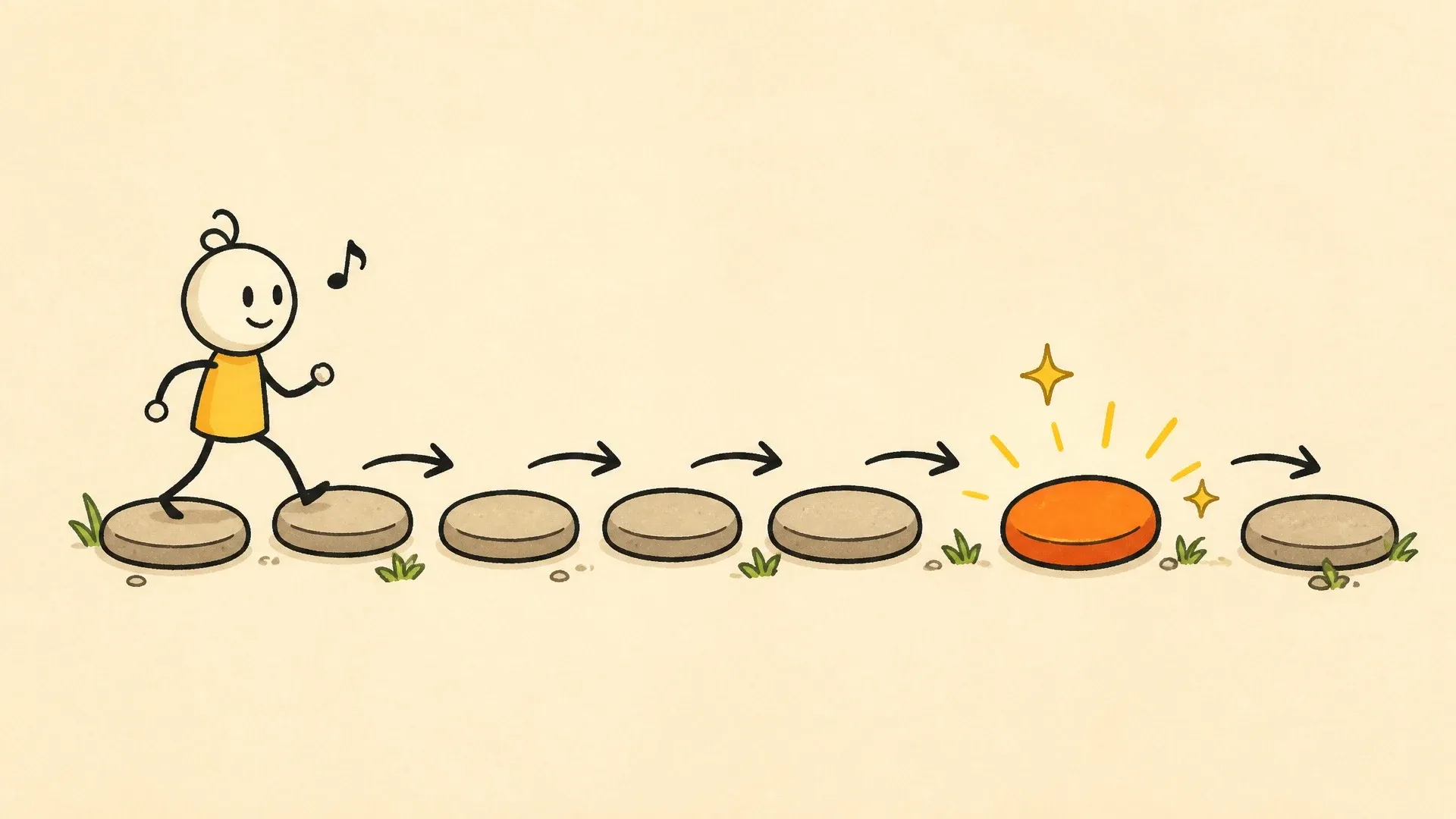
Too much predictability can make a melody forgettable. Too little structure makes it difficult to reproduce. Rhythm keeps events in order, a familiar contour tells the listener roughly where the tune is going, and one unusual turn can give it an identity. Lyrics add verbal cues, but instrumental music can loop too.
Popularity complicates attempts to isolate musical features. A widely reported song may be intrinsically memorable, or it may simply have reached more ears, more often, in more situations. Individual differences matter as well. A tune central to one person’s musical life can be background noise to somebody else.
Quiet attention gives the loop room
Earworms often become noticeable while walking, showering, cleaning, driving a familiar route, or trying to sleep. These activities are not mentally empty. They simply leave less external work competing for awareness.
Laboratory research found more involuntary musical imagery after less demanding tasks than after tasks with higher cognitive load. The song may have been activated earlier, then become noticeable only when attention had room for internally generated material.
Bedtime is a sharper version of the problem. One study connected nighttime earworms with poorer sleep and found that familiar instrumental tracks produced more nighttime earworms than lyrical versions in its laboratory condition. That result does not mean all evening music is harmful. It shows that musical memory can remain active after listening has stopped, and that the relationship depends on the material, person, and context.
Why the end can become another beginning
The mechanism that keeps a fragment repeating is less settled than the basic roles of exposure and memory. One appealing idea says an incomplete excerpt creates tension, so the mind keeps trying to finish it. That could explain why listening to the full song helps some people. Controlled studies, however, have not consistently shown that interrupted music creates more earworms. Closure is not a complete account.
Another possibility is self-cueing. Music is sequential: each moment prepares the next. When a familiar fragment reaches its end, that ending may inadvertently activate the beginning. Attention enters a circular route, and every replay supplies material for another replay.
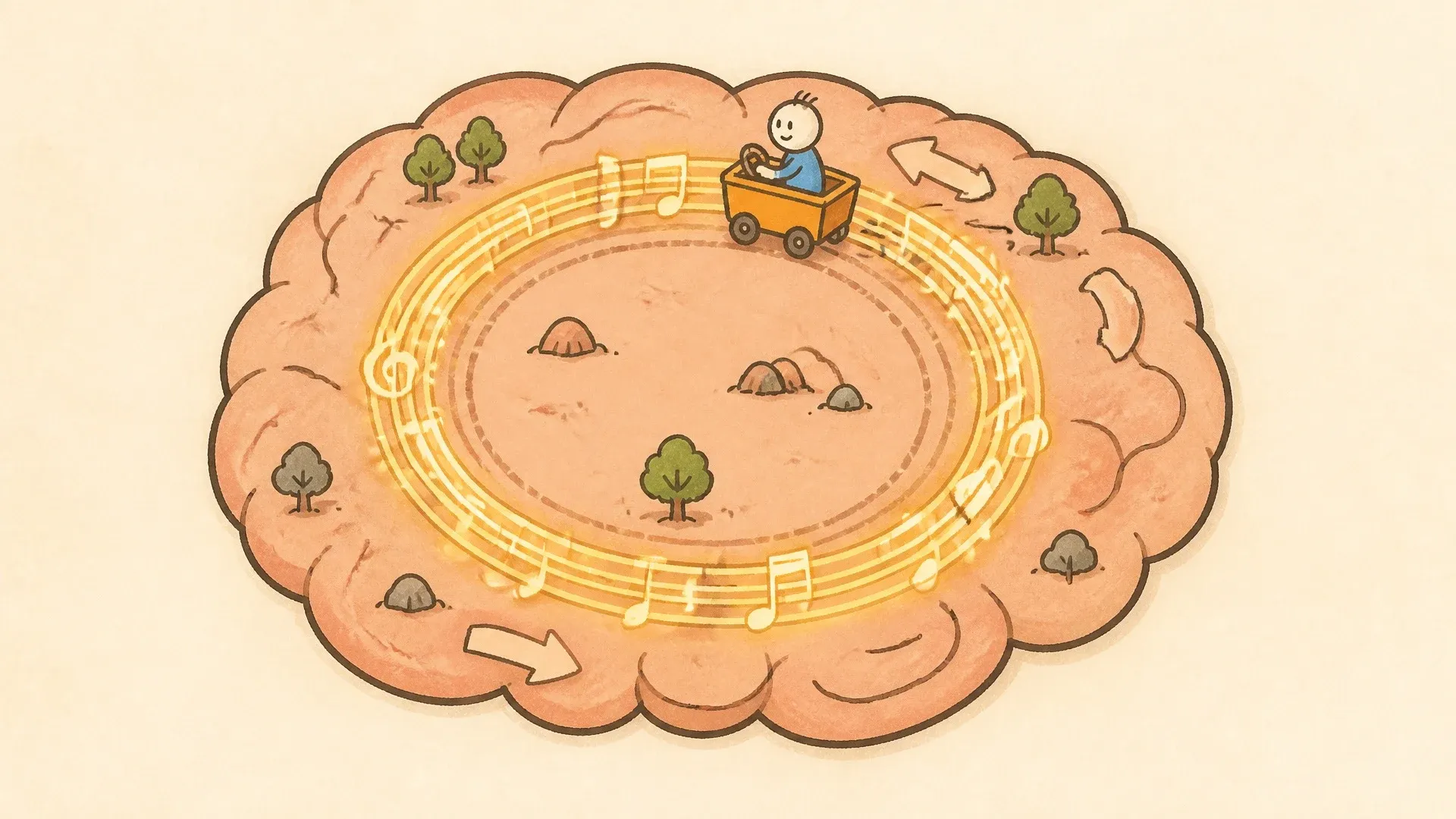
This is a plausible explanation, not a settled mechanism. What is clearer is that a hook can behave like one learned chunk rather than a list of separate notes. Rhythm, pitch relationships, words, and emotion reinforce the same compact pattern.
What can stop an earworm
Trying to force the song away can keep it active. Suppression requires checking whether the thought has disappeared; checking brings the thought back into attention.
Two gentler strategies are more practical:
- Accept it briefly. Removing the struggle can stop the song from becoming the center of attention.
- Replace the mental task. Reading, conversation, a puzzle, or another sufficiently absorbing activity can occupy the working-memory resources used for rehearsal.
Listening to the complete song helps some people, perhaps by replacing a fuzzy fragment with a fuller sequence or providing subjective closure. Chewing gum has also reduced involuntary musical thoughts in laboratory work, possibly because chewing competes with the articulatory planning involved in silent singing. Neither method is guaranteed.
An occasional loop is ordinary spontaneous thought. Musical experiences that become relentless, highly distressing, or seriously disruptive—especially alongside other intrusive thoughts—deserve a conversation with a qualified health professional rather than another internet trick.
For most people, the song is not trapped anywhere. The brain keeps reconstructing a pattern that exposure made available, cues brought forward, and spare attention allowed to run. The hook ends, supplies its own next cue, and begins again.

