Short answer
The answer in plain English
Apple does not send every Siri request to Google Cloud. Its system chooses among models that run on the device, Apple’s Private Cloud Compute, and an extended private-cloud setup hosted on Google Cloud. Apple uses that last tier for its most demanding model, while retaining control of the software and adding hardware-backed privacy protections.
Why it matters
What to understand
The new Siri is better understood as a dispatcher than as one chatbot. Straightforward work can stay on the iPhone; larger requests can move to Private Cloud Compute; the hardest reasoning can use Apple’s Cloud Pro model on confidential NVIDIA hardware in Google Cloud. This does not mean Siri simply forwards every question to Gemini. It is a layered design, and Apple’s privacy claims depend on technical controls that researchers can inspect—but important details about real-world routing remain unknown.
Visual guide
How the pieces fit together
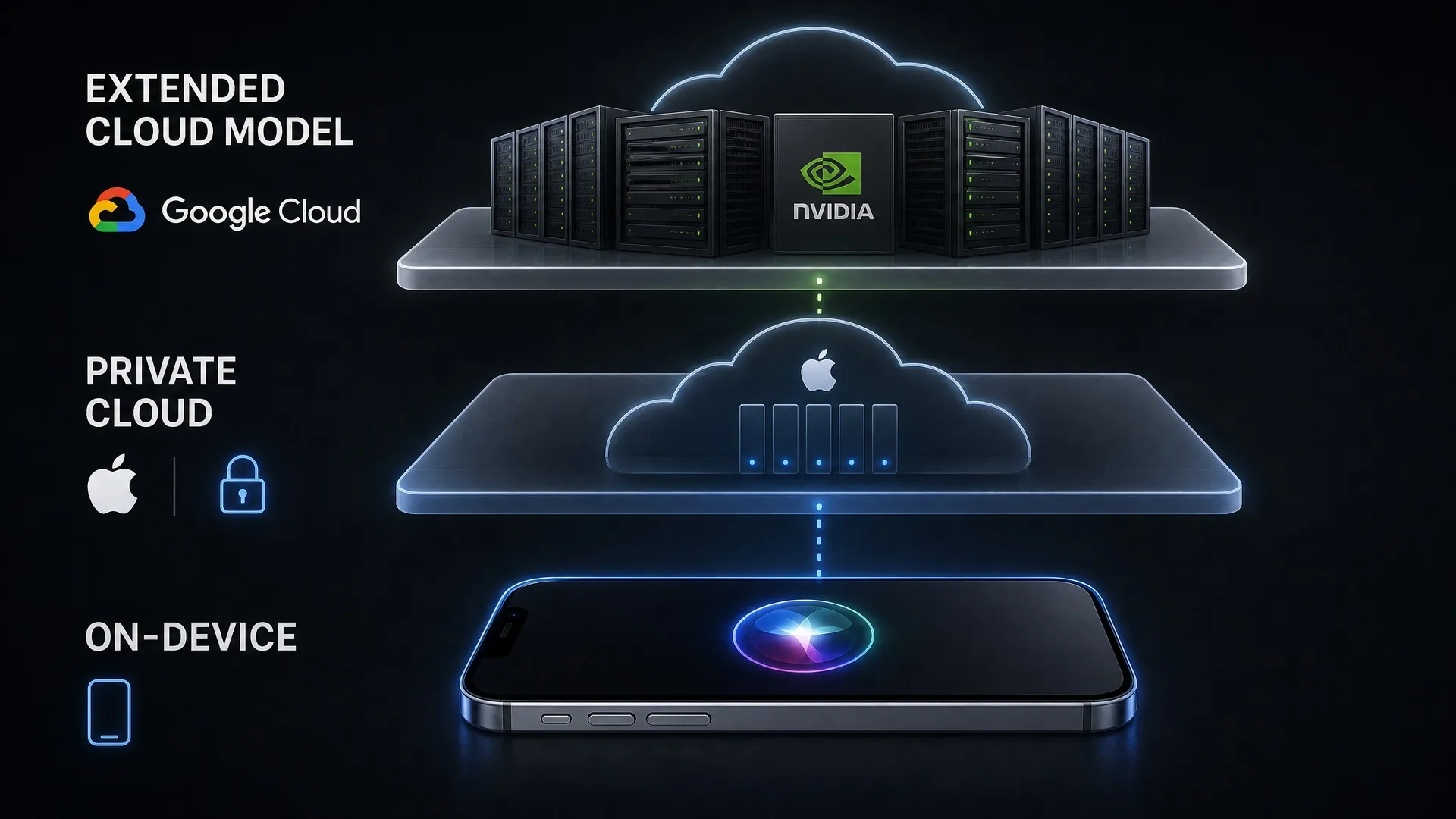
Siri is now a traffic controller
The useful mental model is not “Siri lives on Google Cloud.” It is “Siri decides where each piece of work should run.”
Apple describes several model tiers. Its third-generation lineup includes smaller models for devices, larger models for Private Cloud Compute, a dedicated image model, and a more capable model called AFM 3 Cloud Pro. The system can also use tools on the iPhone to search personal information or perform an action inside an app.
That division matters because different requests need different resources. Setting a timer does not require a data center. Understanding several messages, checking a calendar, comparing options, and planning a sequence of app actions may require much more memory and compute. The software can split a request into parts rather than treating it as one all-or-nothing job.
What can stay on the iPhone
On-device processing is the simplest privacy boundary: the relevant data does not need to leave the phone for the model to use it. Apple says its local models handle many language tasks and that Siri’s system orchestrator can use on-device tools such as Spotlight and the App Toolbox.
Local processing has limits. A phone has far less memory, power, and cooling than a server. Large models also compete with everything else the device is doing. That is why “runs privately” cannot always mean “runs locally.” For a demanding task, the practical choice may be cloud processing with additional safeguards.
Private Cloud Compute is a controlled remote computer
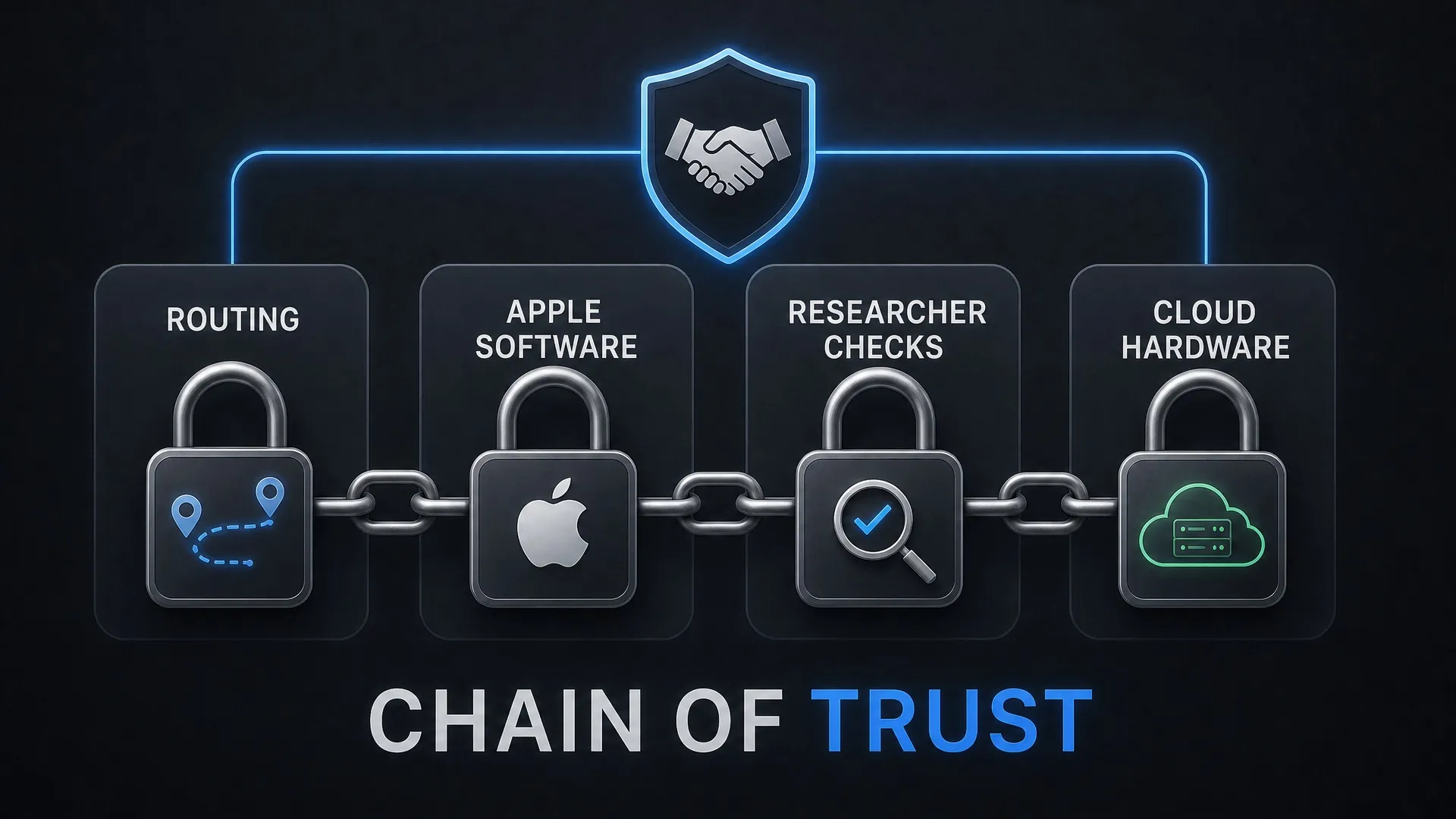
Private Cloud Compute, or PCC, is Apple’s attempt to make remote AI processing behave more like a tightly constrained extension of the device. According to Apple’s security guide, a request is sent only to software that the device recognizes as approved. The server is designed to process the request without retaining it, and ordinary administrator access is intentionally restricted.
Apple also publishes software images and a transparency log so security researchers can inspect the code intended to run in PCC. This is more meaningful than a promise in a privacy policy: the phone’s decision to trust a server is tied to measurable software and hardware state.
Still, “designed not to retain data” is not the same as “cloud computing has no risk.” The protections depend on correct hardware, correct software, secure routing, and a functioning verification system. Apple’s public documentation explains the architecture; it cannot tell an individual user exactly how every future request will be routed.
Why Google Cloud and NVIDIA appear in an Apple system
The most demanding tier needs hardware at a scale Apple does not have to build alone. Apple says AFM 3 Cloud Pro runs in an extended version of PCC using NVIDIA GPUs hosted in Google Cloud. Google and NVIDIA supply the confidential-computing infrastructure; Apple says it retains control of the PCC software stack and the software an Apple device will accept.
The separation is easy to miss. Google Cloud is the host, not automatically the model answering the question. Apple separately says its new foundation models were built in collaboration with Google and draw on Gemini technology. Those facts do not mean every Siri recording is sent to the public Gemini service, nor that every Siri answer comes from one Google model.
The extended platform combines several layers: confidential-computing features in NVIDIA GPUs, Intel TDX isolation for processor workloads, and Google’s hardware security technology. Google describes an open-source host stack intended to make the infrastructure inspectable. Apple adds its own signed software, request-routing rules, and device-side verification.
Why Apple chose a mixed architecture
Apple has not published a simple cost-and-capacity calculation for this decision. A reasonable inference from the architecture is that it wants three things at once: local speed for small tasks, stronger models for hard tasks, and enough external compute capacity to serve many users. No single tier offers all three.
The arrangement also lets Apple keep Siri as the interface layer. A user asks one assistant; the orchestrator decides whether the job needs a local model, a private cloud model, a tool on the device, or a more capable remote model. If that routing works well, the infrastructure becomes invisible. If it fails, users notice a slow response, a missing action, or an answer that lacks context—not which GPU processed it.
What we still do not know
Apple has explained the components more clearly than their everyday frequency. It has not provided a public counter showing how often requests stay on a device, use Apple-operated PCC, or reach the Google Cloud extension. The answer will probably depend on the device, language, feature, task complexity, connectivity, and the stage of Apple’s rollout.
Independent researchers can inspect published PCC software and test parts of the verification system, but that is not the same as observing every production request. Performance, error rates, and the boundary between model tiers will become clearer only as the new Siri reaches more users.
So the accurate headline needs one qualification: some of Apple’s hardest private AI work runs on Google Cloud. The rest of Siri is a layered system built to avoid using that tier when a smaller, closer model can do the job.