Short answer
The answer in plain English
Tokenized stocks use blockchain tokens to represent shares, indirect entitlements, or contracts linked to stock performance. Holding a token does not automatically make you a shareholder. Its legal terms determine dividends, voting, custody, redemption, and the claim you retain if an intermediary fails.
Why it matters
What to understand
A wallet swap transfers tokens without necessarily moving the underlying shares or changing the company’s shareholder record. Creation and redemption can help align prices, but operating hours and eligibility restrict that mechanism. Dividends, votes, and insolvency rights depend on the instrument. Self-custody adds wallet and contract risks while the underlying shares may remain with a traditional custodian.
Visual guide
How the pieces fit together


The token is visible; the rights may not be
A wallet can show a token named after a listed company without showing what its owner actually bought. The token might be a share, an indirect entitlement connected to shares, or a contract whose value follows the stock. A familiar company name and a price chart cannot distinguish those arrangements.
Tokenization introduces a blockchain record into a financial product. It can change how that product is transferred and used in software. The legal instrument still determines who owes the holder what, how dividends are handled, and what can be recovered if an intermediary fails.
That is the first distinction to make before considering trading hours or transaction speed. A blockchain can confirm that a wallet received a token. It cannot, by that fact alone, establish ownership of the referenced company.
Three arrangements can look similar in an app
In an issuer-sponsored arrangement, the company or an authorized agent issues shares in tokenized form. The blockchain participates in the official ownership record. A token representing the same share class can potentially carry the associated dividend, information, and voting rights, subject to its governing terms.
A custodial arrangement introduces a third party that holds underlying shares and issues tokens connected to them. The token holder’s position depends on the relationship with that issuer and its custody structure. The referenced company need not have created or endorsed the product.
A synthetic arrangement instead supplies contractual exposure to a stock’s economic performance. The instrument may be a linked security or derivative. Even where shares provide collateral, the holder’s asset can remain a claim under that contract rather than ownership of the company.
These descriptions are starting points, not mutually exclusive marketing categories. Backing, legal rights, and transfer mechanics are separate dimensions. A product can be backed by shares while still giving its holder a contractual claim.
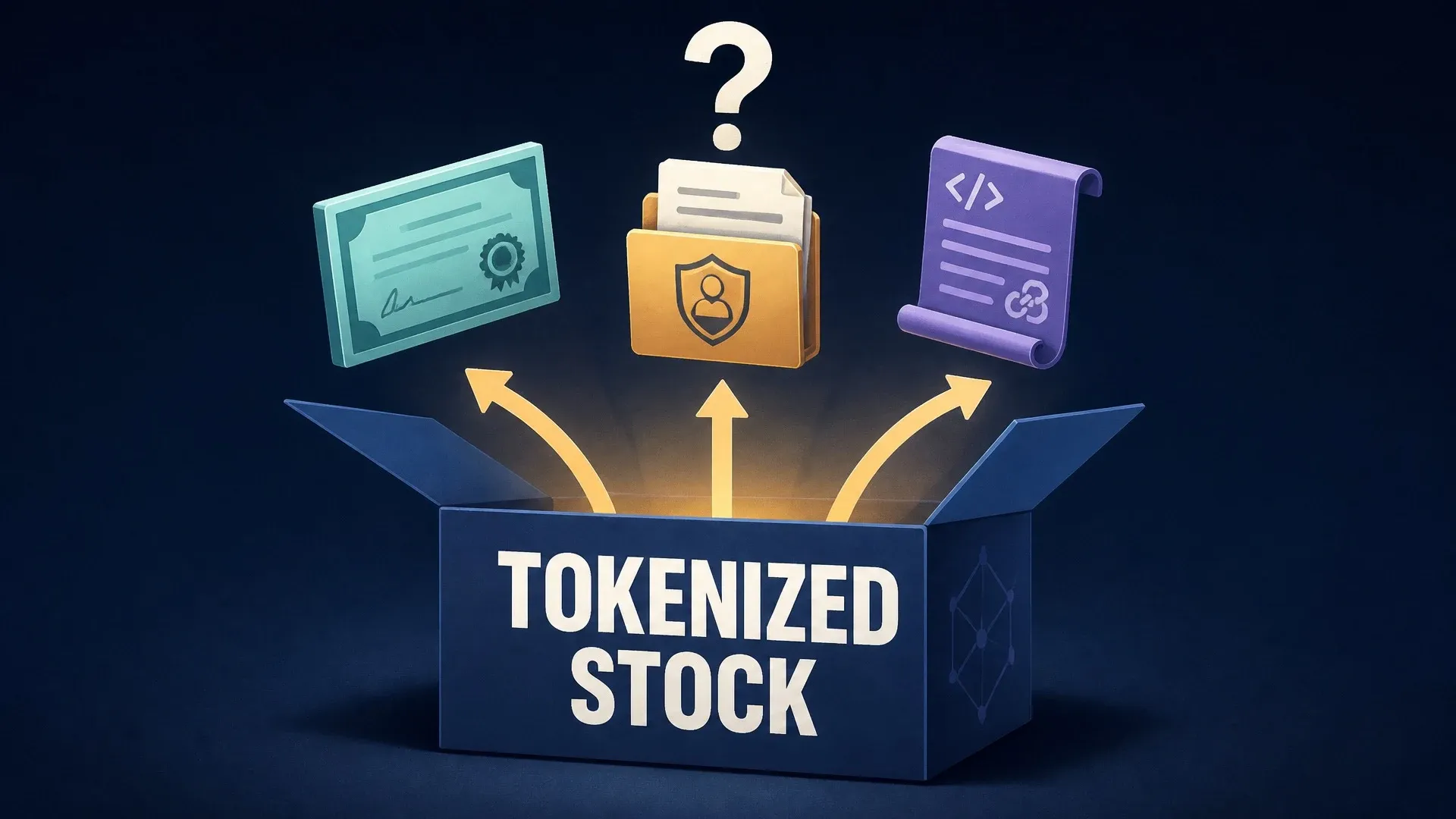
The same product label can cover different legal arrangements. Read the instrument’s terms to identify the actual claim.
What moves during a wallet swap
Imagine an eligible holder swapping stablecoins for a third-party stock token through a decentralized exchange. An approval may authorize a contract to spend stablecoins. A subsequent swap transfers those stablecoins into a pool and sends tokens to the wallet.
The blockchain updates token balances. The underlying shares at a custodian may remain exactly where they were, and the company’s shareholder record may not change. The issuer might not participate in that individual secondary-market transaction.
The article on DeFi liquidity pools and automated market makers explains how a pool quotes and executes that exchange. The pool provides a trading mechanism; it does not establish the legal quality of either asset.
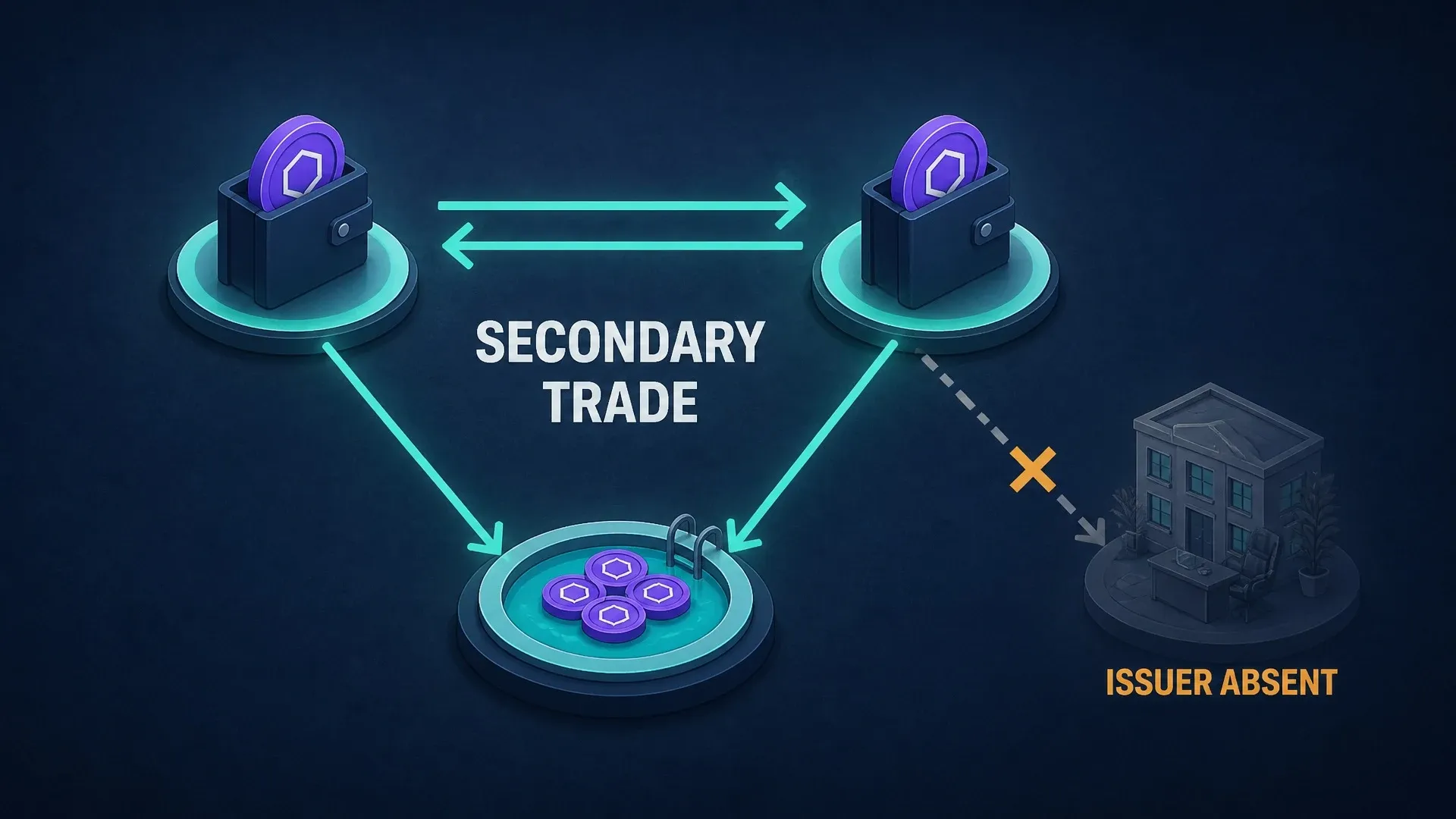
A secondary token swap can settle without moving the underlying share or involving the issuer in that particular trade.
This produces two distinct records to understand: the on-chain token balance and the off-chain arrangement that supports its value. Knowing one does not fully describe the other.
Redemption connects prices only when it can operate
Some products let authorized participants create or redeem tokens against shares, cash, or other specified value. If a token becomes expensive relative to the underlying stock, a participant may be able to create tokens and sell them. If it becomes cheap, buying and redeeming tokens may be attractive.
Those trades can help bring prices together. They depend on eligibility, fees, operating hours, and the ability to complete each step. Direct redemption may be restricted to approved participants or require identity checks and minimum amounts. A retail wallet holder might have to sell in the secondary market instead.
Round-the-clock token trading therefore does not mean round-the-clock access to every part of the arrangement. The exchange for the underlying stock, banks, custodian, and issuer can still operate on schedules. Weekend news may move a token’s price while the underlying market is closed and arbitrage is harder to complete.
A weekend quote can reflect expectations about the next stock-market session rather than an observable live stock price. Thin liquidity can also widen spreads. Fast settlement describes how quickly a transfer becomes final, not whether the execution price was favorable.
Dividends and votes depend on the instrument
A direct tokenized share may carry the normal rights of its share class. Other products can deliver economic adjustments in different ways. A dividend might lead to a cash payment, a stablecoin payment, reinvestment, a balance adjustment, or a change in redemption value.
The supplied xStocks documentation, for example, describes a multiplier mechanism for dividends and stock splits. That design illustrates why receiving a token-balance adjustment differs operationally from receiving cash in a brokerage account. The precise treatment belongs in the product documents.
Taxes, withholding, fees, and timing can affect what reaches the holder. Voting rights are another separate question. Tracking a stock’s price does not automatically give someone a vote at the company’s shareholder meeting. Corporate actions such as mergers and spin-offs likewise require rules connecting the contract to events outside the blockchain.
Backing does not answer every custody question
A statement that tokens are backed one-to-one is incomplete without identifying the assets, their custodian, the liabilities against them, and the holder’s claim. Shares may exist while important questions about segregation, lending, or insolvency remain unresolved.
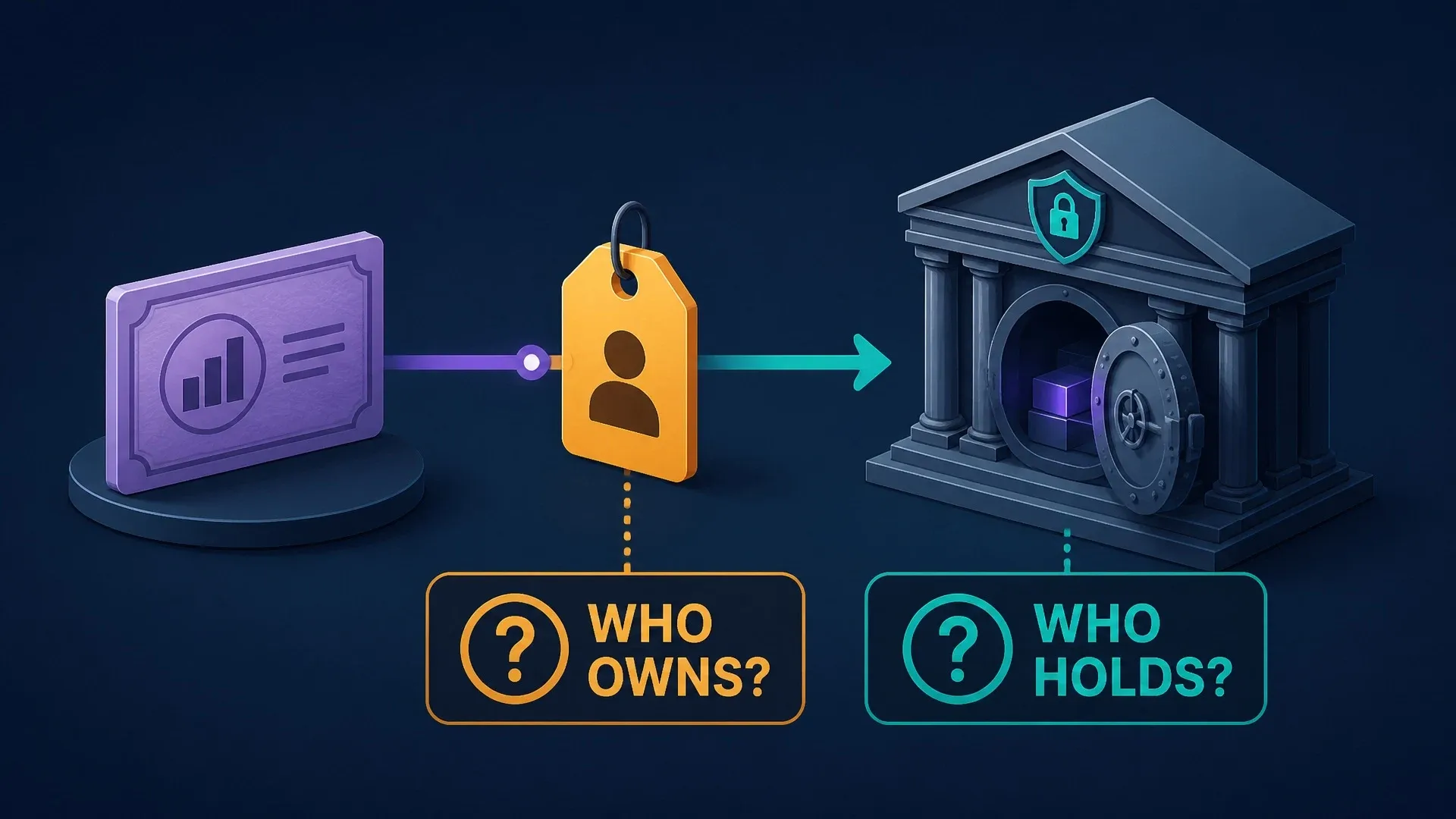
Ownership and custody are different questions. Reserve information alone does not describe every contractual obligation or insolvency outcome.
Proof-of-reserves information can help document assets. It does not automatically establish every liability or determine how a court would treat competing claims. Redemption rights and insolvency provisions matter alongside the reserve count.
Self-custody also leaves the underlying custody arrangement in place. Controlling a private key gives control over the token, while the shares may still sit with a traditional institution. Wallet security and issuer reliability are separate dependencies.
The surrounding crypto system adds its own risks
A sound underlying company does not protect a holder from a malicious approval, an incompatible transfer, a compromised bridge, or a faulty contract. Using the token as loan collateral adds price-feed and liquidation risks. A DeFi position can fail even when the referenced stock remains healthy.
Availability also depends on the jurisdiction and product. A public blockchain does not remove securities or derivatives restrictions. Technical transferability should not be mistaken for permission to buy or distribute an instrument.
The potential benefits are concrete: compatible transfers, fractional exposure, programmable settlement, and integration with digital financial applications. Assessing them requires tracing the full arrangement. Identify the instrument, issuer, custodian, redemption route, corporate-action rules, permitted users, and failure procedures. The token is only the part visible in the wallet.
