Short answer
The answer in plain English
A Venus flytrap does not count consciously. One bend of a trigger hair creates an electrical pulse and a temporary rise in cellular calcium. If another pulse arrives before that signal fades, the combined response crosses the threshold for closure. Continued movement from trapped prey produces more pulses, which strengthens digestive and nutrient-transport responses.
Why it matters
What to understand
The first touch changes the trap without closing it. A second timely electrical pulse pushes a fading calcium signal past the closure threshold. The leaf then uses continued movement as further evidence: a struggling insect drives sealing, digestive enzyme production, and nutrient uptake. This staged response matters because closing and digesting are expensive for a leaf growing in nutrient-poor habitat.
Visual guide
How the pieces fit together


The short answer
A Venus flytrap “counts” by accumulating physical signals. The first bend of a trigger hair produces an electrical action potential and raises calcium inside cells. That change begins to fade. If a second pulse arrives soon enough—often within about 20 to 30 seconds—the combined calcium response crosses the threshold that makes the lobes snap shut.
The plant then keeps listening. A living insect struggles and bends the hairs repeatedly. Those later pulses help turn a loose cage into a sealed digestive chamber and increase the production of digestive enzymes and nutrient transporters. There is no awareness or number sense involved. The count is stored temporarily in the state of the leaf.
A trigger hair is a mechanical sensor
Each trap is the modified end of a leaf, with two curved lobes joined at a midrib. The inner surface usually carries three trigger hairs on each lobe. They are not sticky. They act as tiny levers.
When an insect pushes a hair sideways, cells near its base deform. Touch-sensitive ion channels open, charged particles cross cell membranes, and the changing voltage can produce an action potential. Animals also use action potentials, but the resemblance should not be stretched into a nervous system. The flytrap has no neurons or brain; the electrical wave moves through connected plant tissue.
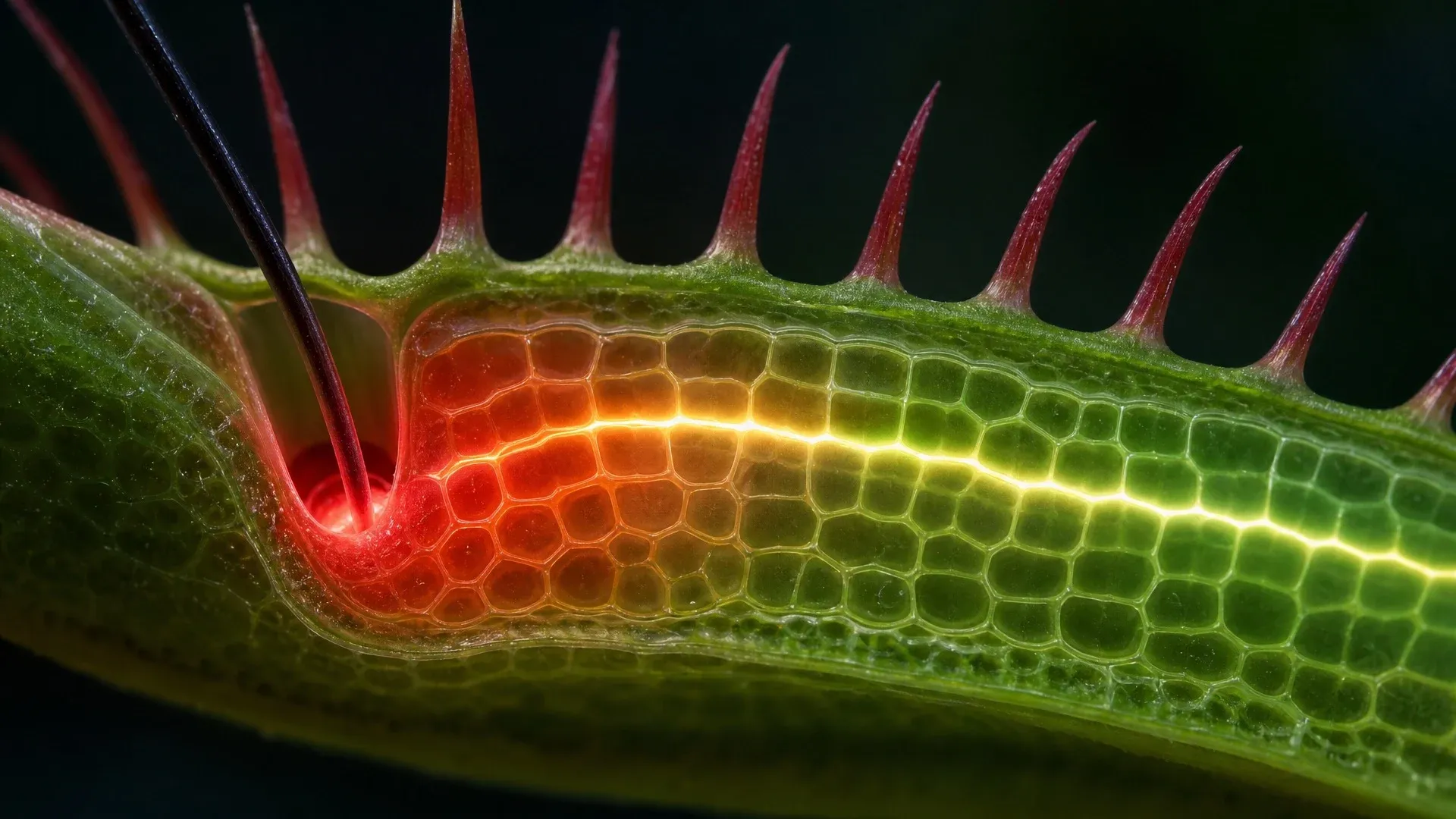
The electrical pulse is paired with a traveling calcium signal. That calcium is crucial because it gives the first touch a short afterlife. The open trap can look unchanged while its cells are temporarily in a different state.
Why one touch is usually ignored
Wind, rain, falling debris, and an animal that immediately leaves can all disturb a trap. Closing for every contact would be costly. A closed trap temporarily performs less photosynthesis, consumes energy, and cannot immediately try again. Reopening takes far longer than the fraction of a second needed to snap shut.
The fading first signal works as a filter. One pulse means something may have touched the leaf. A second pulse before the calcium returns toward baseline is better evidence that an object is still moving inside. The rule is not literally “two different hairs.” A complicated bend can sometimes generate more than one pulse. What matters is enough electrical activity arriving close enough together.
This is a threshold system: the first event changes the starting condition for the next one. A similar principle appears elsewhere in biology whenever cells integrate incomplete signals before committing resources. The details differ, but the broader lesson resembles the preparation behind tardigrade cryptobiosis: spectacular behavior often depends on a controlled change of state, not a single magical component.
The snap releases stored mechanical energy
The lobes do not close because muscles pull them together. Their curved structure already stores elastic energy. Electrical and calcium signaling alters the material behavior of the leaf, including rapid softening in part of the outer cell wall. The lobes then switch curvature, like a flexible lid popping from one stable shape to another.
That snap can happen in a few tenths of a second. At first, the marginal spikes interlock but leave spaces between them.
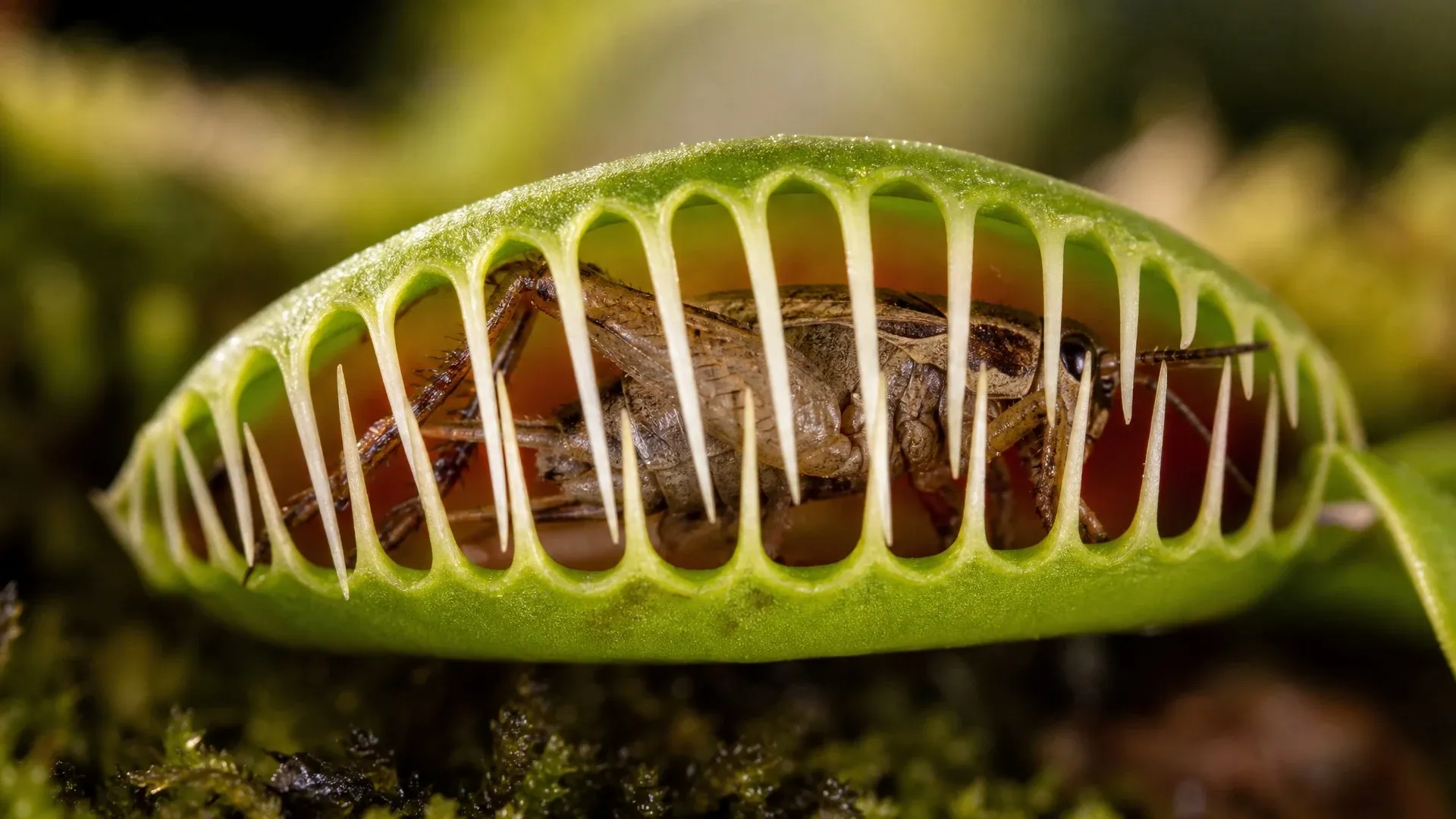
This loose cage is another checkpoint. Tiny animals may escape. If the trap caught debris or empty air, the hairs fall quiet and the leaf can reopen without paying the full cost of digestion. A larger living insect supplies a different signal by kicking against the inner surface.
Why people say the trap counts to five
Controlled experiments found that different numbers of mechanical stimuli produce different responses. Two closely timed pulses initiate closure. Continued pulses activate jasmonate signaling, a pathway better known for plant injury and herbivore defense. By around five action potentials, genes involved in digestion and nutrient transport can become strongly active.
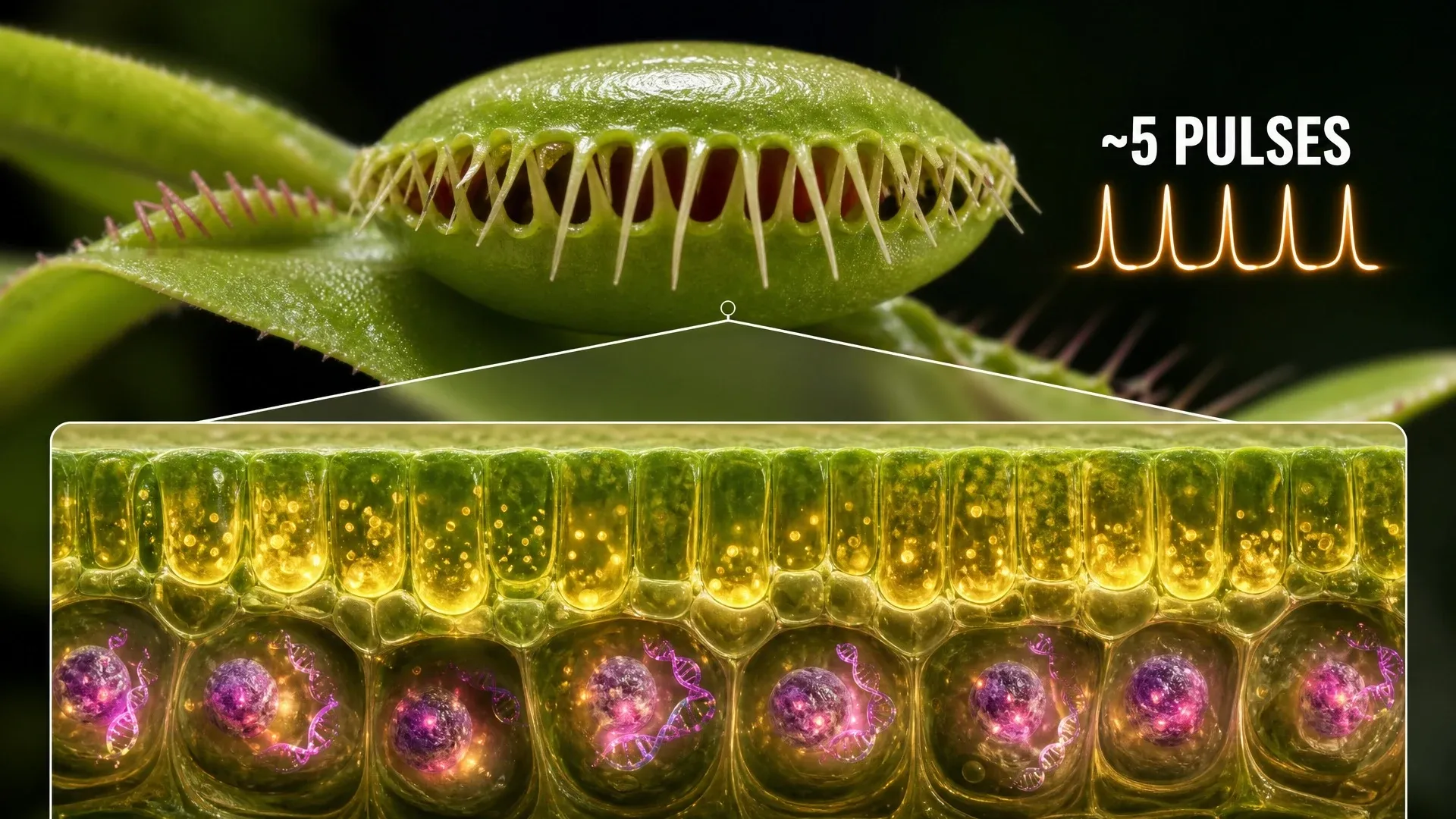
Five is not a hard ceiling or a secret numeral represented in the plant. More stimulation can drive a stronger response. The useful pattern is staged investment:
- one pulse creates a short-lived memory;
- a second timely pulse triggers capture;
- repeated pulses from struggling prey promote sealing and digestion.
Glands inside the trap then release acidic fluid and enzymes. Transport proteins absorb liberated nutrients. Digestion may continue for days before the trap reopens and leaves an exoskeleton behind.
The insect is fertilizer, not fuel
A Venus flytrap still gets energy and carbon through photosynthesis. It does not need animal calories in the way an animal does. Prey supplies concentrated nitrogen, phosphorus, sulfur, and minerals that are scarce in its native soil.
Wild Venus flytraps occupy a small region of the Carolinas, in sunny, wet, acidic habitats kept open partly by fire. The ground is poor in nutrients even when light and water are available. Under those conditions, an insect is valuable fertilizer—but a false closure is an expensive mistake.
The entire sequence follows from that trade-off. The leaf gathers evidence before closing, gathers more evidence before digestion, and scales its investment with continued stimulation. Calling it counting is reasonable shorthand as long as the mechanism stays visible: electricity marks the contacts, calcium holds a fading memory, hormones change gene activity, and a curved leaf converts the decision into motion.

