Short answer
The answer in plain English
Animals see polarized light by comparing photoreceptors that respond most strongly to different orientations of a light wave. Bees use this information as part of a celestial compass. Cuttlefish gain contrast on prey and other objects underwater. Mantis shrimp have several polarization-sensitive regions and can rotate their eyes to improve the contrast of a polarized target against its background.
Why it matters
What to understand
Polarization is not an extra color. It describes the orientation of light's electric field. Scattering in the sky and reflections underwater create polarization patterns that human vision mostly ignores. Aligned light-sensitive structures in animal eyes preserve that information, allowing different species to use it for navigation, object detection, and possibly signaling. False-color polarization images are translations for humans, not literal reconstructions of an animal's experience.
Visual guide
How the pieces fit together


Polarization is an orientation, not a secret color
A bee and a human can look at the same blue patch of sky and receive different information from it. Both see light scattered by the atmosphere. The bee can also use the orientation of that light as part of a compass.
That extra measurement is polarization. Light is an electromagnetic wave, and its electric field oscillates sideways as the wave travels. In ordinary sunlight, many orientations arrive mixed together. Scattering or reflection can make some orientations stronger than others, producing partially polarized light.
A pair of polarized sunglasses demonstrates the idea. Reflected glare often contains a strong preferred orientation. The filter blocks much of it, so the road or water beneath becomes easier to see. Animals with polarization-sensitive vision carry the equivalent of differently aligned filters inside their eyes. Their nervous systems compare the outputs instead of throwing the orientation information away.
How an eye becomes sensitive to polarization
Many insects, crustaceans, and cephalopods use light-sensitive molecules arranged within microscopic structures called microvilli. When those structures line up neatly, a receptor responds more strongly to one polarization orientation than another. A neighboring receptor can be aligned differently. Comparing the pair reveals information that brightness alone cannot provide.
This is not the same as color vision. Color depends on wavelength and on comparing receptors with different spectral sensitivities. Polarization depends on the wave’s orientation and degree of alignment. An animal may use both dimensions, one of them, or neither in a particular part of its eye.
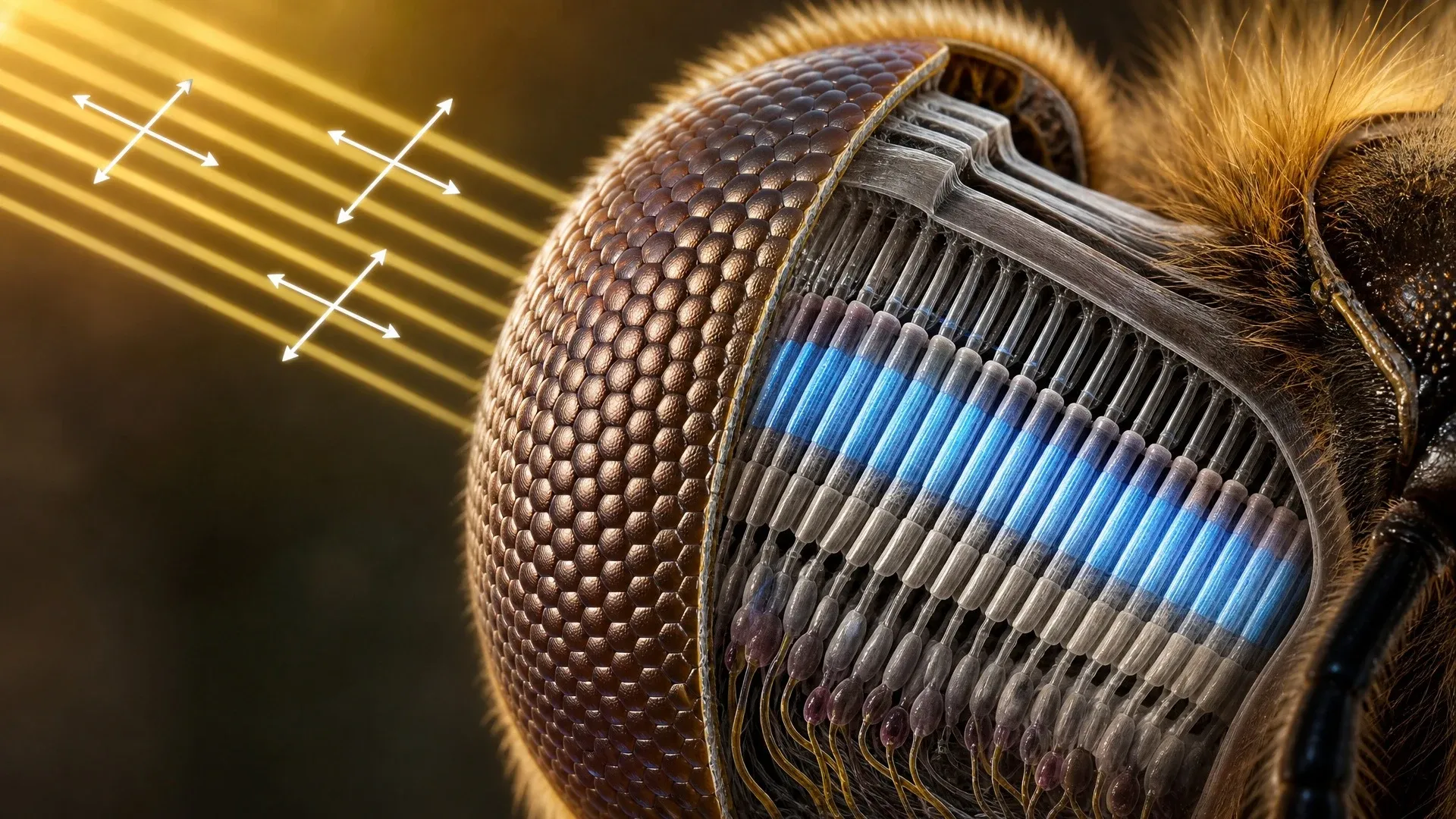
The dorsal rim of a bee’s compound eye contains specialized receptors whose alignment makes them sensitive to polarized skylight.
Bees use the sky as a compass
Sunlight scattered by molecules in the atmosphere creates a broad polarization pattern related to the Sun’s position. The pattern changes through the day, but not randomly. Even when the Sun itself is hidden, a visible patch of sky can still contain directional information.
Honeybees have a specialized region along the upper edge of the compound eye called the dorsal rim area. Its photoreceptors are strongly sensitive to polarized light. Behavioral and anatomical evidence supports a role for this system in celestial orientation, although the research review in the sources cautions against turning that into an unlimited claim about every navigation task.
The bee does not see an arrow painted across the sky. Its brain samples a geometric pattern, combines it with other cues, and estimates direction. For an animal repeatedly traveling between a nest and scattered food, that is useful information hidden inside ordinary blue light.
Underwater, polarization creates contrast
Water produces a more complicated light field. The surface, suspended particles, the seafloor, and animal bodies all scatter or reflect light. Brightness can flicker as waves move overhead, while a transparent or silvery animal may closely match the intensity of its background.
Polarization supplies another difference. A nearly transparent body can bend, scatter, or alter the polarization passing through it. Silvery scales can reflect polarized light. To an eye that compares orientations, the object may separate from its surroundings even when its color and brightness offer little help.
Cuttlefish have camera-like eyes, but the receptors use aligned microvilli. Neighboring channels are sensitive to roughly perpendicular orientations. Experiments reviewed in the scientific literature show that cuttlefish and related cephalopods can detect patterns defined by polarization contrast and can use that sensitivity during prey detection.
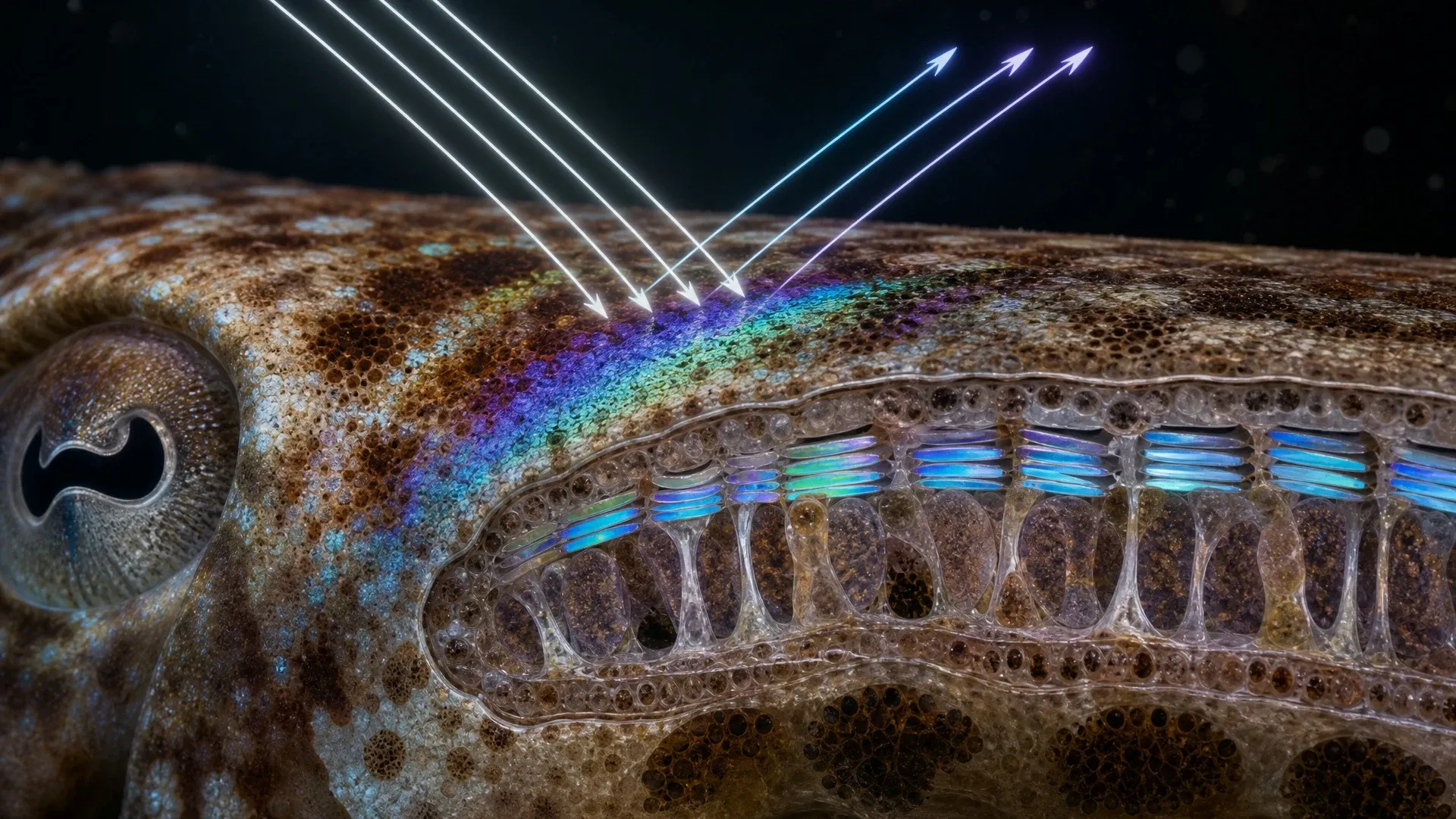
Polarization contrast can survive when ordinary brightness flickers underwater, giving cuttlefish another way to separate an object from its background.
Some cephalopods also reflect polarized patterns from their own bodies. Those patterns may contribute to communication, but “private signal” should be treated as a hypothesis rather than a universal explanation. Demonstrating a body pattern is easier than proving what another animal perceives and how its behavior changes.
Mantis shrimp actively tune the view
Mantis shrimp compound eyes are divided into upper and lower hemispheres by a narrow central midband. Different regions analyze different parts of the light signal. Some species detect several orientations of linear polarization, and some have retinal structures capable of analyzing circular polarization as well.
Their strangest advantage may be movement. Mantis shrimp can roll each eye around its viewing axis. In controlled experiments, two species rotated their eyes in response to polarized targets. The rotations aligned receptor groups in ways that increased the polarization contrast between a target and its background.
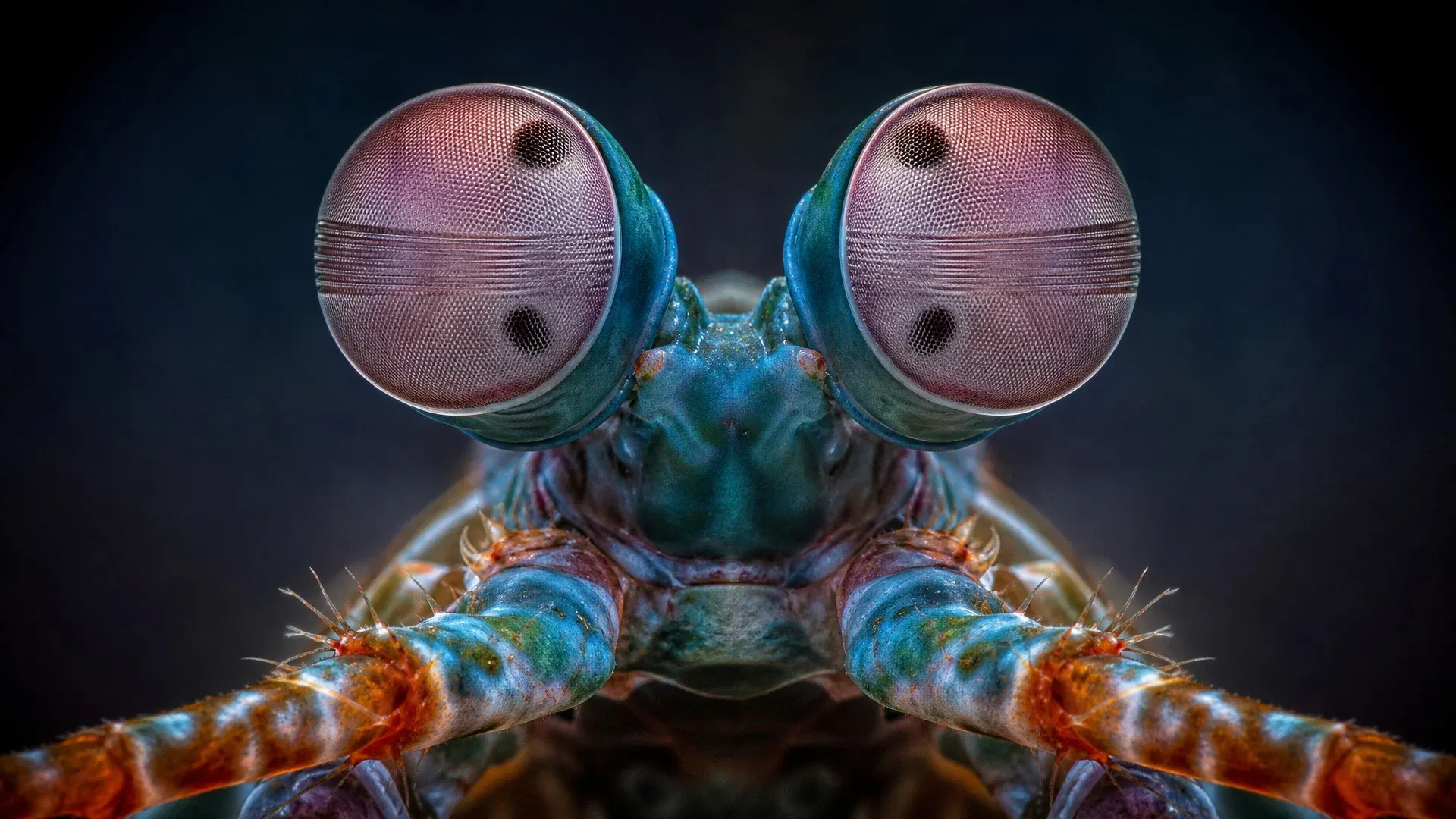
A mantis shrimp eye combines polarization-sensitive regions with unusual freedom to roll, helping the animal improve contrast for a target.
This is an important correction to the usual superpower story. The animal does not receive a flawless polarization map at every angle. Contrast depends on receptor alignment, the target, the background, and the surrounding light. Eye rotation is useful precisely because the signal has geometric limits.
What humans see—and what false color means
Human vision is mostly insensitive to polarization, but not completely. Under controlled conditions, some people can notice Haidinger’s brush: a faint bow-tie-like pattern near the center of vision when viewing strongly polarized blue light. The effect is weak and fades quickly. Humans do not have the dedicated receptor channels that make polarization a dependable everyday cue for these animals.
This is why scientific polarization images often use false color. Researchers assign visible hues to measured polarization angles or strengths so that we can distinguish them. The colors are a translation, not a literal picture of a bee’s or cuttlefish’s experience. The same distinction appears whenever instruments extend the narrow slice of reality human vision can detect.
The same caution applies whenever technology displays sensory information outside ordinary human vision. A translated image can accurately represent a measurement without recreating another animal’s subjective world. What it reveals here is a real structure in light: a sky that carries direction, water that carries contrast, and eyes evolved to keep information ours usually discards.

